
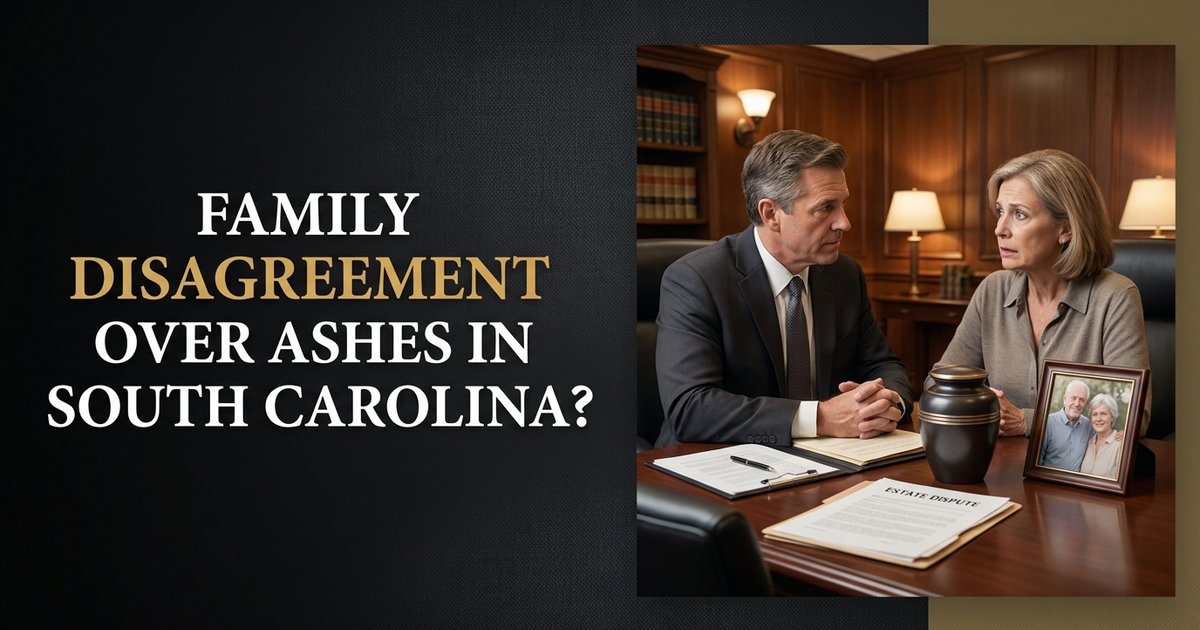
What happens if family members disagree about what to do with a loved one’s ashes when the person’s wishes were communicated informally? – South Carolina
Short Answer
In South Carolina, informal wishes about ashes matter, but they usually do not control unless they were put into a valid cremation authorization, preneed arrangement, will, or other verified and attested document naming the person with authority. South Carolina law looks first to the statutory decision-maker, called the decedent’s agent, and then to the priority list of family members. If people with equal priority disagree, the safest course is to pause any release, scattering, burial, or division of the ashes and ask the South Carolina probate court for an order.
Understanding the Problem
Family disagreement over ashes in South Carolina usually turns on one narrow question: who has legal authority to decide the final disposition when the deceased person’s wishes were shared only in conversation, text messages, or other informal ways. The issue becomes more sensitive when heirs are also handling estate property, a home sale, personal belongings, or a pending partition case. The decision about ashes should be handled separately from the sale of the home, repair bids, estate-auction planning, and ordinary personal property decisions.
Apply the Law
South Carolina’s cremation law gives priority to written directions and then to a ranked list of people who may act as the decedent’s agent. A valid cremation authorization signed by the deceased person before death, or a preneed cremation arrangement, carries strong weight and generally must be followed after death. If there is no valid written direction, South Carolina law identifies who may authorize cremation and control related decisions, starting with a person designated for that purpose, then a spouse, then adult children, then parents, adult siblings, and other listed relatives.
When several people are in the same priority class, one person may act only if that person does not know about an objection from another person in the same class. Once an objection is known, a majority of the reasonably available members of that class must authorize cremation. If the dispute remains unresolved, the probate court can decide the dispute by order. For final disposition of ashes, the agent or funeral establishment must follow the cremation documents and South Carolina law, and a crematory authority may refuse to release or dispose of remains when it knows about a dispute.
Key Requirements
- Valid written direction: A signed cremation authorization, preneed arrangement, will, or other verified and attested document naming an agent can override informal family preferences.
- Correct decision-maker: If no valid written direction exists, South Carolina’s priority list determines who may serve as the decedent’s agent.
- Equal-priority agreement or majority: If adult children, parents, siblings, or another equal-priority class disagree, a majority of reasonably available members may be needed.
- Probate court order when needed: If the family cannot resolve the dispute, the South Carolina probate court is the forum to seek instructions before ashes are released, scattered, buried, divided, or otherwise disposed of.
What the Statutes Say
- S.C. Code Ann. § 32-8-315 (Cremation authorization form) – allows a person to authorize cremation and final disposition before death and limits revocation after death.
- S.C. Code Ann. § 32-8-320 (Persons who may serve as decedent’s agent) – sets the priority list and requires probate court resolution for certain equal-priority disputes.
- S.C. Code Ann. § 32-8-325 (Cremation authorization requirements) – lists information required on the cremation authorization form, including the agent’s authority and known objections.
- S.C. Code Ann. § 32-8-345 (Final disposition of cremated remains) – describes lawful methods of disposition and the funeral home or crematory’s responsibilities if remains are unclaimed.
- S.C. Code Ann. § 32-8-350 (Crematory liability and disputes) – protects a crematory that refuses to release or dispose of remains when it knows about a dispute or reasonably questions authority.
- S.C. Code Ann. § 62-3-709 (Personal representative possession of estate property) – gives a personal representative authority over estate property for administration, but ashes are governed mainly by South Carolina cremation law.
Analysis
Apply the Rule to the Facts: The heirs’ disagreement about selling the deceased parent’s home, clearing personal belongings, getting repair bids, and obtaining an estate-auction quote does not automatically decide what happens to the ashes. If the deceased parent only shared wishes informally, those wishes may help show intent, but the legally important question is whether there is a valid written cremation direction or a person with priority under South Carolina law. If adult children are the highest available class and they disagree, the family should avoid moving, scattering, dividing, or including the ashes with estate-sale items until the dispute is resolved by agreement or court order.
The pending partition case may affect the home sale, access to the property, and timing for handling belongings, but it may not resolve the ashes unless a court order directly addresses them. For more on inherited real property disputes, see what happens in a South Carolina partition action for inherited real property.
Process & Timing
- Who files: The decedent’s agent, a personal representative, or an interested family member with equal or higher priority. Where: The South Carolina Probate Court in the county handling the estate, or the county connected to the funeral home or remains if no estate is open. What: A petition or application asking for instructions or an order concerning authority and final disposition of cremated remains; local forms and filing practices vary by county. When: File before the ashes are released, scattered, buried, divided, or discarded, and act before the funeral home or crematory reaches the 60-day unclaimed-remains period.
- Notify the funeral home or crematory: The person objecting should give prompt written notice that a dispute exists. This helps prevent release or disposition before the family or court resolves authority.
- Gather proof of wishes and authority: Useful documents may include the cremation authorization form, preneed paperwork, a will, a verified and attested designation, written messages, funeral instructions, and the names and availability of equal-priority relatives.
- Seek an order if no agreement is reached: The probate court can determine who has authority or give directions. The final document is typically a written order that the funeral home, crematory, agent, and family members can rely on.
Exceptions & Pitfalls
- Informal wishes are not the same as a signed authorization: Conversations and texts may be persuasive, but they usually do not replace a valid cremation authorization, preneed agreement, will, or verified and attested agent designation.
- A higher-priority person may block a lower-priority person: A lower-priority relative generally should not act if a higher-priority person is reasonably available to decide or object.
- One equal-priority relative should not ignore known objections: If one adult child knows another adult child objects, the family may need a majority of reasonably available adult children or a probate court order.
- Do not treat ashes like ordinary estate-sale property: A personal representative may manage estate property and personal belongings, but cremated remains should not be packed for auction, discarded, divided, or removed without clear authority.
- Location matters for scattering or burial: South Carolina permits disposition in a grave, crypt, niche, scattering area, or on private property with the owner’s consent. Public land or water may involve additional state or federal rules.
- Commingling requires care: South Carolina restricts placing or disposing of cremated remains with another person’s remains without the agent’s express written permission, subject to specific exceptions.
- Crematories may pause when a dispute exists: A crematory authority may refuse release or disposition if it knows about a dispute or has a reasonable concern about the agent’s authority.
Conclusion
When South Carolina family members disagree about a loved one’s ashes and the person’s wishes were only informal, the law looks first for a valid written direction and then to the statutory agent priority list. Equal-priority relatives must respect known objections, and unresolved disputes may require a probate court order. The key next step is to file a petition for instructions with the appropriate South Carolina Probate Court before the ashes are released or the 60-day unclaimed-remains period passes.
Talk to a Probate Attorney
If family members are disagreeing about ashes while also handling a home sale, personal belongings, or a pending partition case, our firm has experienced attorneys who can help clarify authority, protect timelines, and seek probate court guidance when needed.
Disclaimer: This article provides general information about South Carolina law based on the single question stated above. It is not legal advice for your specific situation and does not create an attorney-client relationship. Laws, procedures, and local practice can change and may vary by county. If you have a deadline, act promptly and speak with a licensed South Carolina attorney.

