
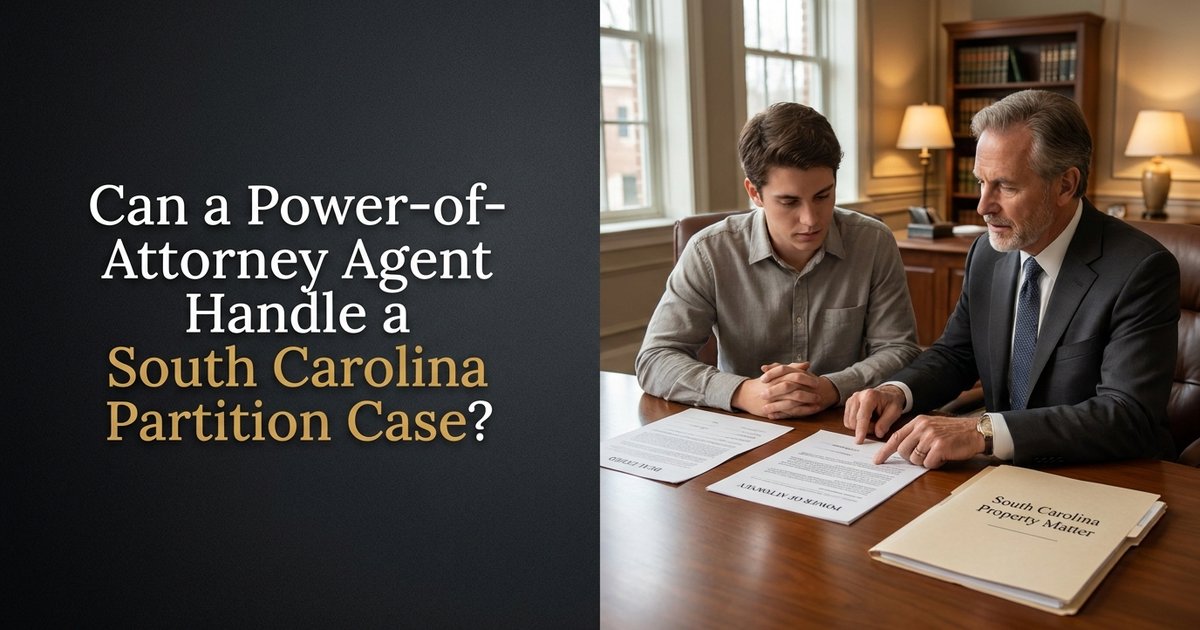
What can I do if the court will not let me appear for my parent in a property sale case? – South Carolina
Short Answer
A South Carolina power of attorney may authorize an agent to manage, partition, or sell a parent’s real property, but it generally does not allow a nonlawyer agent to represent the parent in court. The agent can usually retain a South Carolina attorney for the parent, subject to the document’s terms. Counsel can review the canceled hearing, address any defective filings, enter an appearance, and ask the court to place the partition case back on its calendar.
Understanding the Problem
The issue is whether an agent acting under a South Carolina power of attorney can prosecute a partition sale case for a parent who resides in a nursing home. The key distinction is between making authorized property decisions for the parent and acting as the parent’s legal representative before the Court of Common Pleas. The court’s cancellation raises a single practical question: how can the parent’s partition request proceed when the agent cannot conduct the litigation?
Apply the Law
South Carolina separates an agent’s authority under a power of attorney from authority to practice law. A properly drafted power of attorney may authorize the agent to partition or sell real property, manage claims, make litigation decisions, and hire counsel. However, presenting another person’s case, making legal arguments, and conducting court proceedings generally require a lawyer admitted or otherwise authorized to practice in South Carolina.
A partition action belongs in the South Carolina Court of Common Pleas. The court may divide jointly owned property, allot it to one or more owners with an accounting, or order a sale when a fair physical division or allotment cannot be made. If the property qualifies as heirs’ property, additional valuation, buyout, notice, and sale protections apply.
Key Requirements
- Authority under the power of attorney: The document must authorize the relevant real-property and litigation decisions. Its exact language, execution requirements, limitations, and effective date matter.
- Proper legal representation: An agent who is not authorized to practice law may manage the parent’s decisions but generally cannot serve as the parent’s courtroom advocate.
- Proper partition pleadings and parties: The case must identify the ownership interests, name the necessary cotenants, request an available form of partition, and complete proper service.
- Correct partition procedure: The court must determine whether the property is heirs’ property and whether division, allotment, a cotenant buyout, or a sale is appropriate.
What the Statutes Say
- S.C. Code Ann. § 40-5-310 (Practice of Law) – prohibits a person from practicing law for another unless admitted to the South Carolina Bar or otherwise authorized by the South Carolina Supreme Court.
- S.C. Code Ann. § 62-8-204 (Real-Property Authority) – provides that qualifying real-property authority may include selling, conveying, partitioning, and consenting to partition.
- S.C. Code Ann. § 62-8-203 (General Agent Authority) – permits an authorized agent to seek court assistance and engage and compensate an attorney, subject to the power of attorney’s terms.
- S.C. Code Ann. § 62-8-212 (Claims and Litigation) – describes litigation decisions an agent may make when the power of attorney grants authority over claims and litigation.
- S.C. Code Ann. § 15-61-50 (Partition Jurisdiction) – gives the Court of Common Pleas jurisdiction to divide, allot, or sell jointly owned property.
- S.C. Code Ann. § 15-61-10 (Partition and Heirs’ Property) – permits partition between qualifying co-owners and requires a preliminary determination when the property may be heirs’ property.
Analysis
Apply the Rule to the Facts: The power of attorney may give the individual authority to make property and litigation decisions for the parent, but that authority does not necessarily permit the individual to act as the parent’s lawyer. Because the court canceled the hearing on representation grounds, counsel should examine the power of attorney, the filed papers, the cancellation order, ownership records, service documents, and the case docket. Counsel can then determine whether to enter an appearance, amend or ratify filings, request a new hearing, or restart the action if the earlier filing cannot be corrected.
The parent’s extended nursing-home stay does not, by itself, decide legal capacity or eliminate the representation requirement. If the parent can participate, counsel may seek an appropriate accommodation or remote participation when the court permits it. If capacity is disputed, counsel must evaluate whether the court requires another protective arrangement in addition to the power of attorney.
Process & Timing
- Who files: The parent, through South Carolina counsel, with the agent making authorized decisions under the power of attorney. Where: The South Carolina Court of Common Pleas handling the existing partition case, generally in the county connected to the property. What: A notice of appearance and any motion, amended pleading, or supporting power-of-attorney filing required by the court. When: By any deadline stated in the cancellation order, scheduling notice, or other docket entry.
- Counsel reviews whether the existing case remains open and whether the original paperwork and service can be corrected. If so, counsel may request a rescheduled hearing; if not, counsel may advise filing a proper partition complaint and serving every required party.
- The court determines the ownership interests and whether the property qualifies as heirs’ property. If heirs’ property rules apply, valuation and cotenant-buyout procedures occur before a sale; a cotenant seeking to buy may face a notice deadline of no later than 10 days before the partition trial.
- The court then decides whether physical division, allotment, a statutory buyout, or sale is appropriate. A sale requires a court order and division of the proceeds according to the parties’ established interests.
Exceptions & Pitfalls
- The parent may appear personally: A competent individual can generally represent only that individual’s own interests, but health, travel, and accommodation issues should be raised with the court in advance rather than handled through an unauthorized substitute appearance.
- The document may lack sufficient authority: A power of attorney that omits real-property or litigation authority, has terminated, or was not properly executed may not support the agent’s decisions. Counsel should review the complete document rather than rely on its title.
- The agent should not assume prior filings remain valid: Hiring counsel does not automatically repair every paper submitted by a nonlawyer. The court may require amendment, ratification, substitution, dismissal, or refiling.
- All necessary owners must receive proper notice: Missing a cotenant or using publication without satisfying the applicable requirements can delay the case or undermine later orders.
- Heirs’ property has added protections: Preliminary classification, appraisal, buyout rights, and sale procedures may change the timing and available relief. More detail appears in this overview of the two types of South Carolina partition actions.
- A power of attorney does not transfer ownership: The parent remains the party whose property interest is at issue. The agent acts within delegated authority and must keep the parent’s interests separate from the agent’s own interests.
Conclusion
A nonlawyer agent generally cannot conduct a South Carolina partition case as the parent’s courtroom representative, even when a power of attorney authorizes property and litigation decisions. The action belongs in the Court of Common Pleas and must satisfy ownership, party, service, and partition requirements. The next step is to have South Carolina counsel review the power of attorney, court order, docket, and prior filings before the earliest court-imposed deadline so counsel can request the proper way to resume the case.
Talk to a Partition Action Attorney
If a South Carolina court canceled a parent’s partition hearing because of a representation problem, our firm has experienced attorneys who can review the power of attorney, assess the existing case, and explain the available procedural options and deadlines.
Disclaimer: This article provides general information about South Carolina law based on the single question stated above. It is not legal advice for your specific situation and does not create an attorney-client relationship. Laws, procedures, and local practice can change and may vary by county. If you have a deadline, act promptly and speak with a licensed South Carolina attorney.

