
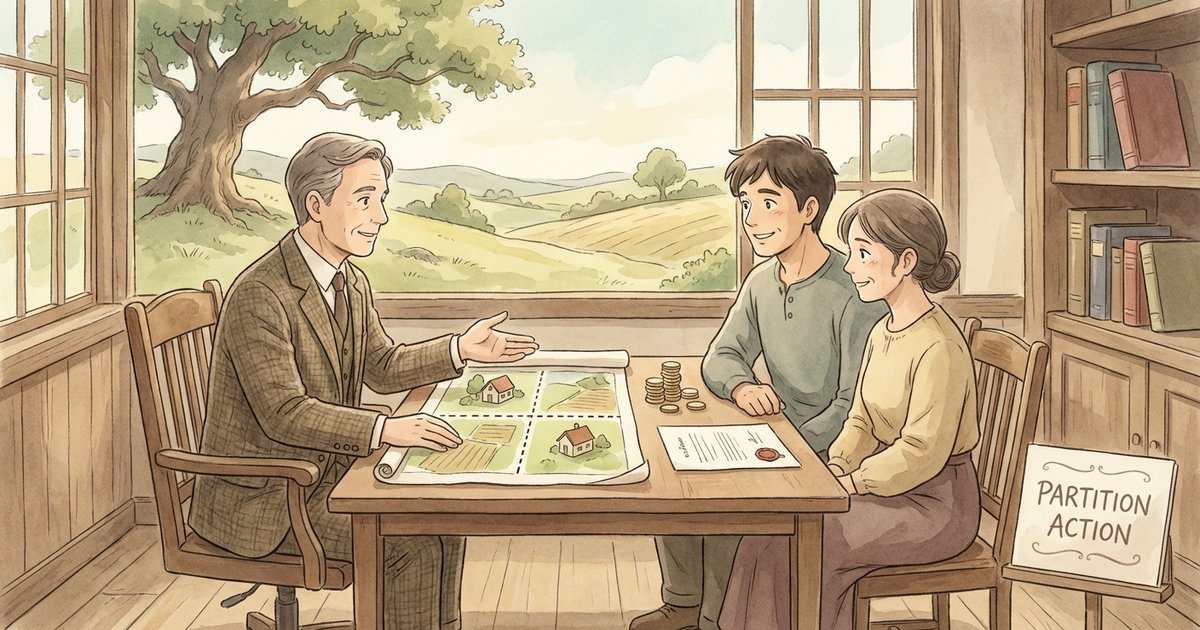
A Comprehensive Guide to Understanding the Two Types of Partition Actions in North Carolina – South Carolina
Short Answer
In South Carolina, a co-owner of real estate can usually force a partition action to end shared ownership. The two main outcomes are partition in kind (the land is physically divided) and partition by sale (the property is sold and the proceeds are divided). If the court decides the property is heirs’ property, South Carolina’s heirs’ property partition rules can add a required early hearing, a court-determined value, and a buyout opportunity before a sale.
Understanding the Problem
In South Carolina partition law, the central question is: when multiple people own the same real estate as joint tenants or tenants in common, can one co-owner force a court case to split the ownership, and what form can that split take. The decision point is whether the case ends with a physical division of the land (partition in kind) or a court-ordered sale (partition by sale). The trigger is a filed partition lawsuit in the South Carolina Court of Common Pleas asking the court to sever the co-ownership.
Apply the Law
South Carolina generally allows joint tenants and tenants in common to compel partition of jointly owned real property through a court action. Early in the case, the court must determine whether the property qualifies as “heirs’ property.” If it is heirs’ property, the case proceeds under South Carolina’s version of the Uniform Partition of Heirs’ Property Act, which adds valuation, notice, and buyout procedures and generally favors a partition in kind unless that would cause manifest prejudice or injury to the co-owners as a group.
Key Requirements
- Co-ownership interest: The parties must hold the property together as joint tenants or tenants in common (or other covered shared interests), so that the court has a basis to sever the shared ownership.
- Proper partition request and parties: A partition lawsuit must be filed in the correct court and should include all co-owners and other interest-holders so the court can enter an order that fully resolves title.
- Heirs’ property determination (when raised): After filing, the court holds a preliminary hearing to decide whether the property is heirs’ property; if so, the heirs’ property partition rules control unless all co-owners agree otherwise in a record.
What the Statutes Say
- S.C. Code Ann. § 15-61-10 (Compelling partition; heirs’ property determination) – Allows certain co-owners to compel partition and requires a preliminary determination of whether the property is heirs’ property.
- S.C. Code Ann. § 15-61-310 (Heirs’ property act title) – Establishes South Carolina’s heirs’ property partition framework.
- S.C. Code Ann. § 15-61-370 (Buyout when a sale is requested) – Creates a process and deadlines for non-selling co-owners to buy out the interests of co-owners seeking a sale.
- S.C. Code Ann. § 15-61-380 (Partition in kind or allotment; when sale is ordered) – Directs the court to order partition in kind or allotment unless it would cause manifest prejudice or injury, otherwise the court orders a sale.
- S.C. Code Ann. § 15-61-340 (Service; publication; property posting) – Adds a sign-posting requirement on the property when heirs’ property and service by publication are involved, with a 10-day posting deadline after the court’s determination.
Analysis
Apply the Rule to the Facts: The question focuses on the two types of partition outcomes: partition in kind versus partition by sale. Under South Carolina law, a co-owner who wants to end shared ownership can file a partition case and ask for one of those outcomes. If the court determines the land is heirs’ property, the case typically includes a valuation step and a buyout opportunity before the court decides whether to divide the land or order a sale.
Process & Timing
- Who files: Any joint tenant or tenant in common seeking to sever co-ownership. Where: South Carolina Court of Common Pleas in the county where the property is located. What: A summons and complaint for partition identifying the property and naming all known co-owners and interest-holders. When: After filing, the court must hold a preliminary hearing to determine whether the property is heirs’ property when the issue is raised by motion or appears from the pleadings.
- Heirs’ property track (if applicable): If a co-owner requests partition by sale, the statute provides a buyout process. A co-owner who did not request the sale must notify the court of an intent to buy out the selling co-owner(s) no later than 10 days before the partition trial, and the court sets a payment deadline that is not sooner than 60 days after notice is sent.
- Outcome order: The court enters an order for partition in kind (or allotment) unless it finds manifest prejudice or injury to the co-owners as a group; otherwise, the court orders partition by sale. The final result is either a reallocation of interests after a buyout, a division of the property, or a sale with proceeds distributed according to ownership interests and the court’s directions.
Exceptions & Pitfalls
- Heirs’ property changes the “sale vs. division” analysis: If the court determines the property is heirs’ property, the case follows special rules that can make a sale harder to obtain and can give other co-owners a structured chance to buy out the selling co-owner’s interest.
- Missing parties can derail the case: Partition is meant to clear up shared ownership. Leaving out a co-owner or other recorded interest-holder can delay the case, force amendments, or prevent clean title after a division or sale.
- Service and notice problems: When a co-owner cannot be found and service by publication is used in an heirs’ property case, South Carolina can require additional notice steps, including posting a sign on the property. Missing the posting deadline or failing to maintain the sign while the case is pending can create avoidable disputes and delays.
Conclusion
South Carolina partition actions generally end shared ownership in one of two ways: partition in kind (a physical division) or partition by sale (a sale with proceeds divided). A co-owner can usually compel partition, but the court must first determine whether the land is heirs’ property, which can add valuation and buyout steps and can favor a division unless it would cause manifest prejudice or injury. Next step: file a partition complaint in the Court of Common Pleas where the property is located and track the 10-day heirs’ property posting deadline if publication service applies.
Talk to a Partition Action Attorney
If a co-owner relationship has reached the point where the property needs to be divided or sold, a partition action can set the rules, deadlines, and end result. Our firm has experienced attorneys who can help explain the difference between partition in kind and partition by sale, identify whether heirs’ property rules may apply, and map out the timelines and notice requirements that often drive these cases.
Disclaimer: This article provides general information about South Carolina law based on the single question stated above. It is not legal advice for your specific situation and does not create an attorney-client relationship. Laws, procedures, and local practice can change and may vary by county. If you have a deadline, act promptly and speak with a licensed South Carolina attorney.
xq

