
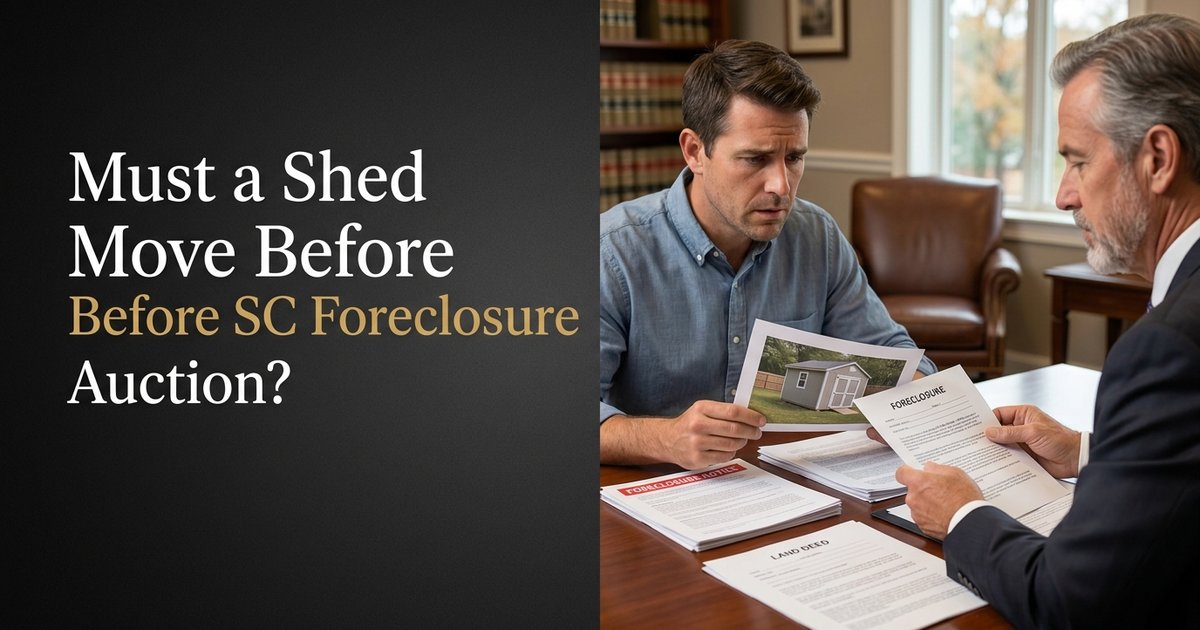
What happens to a shed or outbuilding a family member claims if the land is sold at a foreclosure auction—does it need to be moved beforehand? – South Carolina
Short Answer
In South Carolina, a shed or outbuilding that is permanently attached to the land usually follows the land in a foreclosure sale. If a family member claims it as separate personal property, that claim should be resolved before the auction or, at the latest, before the sale is confirmed and possession changes. A removable, freestanding structure may be personal property, but removing it without authority can create problems if it damages the land, violates the mortgage or court order, or happens after the purchaser takes control.
Understanding the Problem
The issue is whether, under South Carolina probate and foreclosure law, an heir or family member can keep a claimed shed or outbuilding located on a deceased parent’s mortgaged land when that land is headed to a foreclosure auction, and whether the structure must be moved before the sale.
Apply the Law
South Carolina treats this as a real-property and probate administration issue. The key question is whether the shed is part of the land or separate personal property. If it is built into the land, on a permanent foundation, connected to utilities, or intended to stay with the property, it will usually be treated as an improvement that passes with the real estate. If it is portable, not permanently attached, and supported by a bill of sale or other proof showing a sibling bought and owned it separately, it may be treated as personal property.
Foreclosure takes place in the Court of Common Pleas, often through the Master-in-Equity or another court officer. Probate matters start in the county Probate Court. A personal representative may need authority from the Probate Court to deal with estate property, communicate with the lender, protect property, or resolve competing family claims. For more background on inherited homes facing foreclosure, see what rights heirs have when inherited property faces foreclosure in South Carolina.
Key Requirements
- Classify the structure: Decide whether the shed is a fixture that belongs with the land or removable personal property that belongs to an individual.
- Prove ownership: A sibling’s claim is stronger with a bill of sale, receipts, photos, delivery records, permit records, or a written agreement showing the structure was separately owned and meant to be removable.
- Get authority before removal: The personal representative, heirs, lender, court order, or foreclosure sale terms may limit what can be removed and when.
- Respect the foreclosure timeline: After a foreclosure sale and any applicable bidding period, the purchaser may receive title and control of the land and attached improvements.
What the Statutes Say
- S.C. Code Ann. § 62-2-101 (Intestate estate) – property not disposed of by a will passes to heirs under South Carolina intestacy law.
- S.C. Code Ann. § 62-3-901 (Successors’ rights if no administration) – heirs may establish rights in estate property, but they take subject to estate administration and creditor claims.
- S.C. Code Ann. § 62-3-203 (Priority for personal representative appointment) – heirs have priority rules for appointment when there is no will.
- S.C. Code Ann. § 62-3-709 (Personal representative’s possession of estate property) – a personal representative may take control of estate property when needed for administration and must protect estate property in possession.
- S.C. Code Ann. § 29-3-610 (Foreclosure after mortgagor’s death) – a foreclosure sale is not invalid simply because the deceased mortgagor’s personal representative was not made a party.
- S.C. Code Ann. § 15-39-720 (Upset bids after foreclosure sale) – in many foreclosure sales, bidding remains open for thirty days after the sale unless an exception applies.
- S.C. Code Ann. § 15-39-760 (When upset bidding does not apply) – the thirty-day bidding period may not apply when the foreclosure complaint waives a deficiency judgment and the sale notice says bidding will not remain open.
Analysis
Apply the Rule to the Facts: The home, mortgage, and title remain in the deceased parent’s name, so the land and improvements must be handled through both foreclosure procedure and any needed probate authority. The siblings’ notarized statement may show family intent, but it is not the same as a recorded deed transferring real estate interests. If the separate building is attached to the land and looks permanent, the safest assumption is that it may be sold with the land unless the sibling proves it is removable personal property and obtains permission to remove it before the foreclosure process cuts off access.
A shed sitting on blocks that can be lifted and hauled away without damage may be easier to treat as personal property. A wired workshop on a slab, a barn with posts set in the ground, or an outbuilding listed with the real estate is more likely to be treated as part of the land. Written records matter because family members often remember informal ownership arrangements differently after a death.
Process & Timing
- Who files: The heir seeking authority to handle the estate. Where: The Probate Court in the South Carolina county where the deceased parent lived or where probate is proper. What: A request for appointment as personal representative and supporting death, heirship, and asset information required by the local Probate Court. When: File as soon as possible once foreclosure is pending, especially before the auction date.
- Confirm the foreclosure status: Review the foreclosure complaint, judgment, sale notice, and terms of sale in the Court of Common Pleas or Master-in-Equity file. Check whether the sale allows a thirty-day upset-bid period or whether the lender waived a deficiency and the notice says bidding closes at the sale.
- Document the building claim: Gather receipts, photos, delivery records, permit records, insurance records, and any written agreement showing who bought the structure, whether it was meant to be removable, and whether removing it would damage the land.
- Seek permission before moving it: The personal representative or heir should contact the foreclosure attorney, lender, or court officer and, if needed, seek a written court-approved arrangement. Removal should occur only with lawful authority and before possession passes to the foreclosure purchaser.
- Complete the sale or removal step: If the structure is personal property and removal is allowed, remove it without damaging the land and keep proof of the condition before and after removal. If it is a fixture, it normally remains with the land and passes through the foreclosure sale.
Exceptions & Pitfalls
- A notarized statement is not a deed: Siblings can agree among themselves, but a real estate interest usually needs a proper deed signed, witnessed, delivered, and recorded to clear title. For more detail, see how title transfers for an inherited home in South Carolina when there is no will and multiple heirs.
- Probate does not automatically stop foreclosure: South Carolina law allows foreclosure to proceed even if a personal representative is not named as a party, though probate authority may still help with lender communications and estate decisions.
- Removing fixtures can create liability: Taking down a structure that belongs with the land can be treated as damage to the property, especially after a foreclosure judgment or sale.
- Access can end quickly: Once the purchaser has rights to possession, entering the property to remove a building can create trespass or conversion issues.
- Personal property proof must be specific: A general family understanding may not be enough. Strong proof identifies the structure, owner, purchase date, and intent that it remain movable.
- County practice varies: Probate filings, foreclosure sale procedures, and Master-in-Equity requirements can vary by county, so the court file and sale notice matter.
Conclusion
In South Carolina, a shed or outbuilding claimed by a family member does not automatically stay separate from land sold at foreclosure. If it is a fixture or permanent improvement, it usually follows the land. If it is truly removable personal property, the claim should be documented and resolved before access is lost. The next step is to file for personal representative authority in the county Probate Court as soon as possible before the foreclosure sale is finalized.
Talk to a Probate Attorney
If a deceased parent’s home is in foreclosure and a family member claims a shed, workshop, or other outbuilding, our firm has experienced attorneys who can help evaluate probate authority, ownership proof, and foreclosure timelines under South Carolina law.
Disclaimer: This article provides general information about South Carolina law based on the single question stated above. It is not legal advice for your specific situation and does not create an attorney-client relationship. Laws, procedures, and local practice can change and may vary by county. If you have a deadline, act promptly and speak with a licensed South Carolina attorney.

