
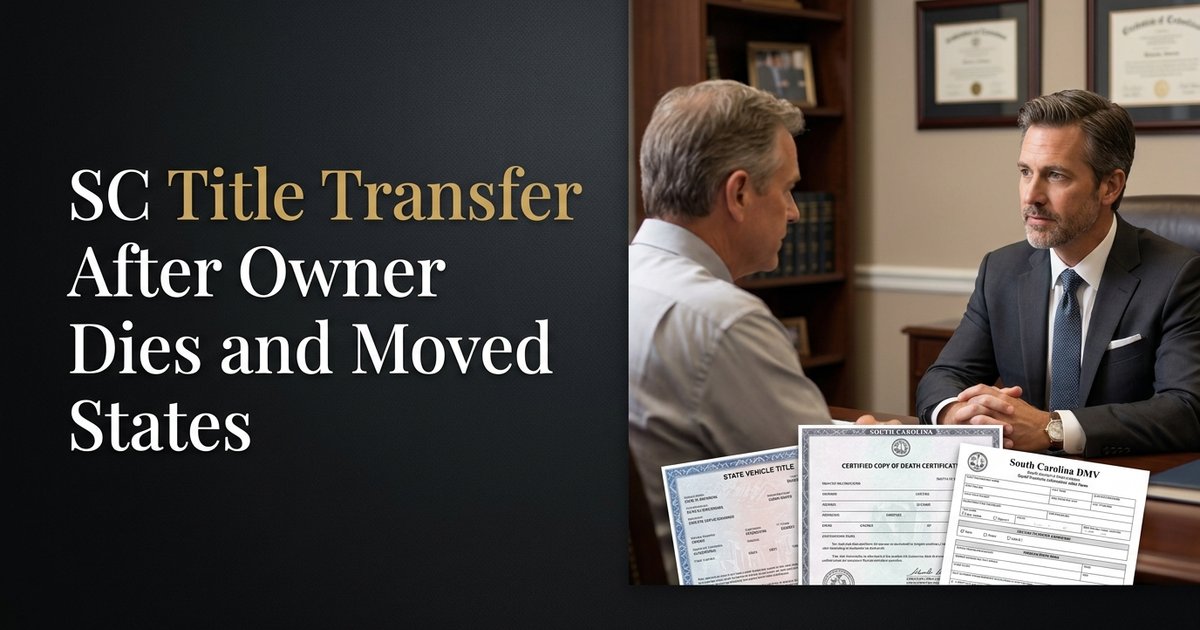
Which state’s rules control the vehicle title transfer when the owner lived in one state before moving and then passed away in another? – South Carolina
Short Answer
In South Carolina, the state that usually matters first is the state where the owner was domiciled at death, because that state controls the main probate case. For the truck title itself, the South Carolina Department of Motor Vehicles applies South Carolina title rules when issuing a South Carolina title, including the requirement that the title be properly assigned and supported by the documents the DMV requires. A prior state of residence does not control by itself.
Understanding the Problem
Can a South Carolina title transfer move forward when a parent signed a truck title before death, moved states, and the DMV rejects the paperwork because the transfer was not completed in the required form? The issue is a single decision point: whether South Carolina treats the truck as already transferred during life or as property that must pass through the proper probate or post-death title process after the owner’s death.
Apply the Law
South Carolina separates two questions. First, did the owner complete a valid lifetime transfer of the vehicle title? Second, if the transfer was not complete before death, who has authority to transfer the vehicle after death? The South Carolina DMV handles title issuance, while the South Carolina probate court handles authority over a deceased person’s estate when South Carolina is the proper probate forum.
For probate venue, South Carolina looks to the decedent’s domicile at death. Domicile generally means the place the person treated as a permanent home, not just a place where the person once lived. If the decedent was domiciled in South Carolina at death, the probate matter generally belongs in the probate court for the South Carolina county of domicile. If the decedent was not domiciled in South Carolina, but the truck or title issue is located in South Carolina, South Carolina law may still allow a local or ancillary process for South Carolina property.
Key Requirements
- Completed title assignment: A vehicle transfer by the owner must comply with South Carolina title-transfer rules before the DMV issues a new title.
- Correct probate forum: If the vehicle was not effectively transferred before death, the probate court for the decedent’s domicile at death usually controls estate authority.
- Proof of authority after death: A successor, personal representative, foreign personal representative, or court-approved small-estate claimant must show legal authority before the DMV will retitle the vehicle.
What the Statutes Say
- S.C. Code Ann. § 56-19-360 (voluntary vehicle title transfers) – a vehicle owner must execute the title assignment, and the transfer is not effective between the parties until the statutory title-transfer steps are met.
- S.C. Code Ann. § 56-19-380 (new certificate after voluntary transfer) – the DMV issues a new title after receiving a properly assigned title, application, fee, and other required documents.
- S.C. Code Ann. § 62-3-201 (probate venue and domicile) – the first probate proceeding usually belongs in the county where the decedent was domiciled at death, or, for a nonresident, where South Carolina property was located.
- S.C. Code Ann. § 62-3-1201 (collection of personal property by affidavit) – after 30 days, a qualifying successor may collect personal property by affidavit if the probate estate is within the statutory limit and no personal representative has been appointed.
- S.C. Code Ann. § 62-3-711 (personal representative powers) – a personal representative generally has power over estate property, subject to fiduciary duties and court limits.
Analysis
Apply the Rule to the Facts: The parent signed over a truck title shortly before death for a nominal amount, but the DMV refused the transfer because the paperwork was not accepted. Under South Carolina title law, the key fact is not the low sale price by itself; the key fact is whether the title assignment met the DMV’s requirements before death. If it did not, the truck may still be treated as estate property, and the person seeking the title must use the proper probate or post-death title process.
The prior state where the parent lived does not automatically control the title transfer. South Carolina first looks at domicile at death for the probate forum, and the DMV applies South Carolina title rules when asked to issue a South Carolina title. For a deeper discussion of post-death vehicle paperwork, see this related guide on documents the South Carolina DMV may require after a family member’s death.
Process & Timing
- Who files: the person claiming the truck, an heir, or the person seeking appointment as personal representative. Where: the South Carolina probate court in the county of the decedent’s domicile at death, or if the decedent was not domiciled in South Carolina, the county where the South Carolina property is located. What: a probate petition, appointment papers, or a small-estate affidavit if the estate qualifies; for the DMV, an application for title and supporting authority. When: a small-estate affidavit cannot be used until 30 days after death.
- If the estate qualifies for the affidavit process, the probate judge must approve and countersign the affidavit before it can be used to collect or transfer personal property. If the estate does not qualify, the probate court may need to appoint a personal representative who can handle the truck as estate property.
- After probate authority is established, the claimant or personal representative presents the DMV with the title, application, proof of authority, fees, and any other required documents. The expected result is either a new title, a request for more documentation, or a determination that a court order or additional probate step is needed.
Exceptions & Pitfalls
- Unfinished lifetime transfer: A signed title that the DMV rejects may not prove a completed transfer. Missing notarization, incomplete assignment fields, lien issues, or mismatched information can push the vehicle into the estate process.
- Domicile disputes: Moving shortly before death can create a dispute over the decedent’s domicile. South Carolina looks at the person’s home at death, not simply the last state listed on older paperwork.
- Small-estate limits: The affidavit process only works if the entire probate estate, after liens and encumbrances, falls within the statutory cap and the other affidavit requirements are met.
- Existing probate in another state: If a probate case or personal representative appointment already exists elsewhere, South Carolina may require proof from that proceeding or a local ancillary step instead of treating the claimant as an individual successor.
- Skipping DMV requirements: Probate authority does not automatically create a clean title. The DMV still requires title paperwork that fits its procedures. More detail is available in this related article on transferring a deceased parent’s car title in South Carolina.
Conclusion
South Carolina focuses on domicile at death for probate authority and applies South Carolina DMV title rules when issuing a South Carolina vehicle title. If the parent’s lifetime title transfer was not completed in the required form, the truck may need to pass through a probate-approved transfer, small-estate affidavit, personal representative, or court order. The next step is to file the proper probate paperwork with the South Carolina probate court after confirming whether the 30-day small-estate waiting period applies.
Talk to a Real Estate Attorney
If a vehicle title problem is tied to a death, a move between states, or unfinished transfer paperwork, our firm has experienced attorneys who can help sort out the proper South Carolina process, the probate forum, and the DMV documentation timeline.
Disclaimer: This article provides general information about South Carolina law based on the single question stated above. It is not legal advice for your specific situation and does not create an attorney-client relationship. Laws, procedures, and local practice can change and may vary by county. If you have a deadline, act promptly and speak with a licensed South Carolina attorney.

