
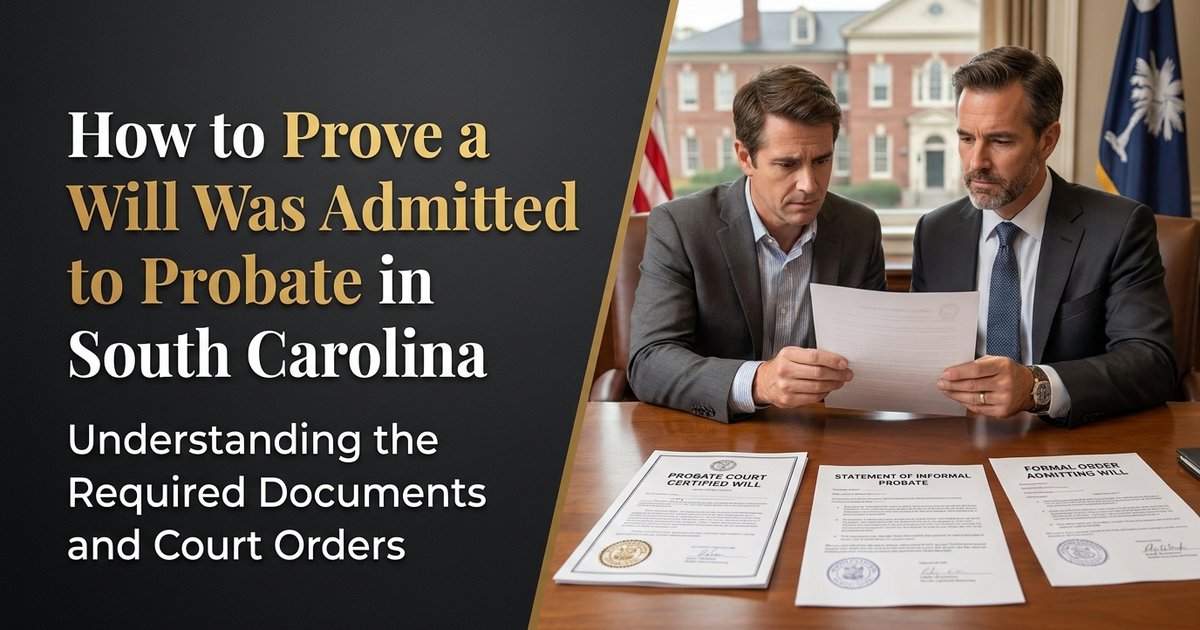
What documents show that a will has been admitted to probate? – South Carolina
Short Answer
In South Carolina, the clearest proof is a certified copy of the will together with the Probate Court’s written statement of informal probate or its formal order admitting the will. An exemplified copy provides additional authentication, but the package should still include the statement, certificate, or order confirming that the court admitted the will.
Understanding the Problem
The issue is whether the documents obtained from a South Carolina Probate Court confirm that the court admitted a particular will to probate. The answer depends on whether the court used an informal proceeding or entered an order after a formal probate proceeding.
Apply the Law
Except as otherwise provided by statute, a will does not become effective to prove a transfer of property or nominate a personal representative merely because someone filed it with the Probate Court. The court must declare the will valid through a written statement of informal probate or an adjudication in a formal proceeding. The Probate Court for the county where the decedent lived generally maintains the estate record and issues certified copies upon payment of the required fee. South Carolina law does not set a statewide turnaround time for copy requests.
Key Requirements
- The admitted will: The copy should identify the will, including any codicils that the court admitted with it.
- The court’s probate action: A written statement of informal probate, certificate reflecting that action, or formal probate order should confirm that the court admitted the document.
- Official authentication: A certified or exemplified copy should carry the clerk’s certification, court seal, or other required authentication.
- Correct estate file: The estate caption, file number, decedent information, and probate date should match across the documents.
What the Statutes Say
- S.C. Code Ann. § 62-3-102 (Necessity of an Order of Probate) – Except as otherwise provided by statute, a will generally must be declared valid by informal probate or a formal adjudication before it can establish a property transfer or nominate a personal representative.
- S.C. Code Ann. § 62-3-302 (Written Statement of Informal Probate) – After making the required findings, the court issues a written statement of informal probate.
- S.C. Code Ann. § 62-3-409 (Formal Probate Determination) – In a formal proceeding, the court determines testacy and formally probates a will found valid and unrevoked.
- S.C. Code Ann. § 62-1-305 (Records and Certified Copies) – The Probate Court must maintain estate records and issue certified copies of probated wills and other filed records after payment of the required fees.
Analysis
Apply the Rule to the Facts: The requested exemplified copy should provide an authenticated reproduction of the will. The accompanying certificate of probate should establish the court’s action if it states that the identified will was admitted to probate and gives the relevant date or proceeding. The estate caption, file number, probate date, seal, and clerk certification should match. If the certificate only addresses the authenticity of the copy, the court’s written probate statement or formal order may still be needed.
Letters issued to a personal representative serve a different purpose. They show the person’s court-granted authority to administer the estate, but standing alone they may not identify the exact will and codicils that the court admitted.
Process & Timing
- Who requests: An estate representative or other requester. Where: The Probate Court maintaining the South Carolina estate file, usually in the county where the decedent was domiciled. What: A certified or exemplified copy of the will and the written statement of informal probate, certificate of probate, or formal probate order. When: South Carolina law sets no specific deadline for requesting these copies or statewide processing period.
- Court processing: The clerk locates the estate record, collects the applicable fee, and prepares the requested certification or exemplification. Processing methods and timeframes may vary by county.
- Document review: Compare the will, codicils, certificate, and order for matching estate information. The final package should authenticate the documents and affirmatively show that the court admitted the identified will.
Exceptions & Pitfalls
- A file-stamped will proves filing, not necessarily admission to probate. Look for an affirmative statement or order showing that the court admitted it.
- An exemplification authenticates a court record but does not replace a missing probate statement or order unless the exemplified material itself confirms admission.
- Codicils may modify the will. The requested package should identify every testamentary instrument admitted by the court.
- A previously probated out-of-state will generally requires an authenticated copy of both the will and the statement or order that admitted it. More information appears in this article about obtaining an authenticated out-of-state probated will for use in South Carolina.
- County terminology varies. A document called a “certificate of probate” should be reviewed for its substance rather than its title alone.
Conclusion
In South Carolina, the strongest proof that a will was admitted to probate is the certified will paired with the Probate Court’s written statement of informal probate or formal probate order. An exemplified copy adds authentication, while letters primarily prove the personal representative’s authority. Confirm with the Probate Court clerk that the requested package includes the admitted will, all admitted codicils, and the court document stating the date and fact of admission.
Talk to a Probate Attorney
If an estate record must prove that a particular will was admitted in South Carolina, our firm has experienced attorneys who can help identify the correct court documents and address county-specific requirements.
Disclaimer: This article provides general information about South Carolina law based on the single question stated above. It is not legal advice for your specific situation and does not create an attorney-client relationship. Laws, procedures, and local practice can change and may vary by county. If you have a deadline, act promptly and speak with a licensed South Carolina attorney.

