
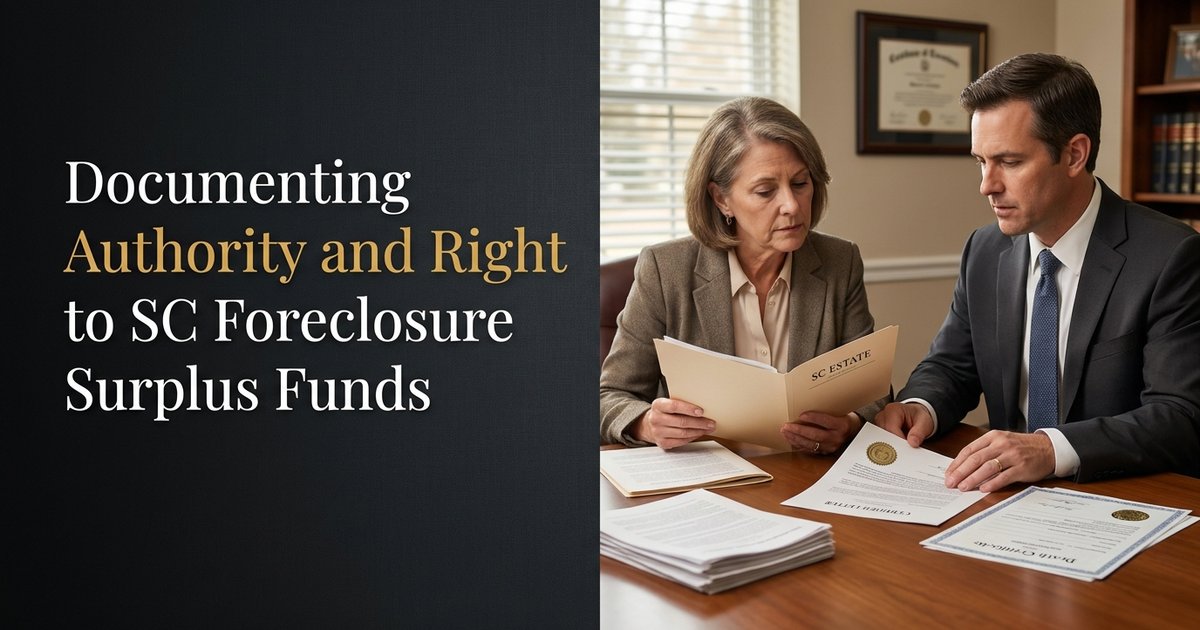
What documents do I need to prove I’m the estate representative and that the estate is entitled to any foreclosure surplus? – South Carolina
Short Answer
In South Carolina, a personal representative should provide certified probate documents showing a valid, current appointment, plus records connecting the decedent to the foreclosed property and establishing who succeeded to the ownership interest. The core package usually includes certified letters of appointment, the appointment order, death certificate, deed, foreclosure records, will or intestacy records, and evidence identifying heirs, devisees, lienholders, and other interested parties. Appointment alone does not prove that the estate should receive the entire surplus.
Understanding the Problem
The single issue is whether a court-appointed personal representative can document both the authority to act for a deceased property owner and the estate’s right to receive foreclosure surplus funds held in South Carolina. The answer depends on the representative’s current authority, the decedent’s ownership when the foreclosure occurred, and the identity of every person or entity whose interest could affect distribution.
Apply the Law
South Carolina separates authority to represent an estate from entitlement to foreclosure proceeds. A person becomes a personal representative after appointment, qualification, and issuance of letters by the Probate Court. A certified appointment order provides evidence of that authority, but the foreclosure court must still determine who held the relevant ownership interest and whether liens, heirs, devisees, or other successors have priority.
Real property generally passes at death to devisees under a will or to heirs when there is no effective will. That transfer remains subject to estate administration, creditor rights, and the personal representative’s statutory powers. Therefore, the personal representative may have authority to pursue or control the funds for administration even when heirs or devisees ultimately hold the beneficial interests.
Key Requirements
- Proof of representative authority: Obtain a certified appointment order and certified letters testamentary or letters of administration. The letters should show no restriction that prevents the representative from pursuing or receiving the funds.
- Proof of the decedent’s property interest: Provide the recorded deed, a title search or ownership report, and foreclosure pleadings that connect the decedent to the property and the sale.
- Proof that surplus exists: Include the foreclosure judgment, order of sale, report of sale, distribution accounting, and any statement from the Clerk of Court, Master-in-Equity, or special referee identifying funds held.
- Proof of succession: Provide the admitted will and probate order, or evidence establishing intestate heirs. Useful records include birth, marriage, adoption, divorce, and death records.
- Identification of competing interests: Build a family tree and review the foreclosure complaint, title records, judgments, liens, assignments, and releases to identify everyone who may require notice.
What the Statutes Say
- S.C. Code § 62-3-103 (Appointment and Letters) – A personal representative must be appointed, qualify, and receive letters before exercising estate powers.
- S.C. Code § 19-5-50 (Evidence of Appointment) – A certified copy of the probate appointment order serves as evidence of the representative’s appointment in South Carolina courts.
- S.C. Code § 62-3-101 (Devolution at Death) – Real property passes to devisees or heirs at death, subject to administration, creditor rights, and the personal representative’s powers.
- S.C. Code § 62-3-709 (Control of Estate Property) – A personal representative may take control of property when necessary for administration and may bring an action concerning possession or title.
- S.C. Code § 62-2-102 (Intestate Share of Surviving Spouse) – A surviving spouse receives the entire intestate estate when the decedent left no descendants, or one-half when the decedent left descendants.
- S.C. Code § 62-2-103 (Other Intestate Heirs) – The statute establishes which relatives inherit the portion not passing to a surviving spouse.
Analysis
Apply the Rule to the Facts: The court-appointed representative should be able to establish authority with certified appointment documents, assuming the appointment remains active and unrestricted. Entitlement requires additional proof that the deceased parent owned the foreclosed interest and that the requested distribution accounts for the surviving spouse, descendants, will beneficiaries, liens, and anyone claiming through those parties.
The spouse’s child should not be treated automatically as the decedent’s intestate heir merely because of the stepchild relationship. That person may still require notice if adopted by the decedent, named in a will, independently listed in the property records, or claiming through the surviving spouse. The family tree should document each relationship rather than rely only on names appearing in the foreclosure caption.
A more detailed document checklist appears in this discussion of documents commonly used for a South Carolina surplus funds petition.
Process & Timing
- Who files: The appointed personal representative, usually through counsel. Where: The South Carolina Court of Common Pleas foreclosure case in the county where the property lies, often before the county Master-in-Equity or a special referee. What: A verified petition, motion, or other filing required by that court, supported by certified probate documents, the deed, foreclosure records, and succession evidence. When: File before the court distributes the surplus and by any date stated in the foreclosure order, notice, or scheduling order; South Carolina does not provide one universal claim period for every judicial foreclosure surplus.
- Confirm authority and ownership: Request certified copies from the appointing Probate Court and obtain the complete foreclosure file, recorded deed, title records, sale report, and accounting. If the estate was closed or the appointment ended, the Probate Court may need to appoint the same or a successor representative before the claim proceeds.
- Identify and notify interested parties: Prepare a documented family tree and respondent list. Serve all parties required by the foreclosure court, including known heirs, devisees, lienholders, and persons claiming through a deceased interested party.
- Obtain a distribution order: The court reviews authority, ownership, lien priority, and succession. If satisfied, it enters an order directing the Clerk of Court, Master-in-Equity, or special referee to distribute the funds to the proper estate, successors, or other interest holders.
Exceptions & Pitfalls
- Foreign appointment: If the representative was appointed outside South Carolina and no local administration is pending, authenticated copies of the appointment and will, if any, may need to be filed in the South Carolina county where the property is located under S.C. Code § 62-4-204. Living outside South Carolina does not, by itself, invalidate a South Carolina appointment.
- Closed estate: Discovery of surplus funds after an estate closes may require subsequent administration and a new appointment under S.C. Code § 62-3-1008.
- Letters alone are insufficient: Appointment documents prove who may act. They do not prove that the decedent owned the property, that no senior claims exist, or that the estate owns every beneficial share.
- Incomplete family tree: Omitting a spouse, deceased child’s descendants, adopted child, devisee, or successor to a deceased heir can delay distribution and create defective notice.
- Stepchild assumptions: A spouse’s child generally does not inherit from the decedent through intestacy solely because of the stepchild relationship. Adoption, a will, a recorded ownership interest, or succession through the spouse may change the analysis.
- Name differences: Variations across the deed, death certificate, probate file, and foreclosure caption should be explained with supporting records or a sworn affidavit.
- Unverified surplus amount: The sale price alone does not establish the available surplus. Court costs, the foreclosed debt, and valid priority claims must be accounted for first.
Conclusion
A South Carolina personal representative generally needs certified letters and the appointment order to prove authority, plus the death certificate, deed, foreclosure accounting, will or intestacy evidence, and a documented list of heirs and other interest holders to prove entitlement. Because real property passes subject to administration and competing rights, appointment alone is not enough. File a supported claim in the county Court of Common Pleas foreclosure case before the distribution deadline stated in the court’s order or notice.
Talk to a Surplus Funds Attorney
If you’re addressing foreclosure surplus funds involving a deceased property owner, our firm has experienced attorneys who can help document the appointment, trace ownership, identify interested parties, and comply with South Carolina filing and notice requirements.
Disclaimer: This article provides general information about South Carolina law based on the single question stated above. It is not legal advice for your specific situation and does not create an attorney-client relationship. Laws, procedures, and local practice can change and may vary by county. If you have a deadline, act promptly and speak with a licensed South Carolina attorney.

