
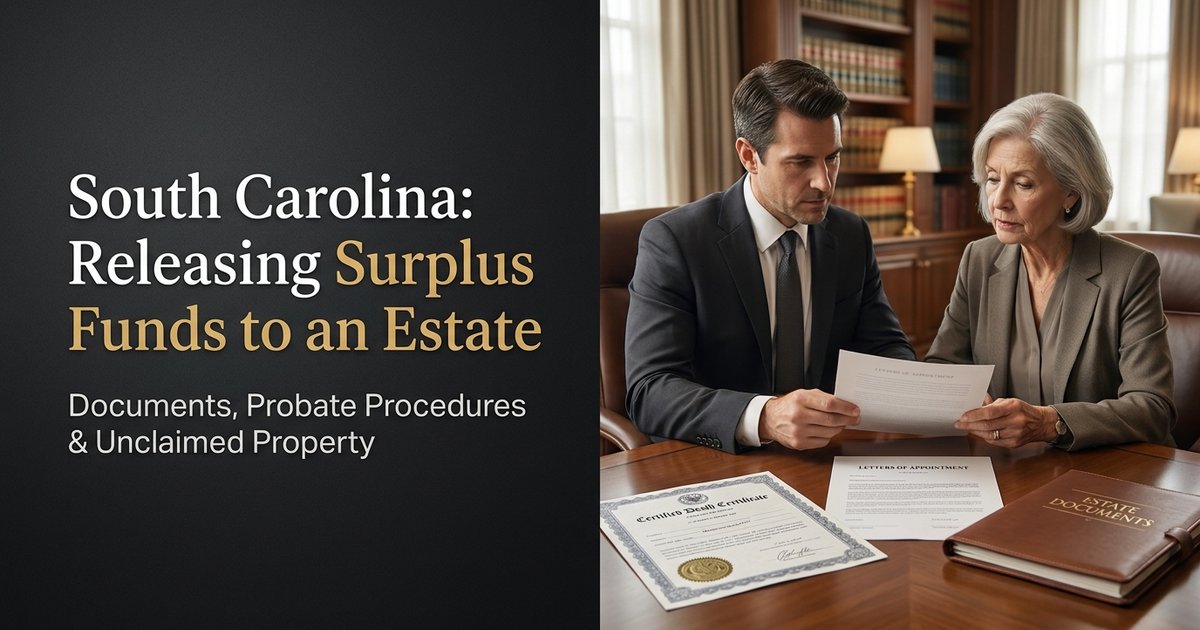
What documents are usually needed to release surplus funds to an estate?
South Carolina probate guidance
Short Answer
In South Carolina, the holder usually requires a certified death certificate, current certified Letters of Appointment, a completed claim or release form, and records proving that the funds belonged to the decedent. If the estate has closed, the Probate Court may need to reopen it and issue new authority. A qualifying small estate may use a court-approved affidavit instead of appointing a personal representative.
Understanding the Problem
Can a firm representative obtain surplus funds or unclaimed property for a South Carolina estate, and which documents must establish the decedent’s ownership and the personal representative’s authority to receive those assets? The answer depends mainly on whether the estate remains open, has closed, or qualifies for collection by affidavit.
Apply the Law
South Carolina generally requires a court-appointed personal representative to collect estate property. The Probate Court for the county where the decedent lived usually handles the estate. The organization or court holding the money may impose its own claim form and identification requirements, but those requirements do not replace proof of probate authority.
Key Requirements
- Proof of death: A certified death certificate connects the claim to the deceased owner.
- Proof of authority: Current certified Letters of Appointment show that the personal representative has qualified and may act for the estate. A court appointment order may also be requested.
- Proof of ownership: The claim packet should include records connecting the decedent to the funds, such as a deed, account statement, closing record, sale report, court order, claim number, or correspondence from the holder.
- Claim and payment documents: The holder may require its signed claim or release form, the estate case number, identification for the personal representative, an authorization for the submitting firm, and instructions showing that payment will go to the estate rather than an individual.
- Updated probate filing: Newly recovered funds generally belong on a supplemental or amended inventory. The original inventory is due within 90 days after appointment.
What the Statutes Say
- S.C. Code § 62-3-103 (Appointment and Letters) – A person generally gains personal-representative authority only after court appointment, qualification, and issuance of letters.
- S.C. Code § 62-3-709 (Possession of Estate Property) – The personal representative has authority and a duty to take control of estate property when needed for administration.
- S.C. Code § 62-3-706 (Inventory and Appraisement) – The personal representative generally must file an inventory within 90 days after appointment.
- S.C. Code § 62-3-708 (Supplementary Inventory) – Newly discovered property must be reported through a supplemental, amended, or corrected inventory.
- S.C. Code § 62-3-1201 (Collection by Affidavit) – Thirty days after the decedent’s death, a successor may use a Probate Court-approved affidavit if the net probate estate does not exceed $45,000 and no appointment proceeding is pending or completed.
- S.C. Code § 62-3-1008 (Subsequent Administration) – The Probate Court may appoint the same or a successor personal representative when property appears after an estate has closed.
- S.C. Code § 27-18-250 (State-Held Unclaimed Property Claims) – A claimant must submit a verified claim on the prescribed form, and the State Treasurer generally considers it within 90 days.
Analysis
Apply the Rule to the Facts: The recovered funds appear connected to the estate, but the firm’s involvement alone does not establish authority to receive them. The claim should identify the appointed personal representative, document the decedent’s ownership, and direct payment to the estate. If the estate has closed, new letters may be required before the holder releases the money.
Process & Timing
- Who files: The personal representative, or an authorized firm representative acting for that person. Where: The holder of the surplus funds and, when a probate filing is necessary, the South Carolina Probate Court that opened the estate. What: The holder’s claim form, certified death certificate, current certified letters, ownership records, identification, authorization, and requested payment documents. When: Submit the packet while the letters remain effective; file the original probate inventory within 90 days after appointment.
- If the asset was not listed previously, file a supplemental or amended inventory with the Probate Court and provide any required copies to interested persons. More information about this issue appears in the firm’s discussion of claiming unclaimed property owed to a South Carolina estate.
- If the estate is closed, apply for subsequent administration in the original Probate Court. After the court issues new letters, send a certified copy to the holder and request a check payable to the estate.
Exceptions & Pitfalls
- A small-estate affidavit may replace letters only when all statutory conditions apply, including the waiting period, the estate-value ceiling, and the absence of a pending or completed appointment proceeding.
- Expired or discharged authority may delay payment. A copy of old letters often does not establish present authority after the estate has closed.
- A death certificate and will do not, by themselves, authorize a beneficiary or firm representative to collect estate funds.
- The holder may require a motion, proposed order, notarized release, indemnity agreement, or additional chain-of-title records when ownership is disputed or the money remains in a court registry.
- The decedent’s name, former addresses, property description, account number, and court case number should match the holder’s records. Unexplained differences often delay review.
- Payment should normally go to the estate under the personal representative’s control, not directly to a beneficiary or the submitting firm.
Conclusion
South Carolina holders usually release estate surplus funds after receiving a certified death certificate, current certified Letters of Appointment, a completed claim or release form, and proof that the decedent owned the funds. A qualifying estate whose entire probate estate, less liens and encumbrances, does not exceed $45,000 may use a court-approved affidavit 30 days after the decedent’s death, while a closed estate may require subsequent administration. Submit a complete claim packet to the holder and file any required supplemental inventory with the Probate Court within the applicable probate timeline.
Talk to a Probate Attorney
If an estate must recover surplus funds or unclaimed property, our firm has experienced attorneys who can help identify the required documents, confirm the personal representative’s authority, and address an estate that has already closed.
Disclaimer: This article provides general information about South Carolina law based on the single question stated above. It is not legal advice for your specific situation and does not create an attorney-client relationship. Laws, procedures, and local practice can change and may vary by county. If you have a deadline, act promptly and speak with a licensed South Carolina attorney.

