
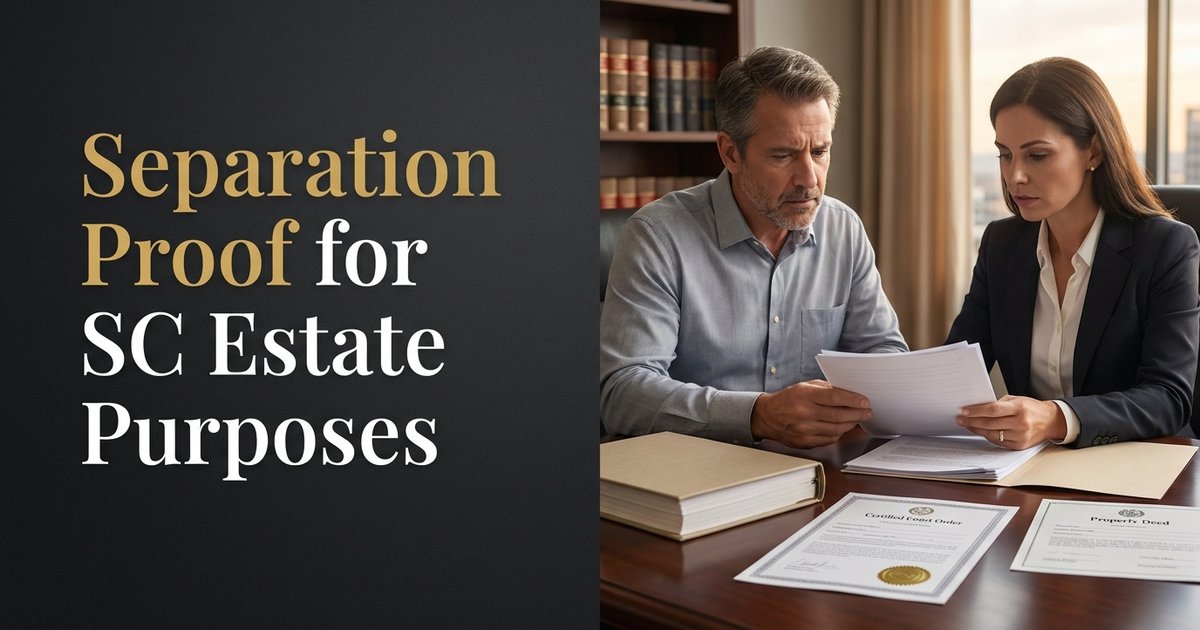
What evidence can show that a deceased relative was separated from a spouse for estate purposes? – South Carolina
Short Answer
In South Carolina, living apart usually does not end a spouse’s inheritance rights or priority to administer an estate. The strongest evidence is a certified divorce or annulment signed by the court and filed with the clerk of court before death, a court order terminating marital property rights or confirming equitable distribution when the spouses were not living together as spouses at death, or, for the estate rights covered by it, a valid written waiver or complete property settlement. Separate addresses, bills, financial records, messages, and witness testimony may prove that the spouses lived apart, but those facts alone generally do not remove surviving-spouse status.
Understanding the Problem
The issue is whether an interested family member can establish that, under South Carolina probate law, a person claiming to be the surviving spouse had legally effective separation documents or had only been living apart from the deceased person. The relevant time is the date of death, and the South Carolina Probate Court must determine whether the separation affected inheritance rights or priority to serve as personal representative.
Apply the Law
South Carolina distinguishes physical separation from a legal event that affects estate rights. A decree of separate maintenance that leaves the marriage intact is not a divorce. Likewise, separate residences and separate finances ordinarily do not prevent a legally married person from qualifying as a surviving spouse.
Key Requirements
- Marriage status at death: A divorce or annulment generally must have been signed by the court and filed with the clerk of court before death. A pending divorce case or an unsigned order ordinarily is not enough.
- Order affecting marital property rights: A spouse may be excluded from certain probate rights if a valid proceeding ended with an order terminating all marital property rights or confirming equitable distribution, provided the spouses were not living together as spouses when the death occurred.
- Written waiver or property settlement: A voluntarily signed waiver may surrender an elective share, homestead allowance, and exempt property when the required written financial disclosures were made. A complete property settlement made after or in anticipation of separation or divorce can also waive inheritance rights unless the document provides otherwise.
- Corroborating evidence of living apart: Leases, deeds, utility bills, driver’s license records, bank statements, insurance records, mail, communications, and testimony from people with personal knowledge can establish separate households. This evidence usually supports a qualifying court order or written agreement rather than replacing one.
What the Statutes Say
- S.C. Code § 62-2-802 (Effect of divorce, separate maintenance, and marital-property orders) – Defines when a spouse does not qualify as a surviving spouse and confirms that separate maintenance alone is not a divorce.
- S.C. Code § 62-2-204 (Waiver and property settlement) – Explains when a signed waiver or complete property settlement can surrender spousal estate rights.
- S.C. Code § 62-3-203 (Priority to serve as personal representative) – Gives first priority to the person nominated in a probated will, followed by other listed persons, including a qualifying surviving spouse.
- S.C. Code § 62-2-901 (Delivery of a will) – Requires a person holding the will to deliver it within 30 days after learning of the death.
Analysis
Apply the Rule to the Facts: The stated facts do not identify a filed divorce decree, a marital-property order, or a signed waiver, so physical separation alone cannot resolve the disputed spouse’s status. The physical will may change who has priority to administer the estate if the court admits it to probate, but it does not automatically eliminate the spouse’s statutory rights. Creditor claims and the possible sale of estate assets affect the amount available for distribution, not whether the claimant qualifies as a surviving spouse.
Evidence should be organized by legal importance. Certified court records and signed settlement documents carry more weight than informal proof of separate households. Address records and witness testimony become especially important when a marital-property order applies only if the spouses were not living together as spouses at death. More background appears in this discussion of inheritance rights when South Carolina spouses separated but never divorced.
Process & Timing
- Who files: The person holding the original will must deliver it to the proper Probate Court or to a person named as personal representative in the will, who must deliver it to the court, and an interested heir or devisee may start the contested proceeding. Where: The Probate Court for the South Carolina county where the deceased person was domiciled. What: The original will and, when court action is needed, a summons and petition for formal probate, determination of appointment priority, removal, or other appropriate relief. When: The will must be delivered within 30 days after actual notice or knowledge of the death.
- Submit the evidence: Obtain certified copies of divorce, separate-maintenance, equitable-distribution, or marital-property orders from the appropriate clerk of court. Include the complete signed waiver or settlement agreement, written financial disclosures, residence records, relevant communications, and affidavits or testimony from witnesses with personal knowledge.
- Request a court determination: Serve the personal representative and other required interested persons. The Probate Court can admit the will, determine appointment priority, decide whether removal or restrictions are appropriate, and enter an order addressing the disputed spouse’s status or rights.
Exceptions & Pitfalls
- Separate maintenance is not divorce: An order allowing spouses to live separately does not remove surviving-spouse status if it leaves the marriage intact and does not terminate the relevant property rights.
- A pending divorce is generally insufficient: The divorce or annulment must be signed and filed before death to qualify as final under the probate statute.
- A waiver may have limited language: A document waiving an elective share may not necessarily waive every benefit or remove appointment priority. The court must review its exact terms, signatures, disclosures, and circumstances.
- Informal records need authentication: Screenshots, copied mail, and secondhand statements may face evidentiary objections. Certified public records, original agreements, account records, and testimony based on personal knowledge are stronger.
- Filing the will does not automatically stop administration: A formal testacy proceeding generally stops further distributions after notice, but separate relief may be needed to restrict other transactions or remove the current personal representative. A removal petition requires statutory cause, not merely family disagreement.
- Creditor claims remain relevant: Even if the court changes the personal representative or determines that the claimant lacks spousal rights, properly allowed debts and administration expenses may still require the estate to use or sell assets.
Conclusion
South Carolina generally continues to treat a physically separated but legally married person as a surviving spouse. A filed divorce, a qualifying order terminating marital property rights, or, for the estate rights covered by it, a valid written waiver or complete settlement provides the strongest contrary evidence; separate-address records mainly corroborate those documents. The immediate next step is to deliver the original will to the Probate Court for the county of the deceased person’s domicile or to a person named as personal representative in the will within 30 days after learning of the death.
Talk to a Probate Attorney
If a disputed spouse is administering an estate while a physical will and separation records are being collected, our firm has experienced attorneys who can help evaluate the documents, protect estate property, and explain the available court procedures and timelines.
Disclaimer: This article provides general information about South Carolina law based on the single question stated above. It is not legal advice for your specific situation and does not create an attorney-client relationship. Laws, procedures, and local practice can change and may vary by county. If you have a deadline, act promptly and speak with a licensed South Carolina attorney.

