
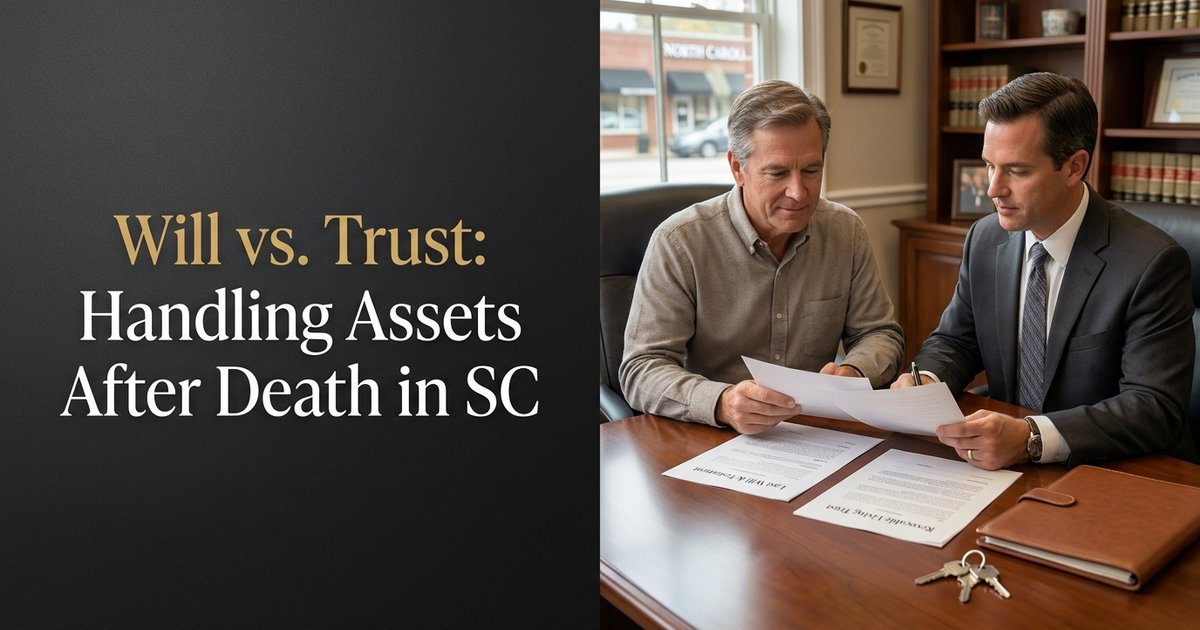
How does a trust differ from a will when assets are handled after death? – South Carolina
Short Answer
In South Carolina, a will directs the distribution of probate assets through the Probate Court, while a funded trust lets a successor trustee handle trust-owned assets outside the routine probate process. A trust controls only property transferred or made payable to it. Assets with surviving joint owners or valid beneficiary designations generally pass under those arrangements rather than under either document.
Understanding the Problem
The central question is whether a personal representative must handle assets through a South Carolina Probate Court under a will or whether a successor trustee may handle them under a trust. The answer depends primarily on how each asset is owned or designated when the owner dies. Reviewing an older will therefore requires comparing its instructions with current ownership records and beneficiary designations.
Apply the Law
A will takes effect at death and governs property included in the probate estate. The Probate Court appoints a personal representative, who collects probate property, addresses valid claims and expenses, and distributes the remaining property under the will. A revocable trust operates during the creator’s lifetime and ordinarily becomes irrevocable at death. The successor trustee then administers property that the trust owns or receives.
Key Requirements
- Identify who owns each asset: A will generally controls individually owned property without a surviving joint owner or beneficiary designation. A trust controls property properly transferred or made payable to the trust.
- Use the correct administration process: A personal representative handles probate assets under Probate Court authority. A successor trustee generally handles funded trust assets without first obtaining a probate appointment.
- Follow claims and distribution duties: Both fiduciaries must identify property, address enforceable obligations, keep appropriate records, and distribute assets under the controlling document and South Carolina law.
- Coordinate nonprobate transfers: Joint ownership with survivorship rights and accounts with valid beneficiary designations usually override conflicting instructions in a will. These arrangements must also coordinate with the trust plan.
What the Statutes Say
- S.C. Code § 62-2-202 (Probate Estate) – Defines the probate estate as property passing under a will or through intestacy, reduced by specified expenses and claims.
- S.C. Code § 62-3-101 (Property at Death) – Makes property passing under a will subject to estate administration and creditor rights.
- S.C. Code § 62-7-603 (Revocable Trusts) – Provides that the creator controls beneficiary rights while the trust remains revocable.
- S.C. Code § 62-7-505 (Claims Against Trust Property) – Allows certain claims, expenses, and family allowances to reach revocable-trust property after death when the probate estate is inadequate.
- S.C. Code § 62-7-604 (Revocable Trust Contests and Distribution) – Sets deadlines for contesting a revocable trust and permits the trustee to distribute property subject to stated protections.
Analysis
Apply the Rule to the Facts: The older will may still direct probate assets, but it does not determine how every asset will pass. The spouses should compare the will with deeds, account ownership, beneficiary designations, and any existing trust documents. If they choose a trust-centered plan, assets must be transferred or directed to the trust; signing a trust without funding it may leave substantial property subject to probate.
A properly funded trust can reduce the property requiring Probate Court administration and can allow continued management for beneficiaries under the trust’s terms. It does not automatically eliminate probate because property left outside the trust may still require administration. A pour-over will can direct remaining probate property to the trust, but those assets ordinarily pass through probate before reaching the trustee.
For a broader review of coordinated planning documents, see which estate planning documents should be in place in South Carolina.
Process & Timing
- Who files: The person holding the original will or the person nominated as personal representative. Where: The Probate Court for the South Carolina county with jurisdiction, generally the county where the deceased person lived. What: The original will and, when administration is needed, an application or petition for probate and appointment. When: The will must be delivered within 30 days after actual notice or knowledge of the death.
- Probate administration: After appointment, the personal representative gathers probate assets, gives required notices, addresses claims, and files an inventory and appraisal generally within 90 days after appointment. Forms and local filing procedures can vary by county.
- Trust administration: The successor trustee reviews the trust, confirms title to trust property, addresses applicable claims and expenses, and distributes or continues managing the property under the trust. A trust contest generally must begin by the earlier of one year after death or 120 days after the trustee sends the statutory trust copy and notice.
Exceptions & Pitfalls
- An unfunded trust may not avoid probate: The trust must own or receive the relevant property. A schedule listing assets does not always complete the transfer of title.
- Beneficiary designations may control: Accounts payable directly to named beneficiaries generally do not pass under the will. Outdated designations can defeat an otherwise coordinated plan.
- Joint ownership changes the result: Property with survivorship rights usually passes to the surviving owner rather than under the will or trust.
- A trust does not necessarily defeat creditor rights: South Carolina law may make revocable-trust property available for claims, administration costs, expenses, and statutory allowances if the probate estate cannot cover them.
- Privacy is not absolute: A will filed for probate becomes part of the court record. A trust usually avoids routine public filing, although disputes or other proceedings can expose trust information.
- Old documents may still operate: Age alone does not invalidate a will. Changes in family circumstances, property ownership, beneficiary designations, or planning goals may nevertheless create unintended results.
Conclusion
In South Carolina, a will controls probate assets through a court-appointed personal representative, while a trust controls only assets transferred or made payable to it and is administered by a successor trustee. The key threshold is asset ownership at death, not merely whether a trust document exists. A will holder must deliver the original to the proper Probate Court or to the person named as personal representative within 30 days after learning of the death. Arrange one coordinated review of the wills, ownership records, and beneficiary designations before changing the plan.
Talk to an Estate Planning Attorney
If an older will may no longer match current assets or family goals, our firm has experienced attorneys who can explain the differences between wills and trusts and help coordinate related powers of attorney and advance directives.
Disclaimer: This article provides general information about South Carolina law based on the single question stated above. It is not legal advice for your specific situation and does not create an attorney-client relationship. Laws, procedures, and local practice can change and may vary by county. If you have a deadline, act promptly and speak with a licensed South Carolina attorney.

