
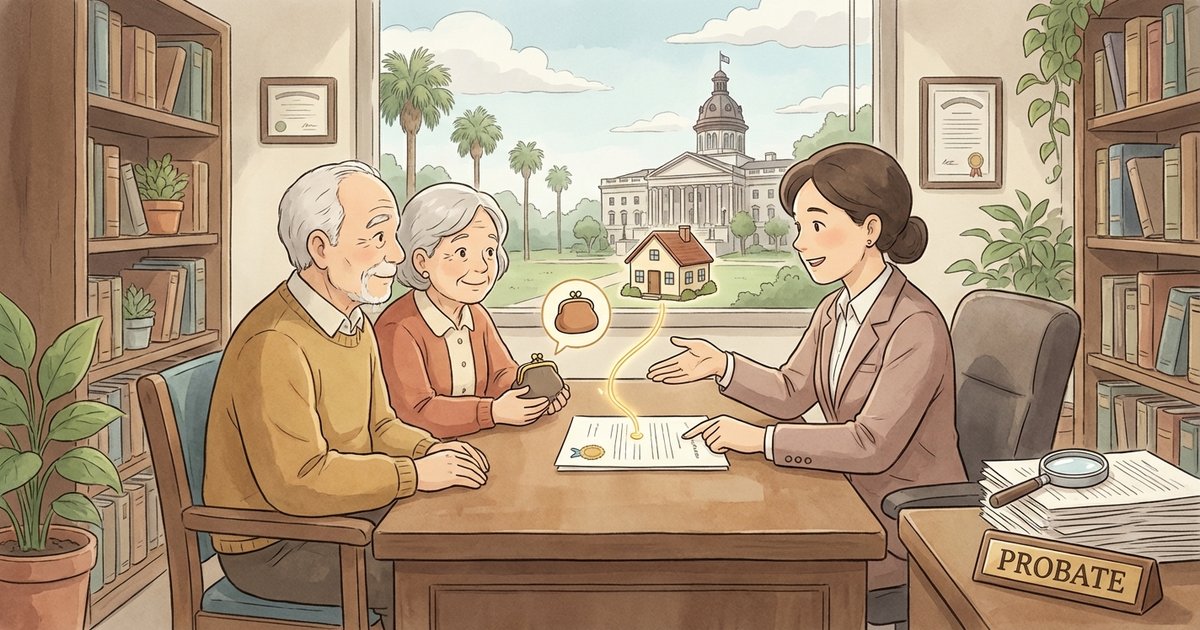
What happens to jointly held bank accounts and property when someone dies without a will in North Carolina? – South Carolina
Short Answer
In South Carolina, many jointly held assets pass automatically to the surviving co-owner if the account or deed includes a right of survivorship. Those assets usually do not become part of the probate estate, even if the person died without a will. If there is no survivorship language (or the asset is held as tenants in common), the deceased person’s share typically goes through probate and is distributed under South Carolina intestacy rules.
Understanding the Problem
When someone dies without a will in South Carolina, what happens to jointly held bank accounts and jointly owned property depends on how the asset is titled. Can a surviving co-owner take the asset automatically, or must the deceased owner’s share go through the South Carolina probate court and be divided under intestate succession? The key trigger is the death of one co-owner and whether the account agreement or deed creates a right of survivorship.
Apply the Law
South Carolina separates (1) assets that transfer by contract or by operation of law (like many survivorship accounts and survivorship deeds) from (2) assets that become part of the probate estate. If an asset passes by survivorship, it generally transfers to the surviving co-owner outside probate. If survivorship is not created, the deceased person’s share is treated like probate property and is distributed under South Carolina’s intestacy statutes through the probate court (typically the Probate Court in the county where the decedent lived).
Key Requirements
- How the asset is titled: The account agreement or deed controls whether survivorship applies or whether the deceased owner’s share becomes a probate asset.
- Right of survivorship language (or account form): Survivorship must be created clearly for real estate, and many financial accounts use survivorship forms that direct the institution to pay the survivor.
- Whether the asset is part of the “intestate estate”: Only probate assets are divided under intestacy; survivorship assets usually are not.
What the Statutes Say
- S.C. Code Ann. § 62-2-102 (Intestate share of spouse) – Sets the surviving spouse’s share of the intestate estate (probate property) when there is no will.
- S.C. Code Ann. § 62-2-103 (Heirs other than spouse) – Explains who inherits the remainder of the intestate estate (children/issue, parents, and more remote relatives).
- S.C. Code Ann. § 27-7-40 (Joint tenancy with right of survivorship in real estate) – Provides how survivorship joint tenancy in real estate is created and how the survivor can record proof of death with the Register of Deeds.
- S.C. Code Ann. § 62-2-804 (Survivorship language and joint tenancy in real property) – Addresses how joint tenancy in real property is treated at death and the importance of express survivorship language.
- S.C. Code Ann. § 34-30-1630 (Joint deposit accounts in state savings banks) – States that certain joint accounts payable to either or the survivor are treated as joint tenancy and are payable to the survivor (absent fraud or undue influence).
Analysis
Apply the Rule to the Facts: If a bank account is titled so it is payable to either owner or the survivor, South Carolina law generally allows the financial institution to pay the surviving owner, and the account usually does not pass through intestate probate. If real estate is deeded “as joint tenants with right of survivorship and not as tenants in common,” the surviving owner generally becomes the sole owner by operation of law. If the deed or account does not create survivorship (for example, it is tenants in common), the deceased owner’s share typically becomes a probate asset and is distributed under South Carolina intestacy rules.
Process & Timing
- Who acts: The surviving co-owner (for survivorship assets) and/or a personal representative (for probate assets). Where: For probate, the South Carolina Probate Court in the county where the decedent lived. For real estate records, the Register of Deeds in the county where the property is located. What: For survivorship real estate, a certified death certificate is commonly recorded to update the public record; for probate, a petition/application to open the estate and appoint a personal representative is typically filed. When: As soon as practical after death, especially if bills must be paid or property must be sold.
- Financial institutions usually require a certified death certificate and their own claim paperwork before releasing funds to a surviving joint owner. If there is a dispute (for example, allegations of undue influence), the institution may pause payment until the parties’ rights are determined.
- For probate assets, the personal representative gathers probate property, pays valid debts and expenses, and then distributes what remains to heirs under intestacy (for example, spouse and children) and closes the estate with the probate court.
Exceptions & Pitfalls
- “Joint” does not always mean “survivorship”: For real estate in South Carolina, survivorship generally must be stated clearly; otherwise, the deceased owner’s share may pass through probate as a tenancy in common interest.
- Undue influence or fraud claims: Some South Carolina account statutes protect survivorship transfers “in the absence of fraud or undue influence,” so disputes can change how quickly (or whether) a survivor receives funds.
- Survivorship does not automatically solve estate administration: Even if major assets pass outside probate, the estate may still need administration to handle debts, final expenses, refunds, or assets titled only in the decedent’s name.
Conclusion
In South Carolina, jointly held bank accounts and property often pass to the surviving co-owner automatically if the account or deed creates a right of survivorship. If survivorship was not created (such as tenants in common ownership), the deceased person’s share usually becomes a probate asset and is distributed under South Carolina intestacy statutes. A practical next step is to confirm the exact account titling and deed language and, if any assets are not survivorship assets, file to open the estate in the county Probate Court promptly.
Talk to a Probate Attorney
If a family is dealing with jointly titled accounts or real estate after a death without a will, a probate attorney can help confirm whether survivorship applies, identify what must go through probate, and map out the steps and timelines to transfer title and close the estate.
Disclaimer: This article provides general information about South Carolina law based on the single question stated above. It is not legal advice for your specific situation and does not create an attorney-client relationship. Laws, procedures, and local practice can change and may vary by county. If you have a deadline, act promptly and speak with a licensed South Carolina attorney.
xq

