
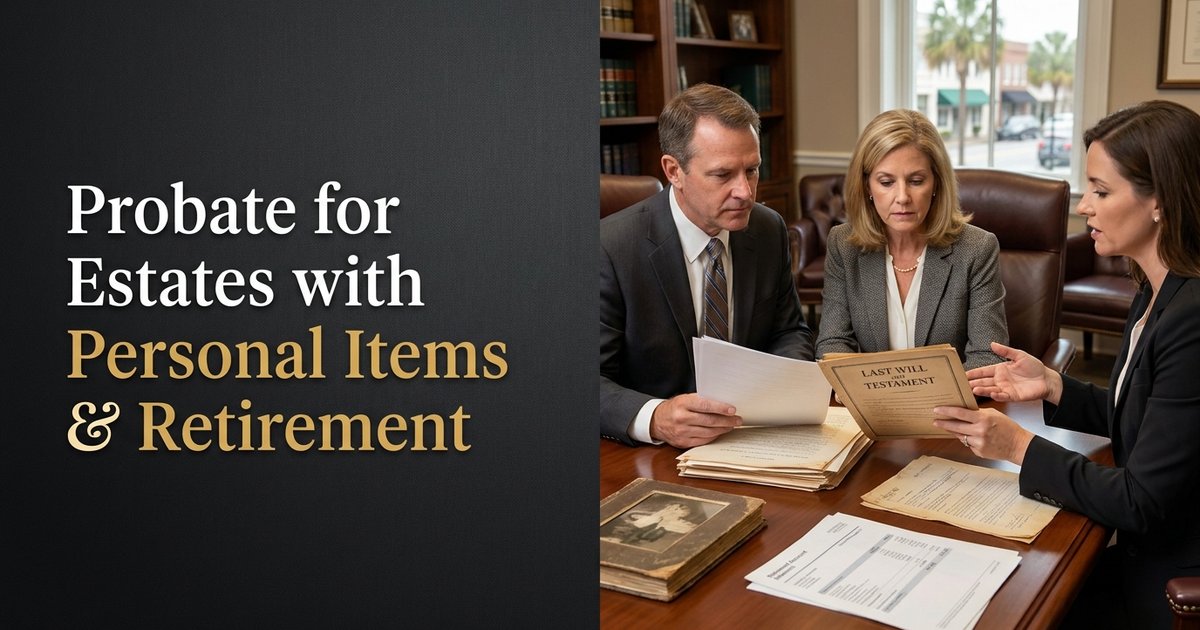
If there’s mostly personal items and retirement accounts, what does the probate process usually involve? – South Carolina
Short Answer
South Carolina probate may be limited when an estate consists mainly of personal belongings and retirement accounts. Retirement accounts usually pass outside probate if they have valid beneficiary designations, while personal items owned individually by the deceased person generally pass through the estate or an available small-estate procedure. The original will still must be delivered to the proper Probate Court, and the trust only controls property transferred to it or made payable to it.
Understanding the Problem
In South Carolina, what must adult children named as co-personal representatives do when a deceased parent left a will, an older trust, personal belongings, and retirement accounts? The central issue is which assets require Probate Court administration and which assets transfer directly under a beneficiary designation or trust ownership.
Apply the Law
The first step is to classify each asset. Probate property generally includes personal items and accounts owned solely by the deceased person without an effective transfer arrangement. Nonprobate property generally includes assets owned by a trust, qualifying jointly owned property, and retirement accounts payable to surviving named beneficiaries.
A trust does not automatically avoid probate merely because it exists. The family must check whether property was titled in the trust, assigned to the trust, or made payable to the trustee. Likewise, the will does not normally replace a retirement account’s valid beneficiary designation. More information about this distinction appears in this discussion of retirement proceeds when an estate is the beneficiary.
Key Requirements
- Identify ownership and beneficiaries: Obtain current retirement account beneficiary records, account statements, the will, the complete trust, and any trust asset schedules or assignments.
- Deliver and probate the will when needed: The person holding the original will must deliver it to the Probate Court for the county where the deceased person lived. The court must appoint the personal representatives before they exercise estate authority.
- Administer probate property: The appointed personal representatives must secure, value, inventory, and distribute probate property according to the will after addressing administration expenses and valid claims.
- Coordinate joint authority: Unless the will provides otherwise, appointed co-personal representatives generally must agree on estate actions. They may file a written delegation with the court for specified duties.
- Consider simplified administration: If the net probate estate meets South Carolina’s current $45,000 threshold, a small-estate affidavit or summary procedure may reduce the required administration, depending on whether a personal representative has already been appointed and other statutory conditions.
What the Statutes Say
- S.C. Code Ann. § 62-2-901 (Delivery and filing of a will) – The person holding the will must deliver it within 30 days after learning of the death.
- S.C. Code Ann. § 62-3-706 (Inventory and appraisement) – An appointed personal representative generally must file an inventory of probate property within 90 days after appointment.
- S.C. Code Ann. § 62-3-801 (Notice to creditors) – An appointed personal representative generally must publish notice once a week for three successive weeks; the published claims period runs eight months from the first publication.
- S.C. Code Ann. § 62-3-717 (Authority of co-personal representatives) – All appointed co-personal representatives generally must concur unless the will provides otherwise or a written delegation applies.
- S.C. Code Ann. § 62-3-1201 (Small-estate affidavit) – After 30 days, qualifying successors may collect certain personal property when the entire probate estate does not exceed $45,000 and no appointment application is pending or granted.
Analysis
Apply the Rule to the Facts: The will identifies the adult children who may seek appointment, but being named does not itself give them authority to act for the estate. The retirement accounts may avoid probate if valid beneficiaries survive, while the personal items may require probate unless they were transferred to the trust or qualify for a small-estate procedure. Because multiple children are named, they should also determine whether the will permits individual action or requires them to serve together.
The older trust must be reviewed alongside current ownership and beneficiary records. An unfunded trust does not control assets that remained in the deceased person’s individual name. If a retirement account names the estate, lacks an effective beneficiary, or becomes payable to the personal representative under the plan’s terms, the account may require probate administration; this related article explains how a personal representative may handle retirement proceeds payable to an estate.
Process & Timing
- Who files: The person holding the original will and, if administration is needed, the adult children seeking appointment. Where: The Probate Court for the South Carolina county where the deceased person was domiciled. What: The original will, a certified death record, the court’s appointment application, and any required renunciations, bond documents, or supporting forms. When: The original will must be delivered within 30 days after actual notice or knowledge of the death.
- Classify and secure the assets: Request date-of-death statements and beneficiary confirmations from each retirement plan. Make a written list of personal belongings, preserve valuable items, and compare ownership records with the trust. After appointment, the co-personal representatives generally publish creditor notice, notify heirs and beneficiaries within 30 days, and file the probate inventory within 90 days.
- Resolve claims and close the estate: The personal representatives address valid claims, distribute personal property under the will, and file the required accounting, proposed distribution, settlement application, and proof of notice unless valid waivers or summary procedures apply. Straightforward estates still commonly remain open through the creditor period, and local filing practices may vary by county.
Exceptions & Pitfalls
- Small-estate options have conditions: The affidavit procedure generally requires waiting 30 days, a probate estate not exceeding $45,000, and no pending or granted appointment of a personal representative. Summary administration after appointment follows different requirements.
- Beneficiary records may differ from old documents: A will or trust may express one plan while the retirement custodian’s current records identify different beneficiaries. Obtain written confirmation directly from the custodian rather than relying on old statements.
- Co-personal representatives cannot assume separate authority: Unless the will changes the default rule, all appointed representatives generally must approve estate actions. A delegation should identify the assigned duties, bear the required signatures, and be filed with the court.
- Early distribution creates risk: Personal items should not be divided before ownership, creditor issues, and the will’s instructions are confirmed. Keep photographs, valuations where appropriate, receipts, and signed distribution records.
- Retirement elections can have significant consequences: Retirement distributions may have tax consequences. Consult a licensed tax professional about tax issues in a particular situation.
Conclusion
When a South Carolina estate contains mostly personal items and retirement accounts, probate usually focuses on the individually owned belongings and any retirement proceeds payable to the estate. Accounts with effective surviving beneficiaries generally transfer outside probate, and a trust controls only assets connected to it. The co-personal representatives must act together unless the will or a filed delegation permits otherwise. As the next step, deliver the original will to the Probate Court for the county of domicile within 30 days after learning of the death.
Talk to a Probate Attorney
If a family is sorting out an older will and trust, retirement beneficiary designations, personal belongings, and multiple co-personal representatives, our firm has experienced attorneys who can help explain the available probate procedures, responsibilities, and timelines.
Disclaimer: This article provides general information about South Carolina law based on the single question stated above. It is not legal advice for your specific situation and does not create an attorney-client relationship. Laws, procedures, and local practice can change and may vary by county. If you have a deadline, act promptly and speak with a licensed South Carolina attorney.

