
What documents show that I’m the legally appointed personal representative or executor? – South Carolina
Short Answer
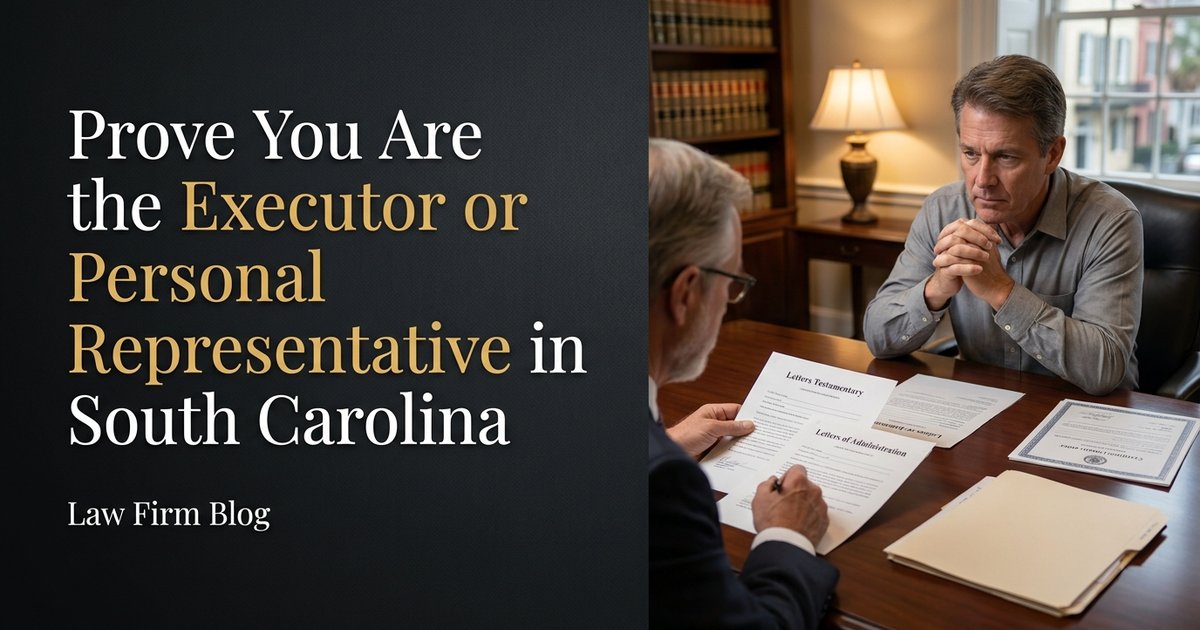
In South Carolina, the main proof of authority is the probate court’s issued letters—usually Letters Testamentary if there is a will naming an executor, or Letters of Administration if there is no will. A person does not have full authority to act for the estate until the probate court appoints that person, the person qualifies, and the court issues letters. If a bank, buyer, or other third party wants confirmation, a certified copy of the probate court’s order and issued letters is usually the clearest proof.
Understanding the Problem
Under South Carolina probate law, the single issue is what document shows that a named executor or other applicant has actually been appointed by the probate court to act for an estate. The answer turns on whether the probate court has completed the appointment and issued the estate papers that give the personal representative legal authority to deal with third parties.
Apply the Law
South Carolina law requires a personal representative to be appointed by the probate court, qualify for the role, and receive issued letters before taking on the powers and duties of estate administration. In practice, those letters are the document most third parties ask for because they show the estate has been opened and the appointment is effective. The usual forum is the probate court in the proper South Carolina county, generally where the decedent lived at death. If there is a dispute over who should serve, the timing and process can change, but the key trigger is the court’s issuance of letters after the required filing and qualification steps are complete.
Key Requirements
- Court appointment: Being named in a will is not enough by itself. The probate court must appoint the personal representative.
- Qualification before authority: Before letters issue, the appointee must complete any required qualification steps, such as filing an acceptance and any bond the court requires.
- Issued letters as proof: The letters issued by the probate court are the standard proof shown to banks, title companies, and others handling estate property.
What the Statutes Say
- S.C. Code Ann. § 62-3-103 (Necessity of appointment for administration) – A person must be appointed, qualify, and be issued letters before gaining the powers and duties of a personal representative.
- S.C. Code Ann. § 62-3-601 (Qualification) – Before receiving letters, the personal representative must file any required bond and a statement accepting the duties of the office.
- S.C. Code Ann. § 19-5-50 (Evidence of appointment of executors or administrators) – A certified copy of the probate court’s order concerning probate or the grant of administration is sufficient evidence of the appointment in South Carolina courts.
- S.C. Code Ann. § 62-3-308 (Informal appointment proceedings; proof and findings required) – In an informal appointment, the probate court reviews the application, oath or affirmation, interested-person status, venue, probate status of any will, required notice, and priority before appointment.
Analysis
Apply the Rule to the Facts: Here, the third party wants proof that [CLIENT] has been formally appointed, not just named in a will or involved in the estate. Under South Carolina law, the best document to provide is the issued Letters Testamentary or Letters of Administration from the probate court, because those letters show the appointment is effective. If the third party wants added confirmation, [CLIENT] can also provide a certified copy of the probate order showing probate of the will or the grant of administration.
If [CLIENT] only has a copy of the will, a death certificate, or unsigned court papers, those documents usually do not prove current legal authority to act for the estate. The key point is whether the probate court has already issued letters after [CLIENT] completed the required appointment steps.
Process & Timing
- Who files: The person seeking to serve as personal representative, or the person named in the will. Where: The Probate Court in the proper South Carolina county. What: The probate filing to open the estate, request appointment, and submit any required acceptance and bond materials so the court can issue Letters Testamentary or Letters of Administration. When: As soon as estate administration is needed; if there is a contest over appointment, timing may lengthen.
- After review, the probate court determines whether the filing is complete and whether applicable notice, venue, probate, and priority requirements are met, and whether the applicant has qualified. If approved, the court issues the letters that establish authority to act for the estate.
- The personal representative then uses certified copies of the letters, and if needed a certified copy of the appointment order, to deal with banks, financial institutions, buyers, and others holding estate property or records.
Exceptions & Pitfalls
- A will alone does not prove authority. Even if a will names an executor, South Carolina still requires court appointment and issued letters before that person can act as personal representative.
- Some third parties ask for certified, not plain, copies. If a bank or title company rejects an ordinary copy, a certified copy from the probate court is often the right fix.
- Authority can be limited or delayed if there is a dispute over priority, notice, venue, bond, or qualification. In that situation, the appointment papers may not issue until the probate court resolves the problem.
Conclusion
In South Carolina, the document that usually proves a person is the legally appointed personal representative or executor is the probate court’s issued Letters Testamentary or Letters of Administration. A certified copy of the probate court’s order may also serve as proof of appointment. The key threshold is formal appointment by the probate court, followed by qualification and issuance of letters. The next step is to request certified copies from the Probate Court and provide them to the third party.
Talk to a Probate Attorney
If a bank, buyer, or other third party is demanding proof of estate authority, our firm can help identify the right South Carolina probate documents, explain what the letters mean, and help resolve delays in getting or using them. For more detail, see what a Letter of Testamentary is in South Carolina and how to apply for probate and obtain letters testamentary in South Carolina.
Disclaimer: This article provides general information about South Carolina law based on the single question stated above. It is not legal advice for your specific situation and does not create an attorney-client relationship. Laws, procedures, and local practice can change and may vary by county. If you have a deadline, act promptly and speak with a licensed South Carolina attorney.

