
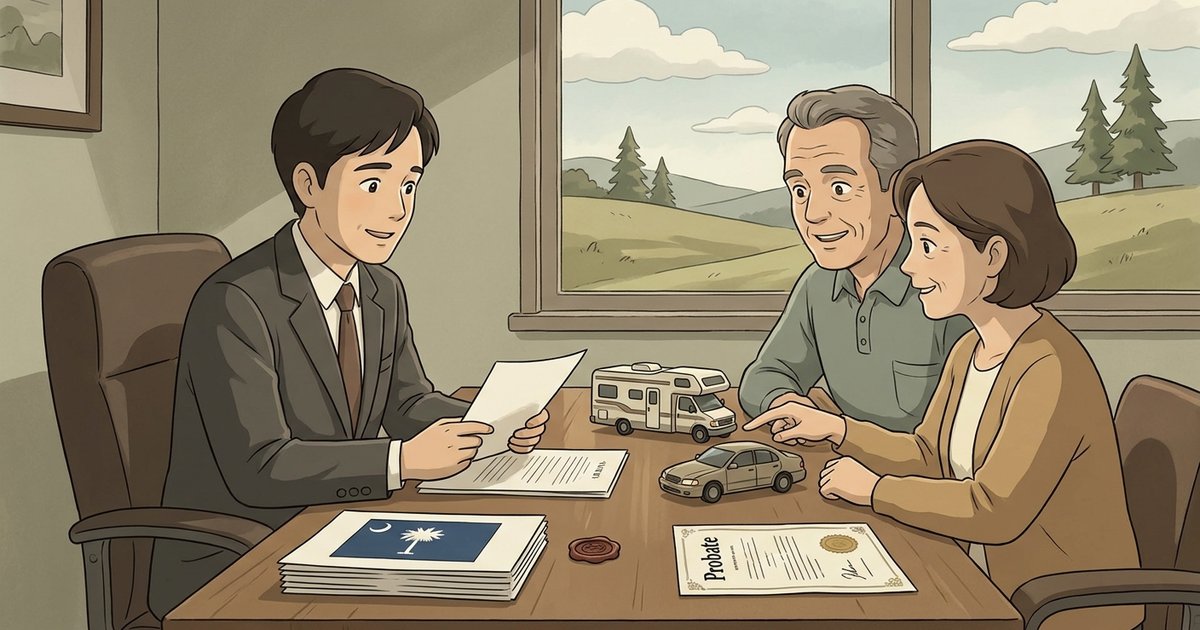
What documents do I need to transfer an RV and a vehicle after a parent dies? – South Carolina
Short Answer
In South Carolina, the key documents usually include the vehicle title, the VIN, current registration, proof of death, and probate authority showing who has the right to act for the estate. If no full probate is open, a small-estate affidavit may work in some cases, but only if the estate qualifies and the probate court approves it. The South Carolina Department of Motor Vehicles generally also requires a title application and proof that property taxes and any lien issues have been addressed.
Understanding the Problem
In South Carolina probate, the single issue is what paperwork is needed to move title to an RV and another motor vehicle after a parent dies. The usual decision point is whether the transfer will be handled by a court-appointed personal representative or through a probate affidavit for a qualifying small estate. That choice affects which ownership papers, death records, and probate documents must be gathered before the Department of Motor Vehicles will retitle the vehicles.
Apply the Law
Under South Carolina law, a motor vehicle that passes after death is treated as an involuntary transfer, so the person receiving authority to act must provide the last certificate of title, if available, proof of the transfer, and an application for a new title to the Department of Motor Vehicles. In probate, personal property generally devolves to heirs or devisees subject to administration, which means the DMV often looks for court-issued authority such as Letters Testamentary or Letters of Administration unless the estate qualifies for collection by affidavit. If the estate is small enough, at least 30 days after death, a successor may use an affidavit approved and countersigned by the probate judge if the probate estate, less liens and encumbrances, does not exceed $45,000 and no personal representative has been appointed.
Key Requirements
- Proof of the vehicle and its identity: The title is best, but the VIN and registration card are also important because they help identify the exact RV and vehicle the estate is transferring.
- Proof of authority to act: The DMV usually needs either probate court authority for the personal representative or a probate-approved small-estate affidavit showing who may collect and transfer the property.
- Proof needed for retitling and registration: A new title application, payment of required fees, and proof that county property tax requirements and any lien issues have been handled are commonly part of the transfer process.
What the Statutes Say
- S.C. Code Ann. § 56-19-390 (Involuntary transfer of vehicle title) – requires the transferee to provide the last title, proof of transfer, and an application for a new title after a nonvoluntary transfer.
- S.C. Code Ann. § 62-3-1201 (Collection of personal property by affidavit) – allows collection of personal property by affidavit after 30 days if the estate qualifies and the probate judge approves the affidavit.
- S.C. Code Ann. § 62-3-101 (Devolution of estate at death) – explains that personal property generally devolves to heirs or devisees subject to administration.
- S.C. Code Ann. § 56-3-1270 (Registration after transfer) – requires the new owner to apply for registration within 30 days after the ownership transfer, with proof that property tax requirements have been met.
Analysis
Apply the Rule to the Facts: Here, the request to locate the VINs, titles, or registration cards makes sense because those records help prove exactly which RV and vehicle belonged to the parent and whether South Carolina titles already exist. If the original titles are available, the transfer usually moves faster because the DMV can match the estate authority to the titled vehicles. If the titles are missing, the VIN and registration still help identify the units, but the estate may need extra DMV steps to replace title records or otherwise prove ownership before retitling can happen.
The next question is who has authority to sign and transfer. If a probate estate is open, the personal representative usually signs using the authority granted by the probate court. If no estate is open and the probate estate is small enough, a probate-approved affidavit may allow collection and transfer instead, but only after 30 days have passed since death and only if no personal representative has been appointed.
Another important point is that an RV is still a titled motor vehicle for DMV purposes, so the same core document hunt matters: title, VIN, registration, lien information, and proof of death. If there is a lender on either vehicle, the lien must be resolved or accounted for before clear title can usually be issued to a new owner.
For a fuller discussion of estate vehicle paperwork, see what paperwork is required to sell an estate vehicle in South Carolina. For small-estate situations, a related overview appears here: how to transfer a vehicle title after death in South Carolina using an affidavit for collection.
Process & Timing
- Who files: the personal representative, or in a qualifying small estate, the successor using a probate-approved affidavit. Where: the Probate Court in the county where the parent was domiciled for estate authority, then the South Carolina Department of Motor Vehicles for retitling and registration. What: typically the death certificate, Letters Testamentary or Letters of Administration, or a probate-approved affidavit under the small-estate statute; the last title if available; VIN and registration information; and the DMV title application. When: a small-estate affidavit cannot be used until 30 days after death, and the new owner generally must apply for registration within 30 days after the ownership transfer.
- Next, the probate court confirms who may act, or the estate opens and the court issues letters. After that, the DMV reviews the title paperwork, transfer proof, tax status, and any lien information. County practice and DMV document requests can vary depending on whether the title is missing or the vehicle record is incomplete.
- Final step and expected outcome: once the DMV accepts the transfer documents and fees, it issues a new title and registration in the proper name, whether that is the estate, a buyer, or the heir entitled to receive the RV or vehicle.
Exceptions & Pitfalls
- A transfer-on-death designation or survivorship title can change the answer because the vehicle may pass outside regular probate.
- A missing title does not always stop the case, but it often slows the transfer because the DMV may require replacement-title steps or other proof tied to the VIN.
- Common mistakes include assuming a child may sign the title without probate authority, overlooking an active lien, or failing to confirm county tax clearance before seeking a new registration.
Conclusion
In South Carolina, the documents needed to transfer an RV and a vehicle after a parent dies usually include the title, VIN, registration, death certificate, and probate authority showing who may act for the estate. If the estate qualifies, a small-estate affidavit may be used after 30 days; otherwise, the personal representative should file for authority in Probate Court and then submit the title paperwork to the DMV.
Talk to a Probate Attorney
If a family is trying to gather titles, VIN records, and probate paperwork to transfer an RV or vehicle after a parent dies, our firm can help explain the required documents, the right probate path, and the timelines that may apply in South Carolina.
Disclaimer: This article provides general information about South Carolina law based on the single question stated above. It is not legal advice for your specific situation and does not create an attorney-client relationship. Laws, procedures, and local practice can change and may vary by county. If you have a deadline, act promptly and speak with a licensed South Carolina attorney.

