
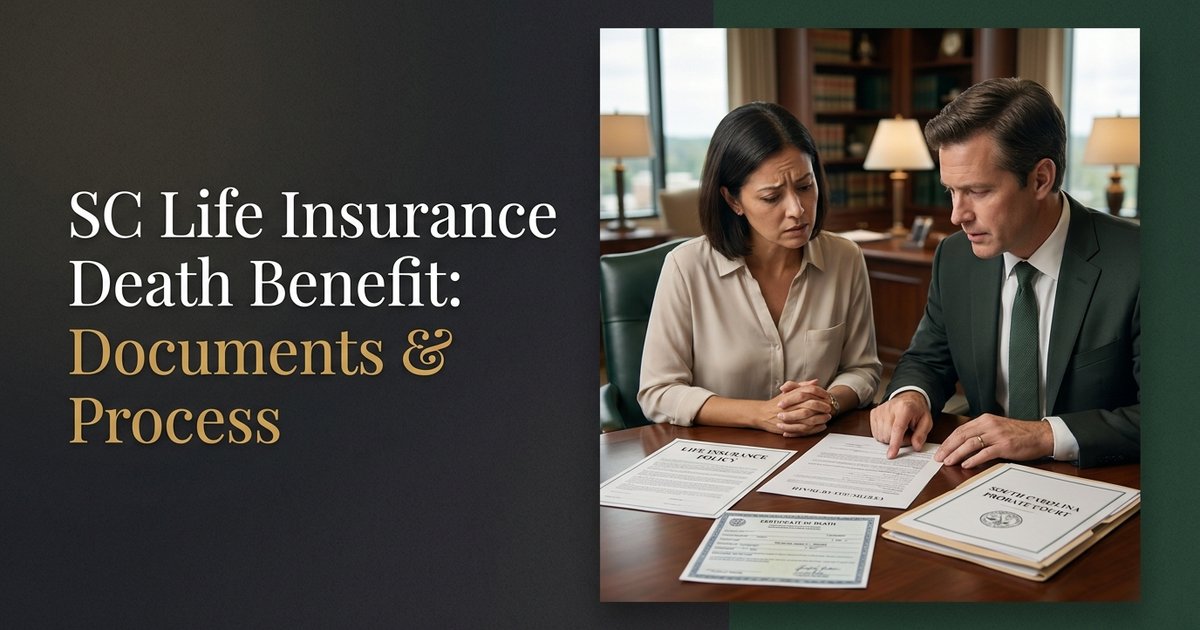
What documents do I need to submit to the insurance company to release the death benefit? – South Carolina
Short Answer
In South Carolina, a named life insurance beneficiary usually submits the insurer’s claim form, a certified death certificate, proof of identity, policy information, and any beneficiary verification the insurer requests. If the insurer will not pay without probate authority, the claimant may also need a South Carolina Probate Court small estate affidavit or appointment papers, plus written renunciations from anyone with higher priority to serve, such as a surviving spouse. The exact packet depends on whether the policy names a valid beneficiary or instead requires payment to the estate.
Understanding the Problem
The issue is whether a South Carolina life insurance beneficiary can collect a grandparent’s death benefit directly from the insurer, or whether the beneficiary must first obtain probate paperwork because the estate has not been opened. The key decision point is whether the insurer needs only beneficiary claim documents or also proof that the claimant has authority through the South Carolina Probate Court, especially when a surviving spouse may have higher priority to administer the estate and must renounce that role before another person can proceed.
Apply the Law
South Carolina treats life insurance as a contract. When a valid beneficiary is named and the beneficiary survives the insured, the insurer usually pays the beneficiary outside probate after receiving its claim documents. For more detail on that issue, see whether life insurance proceeds go through probate in South Carolina when there is a named beneficiary.
Probate paperwork becomes important when the insurer questions who is legally entitled to receive the funds, when no valid beneficiary can be paid, when the policy points to the estate, or when the insurer requires a court-approved small estate process before release. In South Carolina, a small estate collection affidavit generally cannot be used until 30 days after death, and it applies only when the entire probate estate meets the statutory value limit. If the decedent was not domiciled in South Carolina, the affidavit is handled in the county where the South Carolina property is located.
Key Requirements
- Insurance claim documents: The beneficiary should expect to provide the insurer’s completed claim form, a certified death certificate, proof of identity, policy number or policy information, and any beneficiary verification the insurer requires.
- Proof of entitlement: The claimant must show why the insurer should pay that person, either as the named beneficiary or as a court-authorized successor or personal representative.
- Small estate eligibility: A South Carolina small estate affidavit generally requires that 30 days have passed, no personal representative appointment is pending or granted in any jurisdiction, and the probate estate falls within the statutory limit.
- Priority and renunciation: If someone with higher priority, such as a surviving spouse, has a higher right to serve as personal representative, that person may need to sign a written renunciation and nomination before a lower-priority person can proceed informally.
- County filing: The proper forum is the South Carolina Probate Court in the county of the decedent’s domicile, or, for a nonresident decedent, the county where the relevant South Carolina property is located.
What the Statutes Say
- S.C. Code Ann. § 62-3-1201 (Collection of personal property by affidavit) – allows a successor to collect certain personal property by affidavit after 30 days if the entire probate estate does not exceed the statutory limit and no personal representative has been appointed or is pending.
- S.C. Code Ann. § 62-3-203 (Priority among persons seeking appointment as personal representative) – sets the order of priority for appointment and allows higher-priority persons to renounce and nominate another person.
- S.C. Code Ann. § 62-3-310 (Informal appointment notice requirements) – requires notice to persons with equal appointment rights unless they waive that right in writing, and gives them 30 days to object or nominate someone else.
- S.C. Code Ann. § 38-63-40 (Life insurance proceeds and creditor claims) – reflects South Carolina’s treatment of many life insurance proceeds payable to beneficiaries as separate from ordinary estate creditor claims, subject to stated exceptions.
- S.C. Code Ann. § 62-2-803 (Effect of felonious and intentional killing on life insurance and beneficiary designations) – bars a beneficiary who feloniously and intentionally killed the insured from receiving the life insurance benefit.
Analysis
Apply the Rule to the Facts: The client is a grandchild and beneficiary of a grandparent’s life insurance policy, so the first packet should be the insurer’s beneficiary claim packet, certified death certificate, identification, and policy information. Because the insurer is requiring a small estate proceeding before payment, the client likely also needs South Carolina Probate Court paperwork showing authority to collect the proceeds or confirming the proper successor. If the grandparent’s spouse has higher priority to administer the estate, the spouse’s written renunciation and nomination may be needed before the client can seek appointment or small estate authority.
If the policy clearly names the client as beneficiary and there is no dispute, the insurer may not need a full probate estate. If the policy lists the estate, has no surviving beneficiary, has conflicting beneficiary records, or requires court authority for release, the claimant may need probate documents. Related beneficiary issues can be more complex when multiple people claim the same proceeds; see how co-beneficiary rights to life insurance proceeds are determined in South Carolina probate.
Process & Timing
- Who files: The named beneficiary, successor, or proposed personal representative. Where: The South Carolina Probate Court in the county of the decedent’s domicile, or if the decedent was not domiciled in South Carolina, the county where the South Carolina property or claim is located. What: The insurer’s claim form, certified death certificate, proof of identity, policy information, and, if required, South Carolina Probate Court small estate affidavit paperwork, commonly handled through a small estate form such as Affidavit for Collection of Personal Property. When: A small estate affidavit generally cannot be presented until 30 days after death.
- Gather priority documents: If a surviving spouse or another person has higher or equal priority to serve, obtain a signed renunciation, nomination, or waiver as required. If equal-priority persons do not waive in writing, informal appointment may require notice and a 30-day objection period.
- File with the Probate Court: Submit the small estate or appointment paperwork, death certificate, known will information if any, list of heirs and beneficiaries, and any required renunciations. The court may approve and countersign a small estate affidavit if the statutory requirements are met.
- Send the insurer the final packet: After the Probate Court issues the approved affidavit, appointment order, or Letters of authority if needed, send the insurer that court document along with the claim form, certified death certificate, identification, and any insurer-required beneficiary forms.
- Receive the insurer’s decision: The insurer reviews the claim and either pays the proper claimant, requests more documentation, or holds payment if there is a dispute, missing beneficiary proof, competing claims, or unresolved probate issue.
Exceptions & Pitfalls
- Assuming probate is always required: A valid named beneficiary often claims life insurance directly from the insurer without opening an estate.
- Ignoring the policy language: The policy may pay a named beneficiary, contingent beneficiary, trust, or estate, and that language controls the documents needed.
- Skipping the spouse’s renunciation: If the surviving spouse has higher priority to serve and does not renounce or nominate the client, the Probate Court may not informally appoint the client.
- Filing too early: A South Carolina small estate affidavit generally cannot be used until 30 days have passed after death.
- Overlooking the estate value limit: The small estate process depends on the value of the entire probate estate, not just the insurance check.
- Missing another jurisdiction’s appointment: If a personal representative has already been appointed in the decedent’s domicile state, that appointment may affect who has priority in South Carolina.
- Using photocopies when originals are required: Insurers and probate courts often require certified death certificates and signed originals for waivers, renunciations, or claim forms.
- Giving tax answers in the claim packet: Tax treatment can depend on facts outside the probate process, so a claimant should consult a tax attorney or CPA for tax questions.
Conclusion
To release a life insurance death benefit in South Carolina, the beneficiary usually submits the insurer’s claim form, certified death certificate, identification, policy information, and proof of beneficiary status. If the insurer requires probate authority, file the proper small estate or appointment paperwork with the South Carolina Probate Court, including any required spouse renunciation, after the 30-day waiting period for a small estate affidavit.
Talk to a Probate Attorney
If an insurer is refusing to release a life insurance death benefit without South Carolina probate paperwork, our firm has experienced attorneys who can help identify the right documents, address renunciations, and keep the claim moving on the proper timeline.
Disclaimer: This article provides general information about South Carolina law based on the single question stated above. It is not legal advice for your specific situation and does not create an attorney-client relationship. Laws, procedures, and local practice can change and may vary by county. If you have a deadline, act promptly and speak with a licensed South Carolina attorney.

