
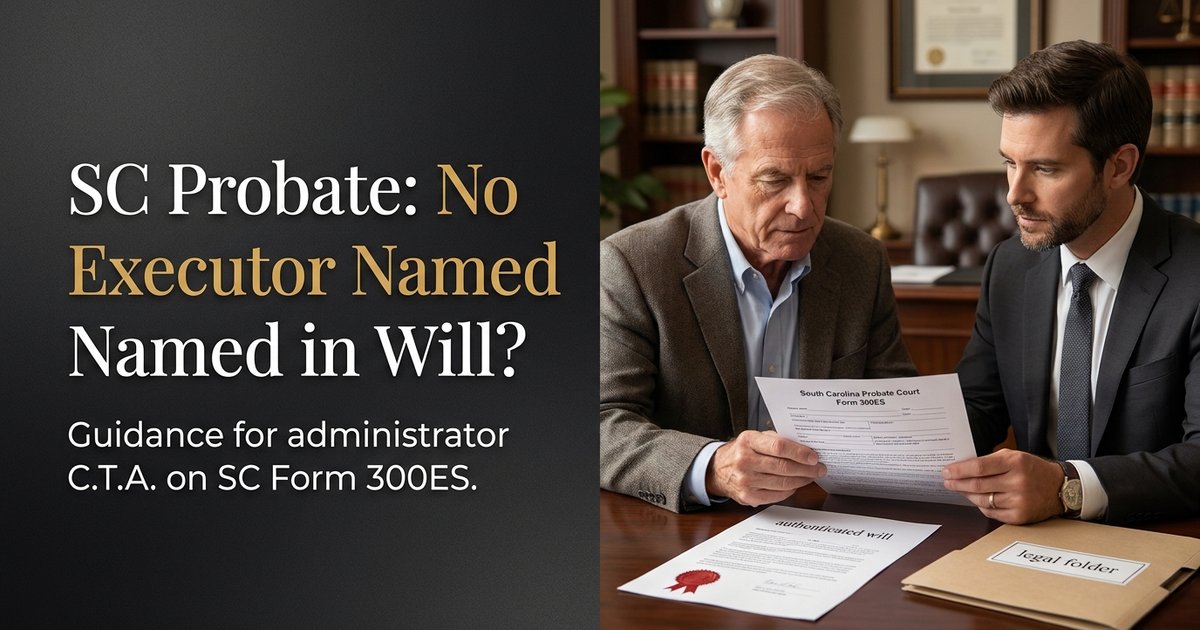
Which box should I check to show who is applying when no executor was named? – South Carolina
Short Answer
If the applicant is the person appointed as administrator C.T.A. in the prior probate proceeding, the applicant should generally check “Other” and write “Administrator C.T.A. appointed in the prior proceeding.” Do not check the box for a personal representative named in the will because the will named no executor. If someone else is filing, that person should select the box that reflects the person’s actual status, such as devisee or heir.
Understanding the Problem
In South Carolina, which applicant-role box should a court-appointed administrator C.T.A. select when filing to probate an out-of-state will without qualifying as a South Carolina personal representative?
Apply the Law
South Carolina allows an interested person to apply for informal probate of a will previously probated elsewhere. The applicant must accurately state the basis for filing. An administrator C.T.A. is a personal representative appointed by a court to administer an estate under a will when the will does not provide an executor who can serve. That status differs from being a personal representative named in the will.
Key Requirements
- Correct applicant capacity: If the applicant received an administrator C.T.A. appointment in the prior proceeding, select “Other” and describe that court-appointed capacity.
- Accurate relationship: State “Administrator C.T.A. appointed in the prior proceeding” or similar wording. If the form separately requests a family relationship, provide that relationship only if it applies.
- Authenticated documents: Submit an authenticated copy of the will and the statement probating it from the office or court where it was first probated. Include proof of the administrator C.T.A. appointment when that appointment establishes the applicant’s interest.
- Proper South Carolina county: For a person who was not domiciled in South Carolina, file in a county where the person owned property at death.
What the Statutes Say
- S.C. Code § 62-3-301 (Contents of Probate Applications) – Requires the application to state the applicant’s interest and identify an authenticated will previously probated elsewhere.
- S.C. Code § 62-3-303(d) (Will Previously Probated Elsewhere) – Allows any interested person to seek informal probate by filing an authenticated copy of the will and the prior probate statement.
- S.C. Code § 62-3-201 (Probate Venue) – Places venue for a nonresident’s estate in a South Carolina county where the person owned property at death.
- S.C. Code § 62-3-108 (Time Limits) – Provides an exception to the ordinary ten-year limit for a will previously probated at the person’s domicile.
Analysis
Apply the Rule to the Facts: The will named no executor, so the applicant should not identify as a personal representative named in the will. If the applicant is the administrator C.T.A. appointed in the prior probate, the most accurate selection is “Other,” followed by wording that identifies that appointment. The authenticated will, prior probate statement, and appointment document should support the stated capacity.
Probating the will “without qualification” means the applicant seeks recognition of the will without requesting appointment as a South Carolina personal representative. The applicant’s prior appointment does not convert into a nomination under the will. If local authority is later needed, the applicant may need a separate filing, as discussed in this overview of South Carolina ancillary probate.
Process & Timing
- Who files: The administrator C.T.A. or another interested person. Where: The South Carolina Probate Court in a county where the nonresident owned property at death. What: South Carolina Probate Court Form 300ES, with “probate without qualification” selected, plus authenticated copies of the will and prior probate record. When: File promptly after determining that South Carolina probate is required; a will previously probated at the person’s domicile is not subject to the ordinary ten-year cutoff.
- Clerk review: Probate Court staff review the form, venue allegations, authenticated records, and filing fee. The court may request a corrected description of the applicant’s capacity or additional proof of the foreign appointment.
- Probate document: If the requirements are satisfied, the court may issue its written statement of informal probate without appointing a South Carolina personal representative.
Exceptions & Pitfalls
- If the applicant was not appointed administrator C.T.A. in the prior proceeding, the applicant should not claim that capacity. The correct selection may instead be devisee, heir, creditor, or another applicable status.
- Do not select “personal representative named in the will” merely because the applicant administered the estate elsewhere. That box describes a nomination appearing in the will itself.
- Use an authenticated probate record that satisfies the Probate Court’s requirements. An ordinary photocopy may not be enough.
- Do not request qualification or appointment if the intended relief is limited to probate of the will without qualification. Appointment involves separate priority, acceptance, and possible bond requirements.
- County procedures can differ. Confirm the required supporting documents and filing fee with the Probate Court before submission.
Conclusion
When the will named no executor, an administrator C.T.A. appointed in the prior proceeding should generally check “Other,” not “personal representative named in the will,” and describe the prior court-appointed capacity. South Carolina permits an interested person to submit a will previously probated elsewhere, and the ordinary ten-year limit may not apply when the prior probate occurred at the person’s domicile. File Form 300ES with the proper county Probate Court and attach authenticated copies of the will, prior probate statement, and appointment document.
Talk to a Probate Attorney
If an out-of-state will must be recognized in South Carolina, our firm has experienced attorneys who can help identify the correct applicant capacity, supporting records, county, and filing procedure.
Disclaimer: This article provides general information about South Carolina law based on the single question stated above. It is not legal advice for your specific situation and does not create an attorney-client relationship. Laws, procedures, and local practice can change and may vary by county. If you have a deadline, act promptly and speak with a licensed South Carolina attorney.

