
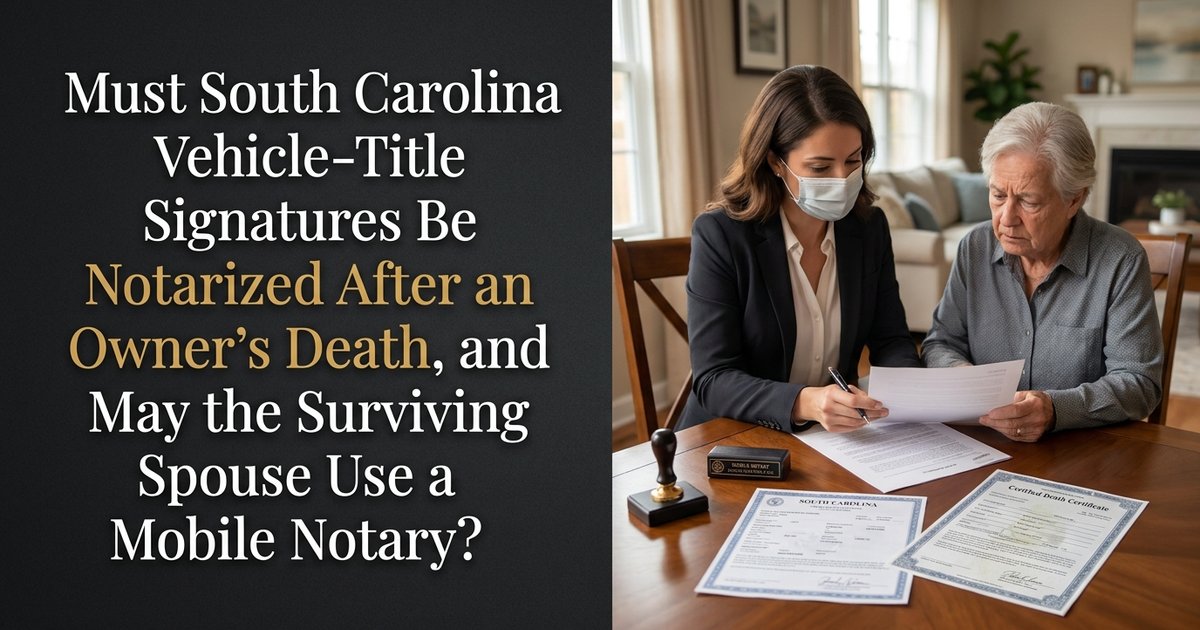
Do the title signatures for a deceased person’s vehicle transfer need to be notarized, and can a mobile notary be used if the surviving spouse can’t travel? – South Carolina
Short Answer
South Carolina generally does not require notarization of the ordinary seller and buyer signatures on a vehicle title. However, a separate affidavit or other supporting document must be notarized if it contains a notarial certificate or expressly requires notarization. A South Carolina mobile notary may travel to the surviving spouse, provided the proper signer personally appears before the notary with acceptable identification.
Understanding the Problem
The narrow question is whether a surviving spouse or other authorized successor must notarize vehicle-transfer signatures after a South Carolina Probate Court has certified a small-estate collection affidavit, and whether the required signing can occur at the spouse’s location when travel is not possible. The answer depends on which person the affidavit authorizes to act and whether the particular title or supporting document includes a notarial certificate.
Apply the Law
South Carolina separates probate authority from the mechanics of transferring a vehicle title. The certified collection affidavit establishes the claiming successor’s authority to collect the estate property. The South Carolina Department of Motor Vehicles then requires the last title, if available, proof of the transfer, a title application, and any other documents applicable to the transaction. Ordinary title-assignment signatures generally do not require notarization, but any document containing an acknowledgment, jurat, or other notarial certificate must be completed before a notary.
Key Requirements
- Authority to sign: The person identified as the claiming successor in the certified collection affidavit should sign for the deceased owner in the capacity accepted by the Department of Motor Vehicles. A person merely helping with the estate should not sign unless that person has documented authority.
- Correct title assignment: The authorized signer must complete the seller or transferor section without signing the deceased person’s name as though the deceased person were still living. The purchaser or surviving spouse completes the new-owner portions required for that transfer.
- Notarization only when required: A normal South Carolina title assignment generally needs signatures but not notarization. A separate affidavit or form with notarial wording must be signed as that wording directs.
- Valid personal appearance: For a paper notarization, the signer must physically appear before the notary, present satisfactory identification, and sign a complete document. A mobile notary can satisfy this requirement by traveling to the signer.
What the Statutes Say
- S.C. Code § 62-3-1201 (Collection of Personal Property by Affidavit) – permits a qualified successor to collect personal property through a probate-approved affidavit after 30 days when the net probate estate does not exceed $45,000.
- S.C. Code § 62-3-1202 (Effect of Collection Affidavit) – protects a person or agency that transfers property in reliance on a valid collection affidavit.
- S.C. Code § 56-19-390 (Procedures for Involuntary Transfer or Repossession) – requires the transferee to provide the last title, if available, proof of transfer, and the prescribed title application promptly.
- S.C. Code § 56-19-360 (Voluntary Vehicle Transfers) – requires proper execution and delivery of the title assignment when a vehicle is transferred to a purchaser.
- S.C. Code § 26-1-90 (Powers of Notary Public) – requires the signer’s presence, satisfactory identification, a complete document, and a disinterested notary.
- S.C. Code § 56-3-1270 (Registration After Transfer) – generally requires the new owner to apply for South Carolina registration and a license plate within 30 days after ownership transfers.
Analysis
Apply the Rule to the Facts: Because the Probate Court approved and countersigned the collection affidavit, the person identified in that affidavit has evidence of authority to handle the two vehicles. That person should execute the transferor portions in the representative capacity accepted by the Department of Motor Vehicles, while the third-party purchaser and surviving spouse complete their respective new-owner sections. Nothing in the stated facts creates a separate requirement to notarize the ordinary title signatures.
If a supporting affidavit or other required document includes notarial wording, the surviving spouse does not need to travel to a bank, office, or government location. A commissioned South Carolina mobile notary may meet the spouse at a residence, care setting, or another suitable location within South Carolina. The notary must verify identity, observe the required signature, assess willingness and basic understanding, and complete the notarial certificate.
For additional background on the probate documents commonly used in this process, see transferring a South Carolina vehicle through a collection affidavit.
Process & Timing
- Who files: The person receiving each vehicle or that person’s authorized representative. Where: The South Carolina Department of Motor Vehicles. What: The last title, if available, the prescribed title application, the certified collection affidavit, and any additional ownership or lien documents required for that vehicle. When: Submit the title paperwork promptly; an application for South Carolina registration and a license plate is generally due within 30 days after the transfer.
- Complete each transfer separately: The authorized successor signs the transferor section for the vehicle being sold, and the purchaser completes the buyer section. For the second vehicle, the surviving spouse completes the new-owner section. The Department of Motor Vehicles may request corrections or additional proof if the title, affidavit, and ownership names do not match.
- Close the estate: After both transfers have been accepted and the estate property has been distributed, file any final or closing affidavit required by the Probate Court that handled the small estate. The form and review time can vary by county.
Exceptions & Pitfalls
- A lien, missing title, altered title, out-of-state title, or mismatch between the title and collection affidavit can require additional documents and may change the signing instructions.
- The person named as successor should confirm the Department of Motor Vehicles’ preferred signature format before writing on the original title. Signing in the wrong location, using correction fluid, or crossing out information can lead to a duplicate-title requirement.
- A notary cannot notarize a blank or incomplete document. The signer must personally appear with current government-issued identification unless another legally sufficient identification method applies.
- The notary cannot be a signer, party, or beneficiary of the document. A family member who will receive the vehicle should not notarize the transaction.
- A mobile notary provides convenience but does not replace probate authority. The notary verifies the signing; the notary does not decide who inherited the vehicle or complete the legal forms for the parties.
- The title’s exact ownership language matters. Multiple names connected by “and,” “or,” or survivorship wording can affect whether the vehicle belongs to the probate estate and who must sign.
Conclusion
South Carolina generally does not require notarization of ordinary vehicle-title assignment signatures, but any supporting document containing a notarial certificate must be notarized. A mobile notary may travel to the surviving spouse if the signer personally appears, provides satisfactory identification, and signs a complete document. The authorized successor—not merely someone assisting the family—must execute the estate’s transfer. Submit each title package to the South Carolina Department of Motor Vehicles promptly and apply for registration within 30 days after transfer.
Talk to a Probate Attorney
If a family is completing vehicle transfers under a South Carolina small-estate affidavit, our firm has experienced attorneys who can help clarify signing authority, document requirements, and filing timelines.
Disclaimer: This article provides general information about South Carolina law based on the single question stated above. It is not legal advice for your specific situation and does not create an attorney-client relationship. Laws, procedures, and local practice can change and may vary by county. If you have a deadline, act promptly and speak with a licensed South Carolina attorney.

