
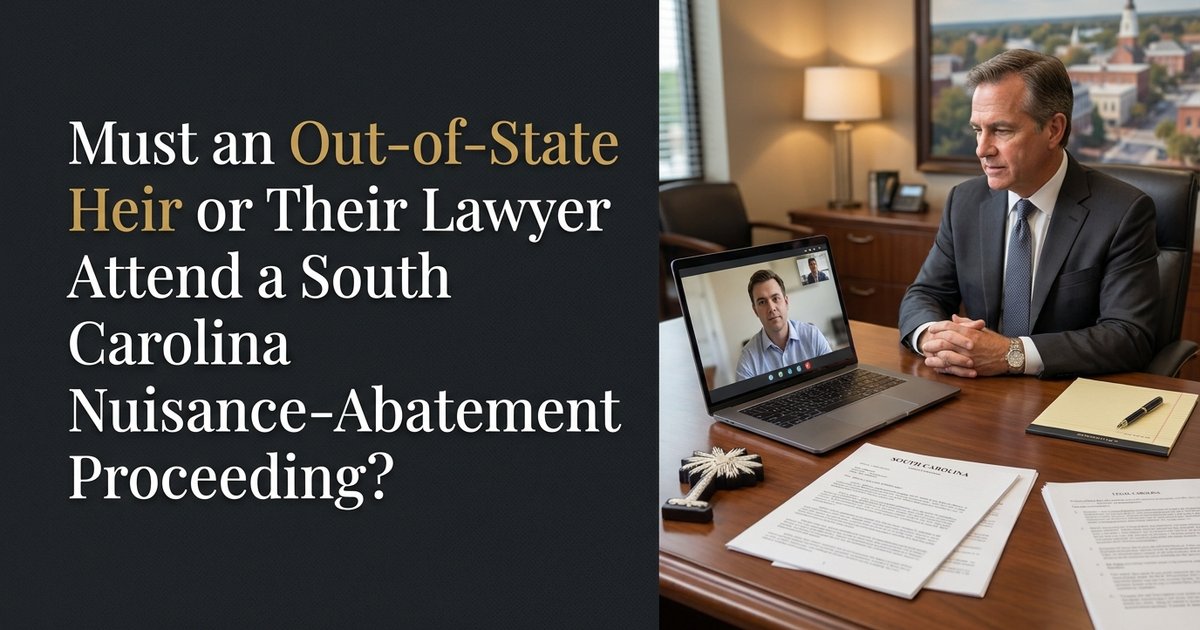
Do I or my lawyer have to appear for a nuisance-abatement proceeding involving inherited property if I live out of state? – South Carolina
Short Answer
South Carolina law does not impose one appearance rule for every nuisance-abatement proceeding. The notice, local ordinance, and any hearing order control whether an out-of-state heir must attend personally, may appear through a South Carolina lawyer, or may request remote participation. Ignoring the proceeding can allow the agency to issue an order, correct the conditions, or place permitted costs against the property.
Understanding the Problem
Must an out-of-state South Carolina heir personally attend a nuisance-abatement hearing concerning inherited property, or can a lawyer respond and appear instead? The answer depends on the type of proceeding, the instructions and deadline in the government notice, whether the heir is a record owner or other party in interest, and whether the hearing officer requires testimony.
Apply the Law
South Carolina gives municipalities and counties authority to address debris, unsafe dwellings, and other conditions that qualify as public nuisances. These proceedings commonly take place before the local official, hearing officer, board, or court identified in the notice. Some statutes allow an owner or interested party to appear “in person or otherwise,” but local procedures determine whether that includes appearance through counsel, a written submission, or video participation.
Key Requirements
- Determine the type of proceeding: A code-enforcement conference, unsafe-dwelling hearing, civil nuisance lawsuit, and criminal proceeding have different appearance rules.
- Confirm the recipient’s legal interest: Deeds, probate filings, and estate documents help establish whether the heir, the estate, a surviving spouse, or several co-owners must receive notice and respond.
- Follow the notice and hearing order: The stated response date, hearing date, method of appearance, and instructions for requesting remote participation control unless the issuing authority approves another arrangement.
- Arrange representation correctly: A South Carolina lawyer can often communicate with the agency and appear in a civil or administrative matter, but counsel should obtain confirmation if the heir plans not to attend.
- Preserve evidence and defenses: The responding party should document ownership, occupancy, attempts to inspect the property, corrective work, and any inability to gain access from an occupant.
For municipal or county unsafe-dwelling proceedings conducted under an ordinance that includes the statutory procedures, the hearing generally must be scheduled no fewer than ten and no more than thirty days after service of the complaint. A different statutory nuisance action involving the specific nuisances addressed in S.C. Code § 15-43-120 may require ten days’ written notice and an opportunity to abate before proceedings begin. The exact local ordinance and notice must be reviewed because not every nuisance matter follows these statutes.
What the Statutes Say
- S.C. Code § 5-7-80 (Municipal property upkeep) – Allows municipalities to require removal of rubbish, debris, and unhealthy conditions and to make authorized correction costs a lien against the property.
- S.C. Code § 31-15-30 (Municipal unfit-dwelling proceedings) – Authorizes a hearing between ten and thirty days after service and permits owners and interested parties to answer and appear in person or otherwise.
- S.C. Code § 31-15-330 (County unfit-dwelling proceedings) – Provides similar notice, hearing, and appearance procedures for qualifying county ordinances.
- S.C. Code § 15-43-120 (Notice before statutory nuisance action involving the nuisances addressed in that chapter) – Requires ten days’ written notice to the owner or agent before an action under that nuisance chapter begins.
- S.C. Code § 15-61-10 (Partition of co-owned property) – Allows qualifying co-owners to seek partition and requires a preliminary determination of whether the property is heirs’ property.
Analysis
Apply the Rule to the Facts: The out-of-state heir should not assume that personal travel is required, but neither the heirs’ agreement to sell nor the possible interest of an uncooperative surviving spouse excuses a response. Counsel must first identify the proceeding, confirm who received notice, and determine whether the issuing authority will accept an attorney appearance, written response, or remote attendance. Evidence about the occupant and efforts to inspect or correct the conditions may matter, but uncertain access does not automatically stop abatement.
The proposed sale or partition is separate from the nuisance matter. A South Carolina partition action may address the ownership interests and the uncooperative or missing occupant, but filing that case does not ordinarily suspend a nuisance deadline. More information about handling an absent or objecting co-owner appears in this discussion of moving forward with a South Carolina partition case when a co-owner cannot be found or objects.
Process & Timing
- Who files: The heir, estate representative, record owner, or South Carolina lawyer acting for the proper party. Where: The local agency, hearing officer, board, or court named in the notice. What: A written answer, hearing request, notice of representation, request for remote appearance, and supporting property records, as required. When: By the response deadline printed in the notice; an unsafe-dwelling hearing under the cited statutes may occur 10 to 30 days after service.
- Confirm appearance arrangements: Counsel should obtain written confirmation that the lawyer may appear without the heir or that the heir may participate remotely. The request should be made promptly rather than on the hearing date.
- Attend and obtain the ruling: The authorized participant should present the ownership, access, and correction evidence. Afterward, counsel should obtain the written decision and calendar every deadline for repairs, review, or appeal.
Exceptions & Pitfalls
- A subpoena, hearing order, or demand for first-hand testimony may require the heir’s personal or approved remote appearance even when a lawyer represents the heir.
- An emergency involving an immediate danger may permit faster government action and may limit whether an appeal pauses corrective work.
- Failing to appear may lead to a decision based only on the agency’s evidence. The government may then order cleanup, closure, repair, or demolition and may impose authorized costs against the property.
- Hiring a lawyer does not automatically excuse personal attendance. The agency or court should confirm the arrangement in writing.
- The occupant’s refusal to cooperate does not necessarily defeat the nuisance claim. The owner should document access requests, communications, inspections, and proposed corrective work.
- A partition complaint must address all parties claiming an ownership interest. If a party cannot be located after diligent efforts, court-approved alternative service may be available, but that process does not replace the response required in the nuisance matter.
Conclusion
An out-of-state heir does not automatically have to travel to South Carolina for every nuisance-abatement proceeding. The notice, governing ordinance, and hearing order determine whether counsel may appear alone or whether the heir must attend personally or remotely. Because an unsafe-dwelling hearing may occur 10 to 30 days after service and nonappearance can lead to an adverse order, the next step is to have South Carolina counsel file the required response and request approved appearance arrangements by the deadline stated in the notice.
Talk to a Partition Action Attorney
If an inherited property faces nuisance proceedings while ownership, occupancy, or a sale remains unresolved, our firm has experienced attorneys who can help clarify the parties’ interests, communicate with the issuing authority, and address the available appearance and partition options.
Disclaimer: This article provides general information about South Carolina law based on the single question stated above. It is not legal advice for your specific situation and does not create an attorney-client relationship. Laws, procedures, and local practice can change and may vary by county. If you have a deadline, act promptly and speak with a licensed South Carolina attorney.

