
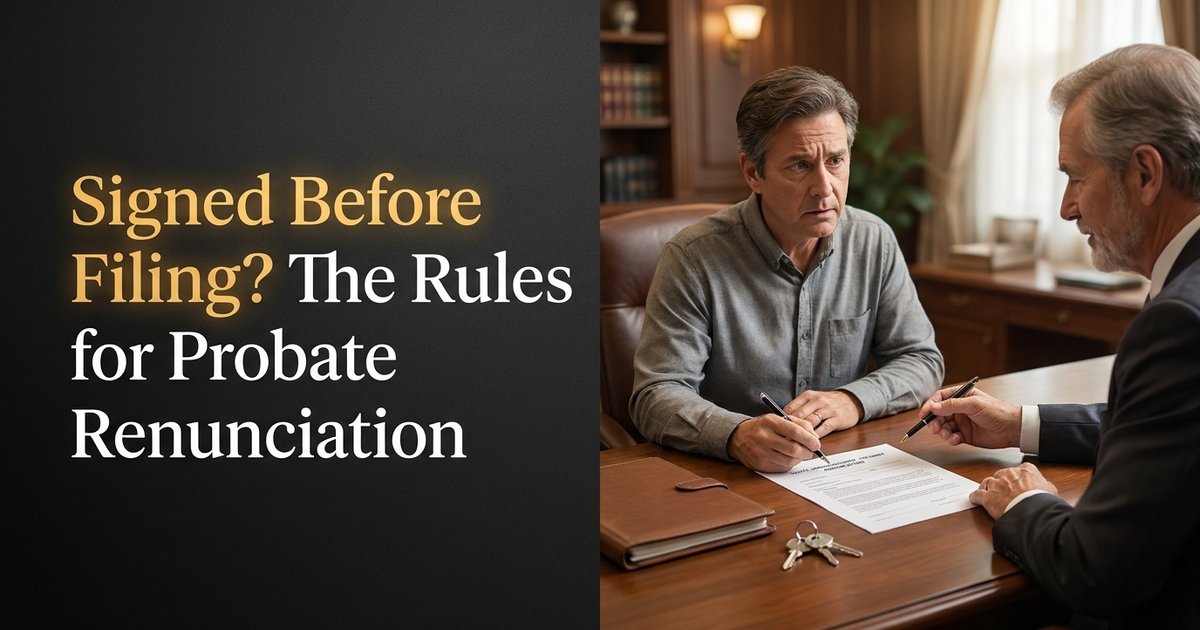
Can renunciation paperwork be signed before it is filed in probate court? – South Carolina
Short Answer
Yes. In South Carolina, a person generally signs probate renunciation paperwork before someone files it with the Probate Court. However, signing alone does not complete a written waiver that must be filed, and an agent should not sign under a power of attorney unless the document grants the necessary authority and the court accepts that method of signing.
Understanding the Problem
In South Carolina probate, can a person with priority to serve as personal representative sign a renunciation before the document is submitted to the Probate Court handling the estate? The issue concerns the order of signing and filing, including whether an agent may sign when the person acts through a power of attorney.
Apply the Law
South Carolina law gives certain people priority to serve as personal representative. A person with priority may provide a written renunciation or waiver so another qualified person can seek appointment. The renunciation is normally executed first and then filed with the Probate Court in the county where the estate proceeding is pending. If a person with equal appointment priority has not filed a written waiver, the applicant generally must give that person notice and wait through the statutory 30-day response period.
Key Requirements
- Correct document: The document should clearly renounce the signer’s right to serve, nominate another person if intended, or waive bond if applicable. South Carolina commonly uses Form 302ES, Renunciation of Right to Administration and/or Nomination and/or Waiver of Bond.
- Proper execution: The person should sign and date the completed document and follow every witness or notarization instruction shown on the form. A blank or incomplete form should not be signed.
- Filing with the correct court: After execution, the original or an accepted electronic version must reach the Probate Court handling the estate. A signed form kept at home or in an office does not satisfy a requirement that the waiver be filed.
- Authority to sign: When an agent proposes to sign under a power of attorney, the power of attorney must be valid and contain authority broad enough for the particular renunciation. The agent may also need to provide the power of attorney or other proof of authority to the court.
What the Statutes Say
- S.C. Code § 62-3-203 (Priority for Appointment) – Establishes the order of priority for appointment as personal representative and permits certain people with priority to nominate another person.
- S.C. Code § 62-3-310 (Notice of Informal Appointment) – Requires notice to a person with an equal right to appointment unless that right has been waived in writing and the waiver has been filed with the court.
- S.C. Code § 62-8-201 (Authority Requiring a Specific Grant) – Requires express power-of-attorney authority for certain significant acts, including disclaiming property, exercising delegable fiduciary powers, or renouncing a share from an estate.
Analysis
Apply the Rule to the Facts: The individual involved in the grandparent’s estate may generally sign a properly completed renunciation before it is filed. The person preparing the estate filing can then submit the signed document to the Probate Court. If someone else proposes to sign for the individual, the power of attorney must be reviewed because authority to manage routine affairs does not automatically establish authority for every probate renunciation.
Process & Timing
- Who files: The person seeking appointment, that person’s representative, or another authorized filer. Where: The Probate Court handling the deceased person’s estate. What: The completed Form 302ES or other court-approved written renunciation, together with any required application or petition. When: It may be signed before filing and is often submitted with the appointment papers.
- The Probate Court reviews the document to confirm the signer’s identity, appointment priority, selections on the form, and compliance with execution requirements. Local filing procedures can vary by county.
- If all people with equal priority provide filed written waivers, the court may process the application without waiting for their responses. Otherwise, South Carolina’s informal appointment procedure generally provides 30 days from the mailing of the application and notice for an objection, nomination, or competing filing.
Exceptions & Pitfalls
- A renunciation of the right to serve as personal representative is not necessarily a disclaimer of an inheritance. Giving up estate property involves different rules, and an agent needs express authority under the power of attorney to disclaim property or renounce a beneficial share. A tax attorney or CPA should address any potential tax consequences.
- A signature by an agent may be rejected if the power of attorney lacks the necessary language, has ended, or does not satisfy applicable execution requirements. The court may request the original power of attorney, a copy, or an agent certification.
- Signing the wrong option on a multipurpose form can unintentionally nominate another person or waive bond. Each checked provision should be reviewed before signing.
- A person who has already accepted appointment as personal representative generally follows a resignation or removal process rather than a pre-appointment renunciation. Additional information appears in this article about renouncing or resigning as personal representative in South Carolina.
- Submitting an unsigned copy, omitting required notarization, or keeping the signed original without filing it can delay the appointment process.
Conclusion
South Carolina probate renunciation paperwork can usually be signed before it is filed, and signing first is the normal sequence. The document must identify the right being renounced, satisfy the form’s execution requirements, and reach the Probate Court before it functions as a filed waiver. Have the correct person execute the completed form and file it with the Probate Court handling the estate before the appointment application is processed or, if notice has issued, within the applicable 30-day response period.
Talk to a Probate Attorney
If a probate renunciation is being prepared or someone may need to sign through a power of attorney, our firm has experienced attorneys who can help clarify the proper document, signing requirements, and filing timeline.
Disclaimer: This article provides general information about South Carolina law based on the single question stated above. It is not legal advice for your specific situation and does not create an attorney-client relationship. Laws, procedures, and local practice can change and may vary by county. If you have a deadline, act promptly and speak with a licensed South Carolina attorney.

