
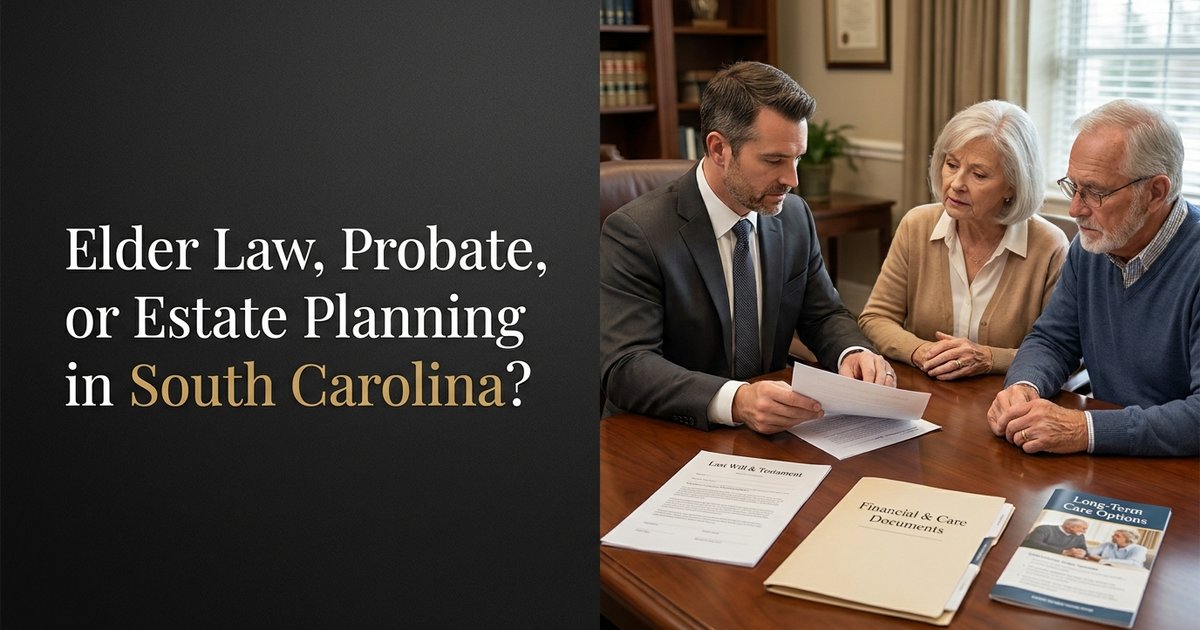
How do I know whether my situation is an elder law issue or a probate or estate planning issue? – South Carolina
Short Answer
The main goal and timing usually determine the practice area. Estate planning prepares for incapacity and death, probate administers a person’s estate after death, and elder law commonly addresses long-term care, Medicaid, government benefits, exploitation, or decision-making for an older or vulnerable adult. These areas overlap, so a law firm may need a brief description of the problem before deciding whether it handles the matter.
Understanding the Problem
In South Carolina, the decision is whether a prospective client needs documents for future planning, help administering an estate after a death, or guidance about an older adult’s present care, benefits, protection, or decision-making needs. Asking whether a firm “handles elder law” may not provide enough information because law firms define that service differently. The underlying goal, the person affected, and whether a death or loss of capacity has occurred usually control where the matter belongs.
Apply the Law
South Carolina does not assign every legal concern involving an older adult to a separate “elder law” court. Instead, the type of relief determines the governing law and forum. Estate planning usually occurs outside court and may include wills, trusts, financial powers of attorney, health care powers of attorney, and coordination of asset ownership and beneficiary designations. A person interested in these documents can review common South Carolina estate planning documents for additional background.
Probate administration begins after death. It usually involves presenting a will, obtaining authority for a personal representative, identifying estate property, addressing valid claims, and distributing the remaining property. The Probate Court in the county where the deceased person lived generally handles the estate.
Elder law often focuses on problems arising during an older or vulnerable adult’s lifetime. Examples include Medicaid eligibility for long-term care, nursing-facility concerns, government benefits, financial exploitation, special needs planning, guardianship, and conservatorship. Some of these matters also involve the Probate Court, but that does not automatically make them ordinary probate administration.
Key Requirements
- Identify the primary goal: Preparing documents for future incapacity or death usually points to estate planning. Addressing current long-term care, public benefits, or protection needs often points to elder law.
- Identify the timing: A matter involving a living person’s plan is generally estate planning or elder law. A matter involving property and obligations after death is generally probate administration.
- Identify the legal task: Medicaid planning, benefits eligibility, or long-term-care financing may require elder law services even when a will or power of attorney is also needed.
- Identify any capacity concern: If a person can still understand and sign appropriate documents, planning may avoid a court proceeding. If the person cannot manage personal or financial affairs and existing documents do not provide a solution, a guardianship or conservatorship petition may be necessary.
What the Statutes Say
- S.C. Code Ann. § 62-1-302 (Probate Court jurisdiction) – Gives the Probate Court jurisdiction over deceased estates, guardianships, protective proceedings, trusts, and certain special needs trusts.
- S.C. Code Ann. § 62-8-105 (Execution of a financial power of attorney) – Requires the principal’s signature, will-level witnessing formalities, and acknowledgment or proof.
- S.C. Code Ann. § 62-5-503 (Health care power of attorney requirements) – Establishes signing, witness, and health care agent requirements.
- S.C. Code Ann. § 62-5-303 (Adult guardianship petition) – Requires a petition to explain the alleged incapacity, requested authority, and why less restrictive options are not appropriate.
- S.C. Code Ann. § 62-5-403 (Conservatorship and protective proceedings) – Governs requests to protect the property of a person who cannot manage financial affairs effectively.
- S.C. Code Ann. § 43-7-460 (Medicaid estate recovery) – Authorizes recovery of certain Medicaid payments from qualifying estates, subject to statutory limits and hardship provisions.
Analysis
Apply the Rule to the Facts: The prospective client asked only whether the firm accepts new clients and handles elder law. Those facts do not reveal the primary goal, whether anyone has died, whether long-term-care benefits are involved, or whether a person lacks decision-making capacity. The matter therefore cannot be classified by the label alone; the firm would need a short description of the requested legal task.
If the caller wants a will, trust, financial power of attorney, or health care directive for a living person, the issue likely falls within estate planning. If someone has died and the caller needs authority to collect assets, pay claims, or distribute property, it likely falls within probate administration. If the concern involves Medicaid eligibility, payment for long-term care, exploitation, or court protection for an incapacitated adult, it likely calls for elder law or a closely related guardianship practice.
Process & Timing
- Who files: No one must file anything merely to classify the matter. Where: Initial screening occurs with the law firm. What: The caller should identify whether the request concerns planning documents, a death, long-term care, benefits, exploitation, or incapacity. When: Capacity-related planning should occur while the person can understand and execute the necessary documents.
- If it is estate planning: The client and attorney review goals, family circumstances, asset ownership, existing documents, and beneficiary designations. The attorney then prepares and supervises the signing of the appropriate documents. Asset ownership and beneficiary designations matter because a will or trust may not control every asset.
- If it is probate: An interested person generally applies to the South Carolina Probate Court in the county where the deceased person lived. An informal probate or appointment application ordinarily must fall within the statutory 10-year outer limit stated in S.C. Code Ann. § 62-3-108, although waiting can create practical problems and exceptions are limited.
- If it is elder law: The attorney first determines whether the matter concerns long-term-care benefits, an agency application, protective action, or a Probate Court petition. Medicaid and government-benefit rules can change, and eligibility questions may depend on the applicant’s finances, transfers, care setting, and family circumstances.
Exceptions & Pitfalls
- One situation may involve more than one field: A long-term-care plan may require estate planning documents, while a deceased Medicaid recipient’s estate may involve both probate administration and estate-recovery rules.
- Age alone does not decide the category: An older adult seeking a routine will may have an estate planning matter, while a younger person with a disability may need benefits or special needs planning.
- A power of attorney is not a substitute for every court proceeding: Its scope and validity must be reviewed. If no adequate document exists and the person cannot manage personal or financial affairs, guardianship or conservatorship may be considered.
- Do not transfer assets based on general Medicaid information: Transfers can affect benefits and later estate recovery. Advice should address the specific program and current rules.
- Do not assume a will controls every asset: Joint ownership, beneficiary designations, and trust ownership may determine how property passes. Estate planning should coordinate those arrangements with the written documents.
Conclusion
A South Carolina matter generally involves estate planning when the goal is to prepare for incapacity or death, probate when someone has died and the estate needs administration, and elder law when the central concern is long-term care, Medicaid, benefits, exploitation, or protection of a vulnerable adult. Overlap is common, especially with guardianships and Medicaid estate recovery. As the next step, provide the law firm with a brief statement identifying the person affected, the requested result, and whether death, incapacity, or long-term care is involved.
Talk to an Estate Planning Attorney
If a legal concern could involve estate planning, probate administration, or elder law, our firm has experienced attorneys who can help determine whether the issue falls within the firm’s services and explain the available options and timelines.
Disclaimer: This article provides general information about South Carolina law based on the single question stated above. It is not legal advice for your specific situation and does not create an attorney-client relationship. Laws, procedures, and local practice can change and may vary by county. If you have a deadline, act promptly and speak with a licensed South Carolina attorney.

