
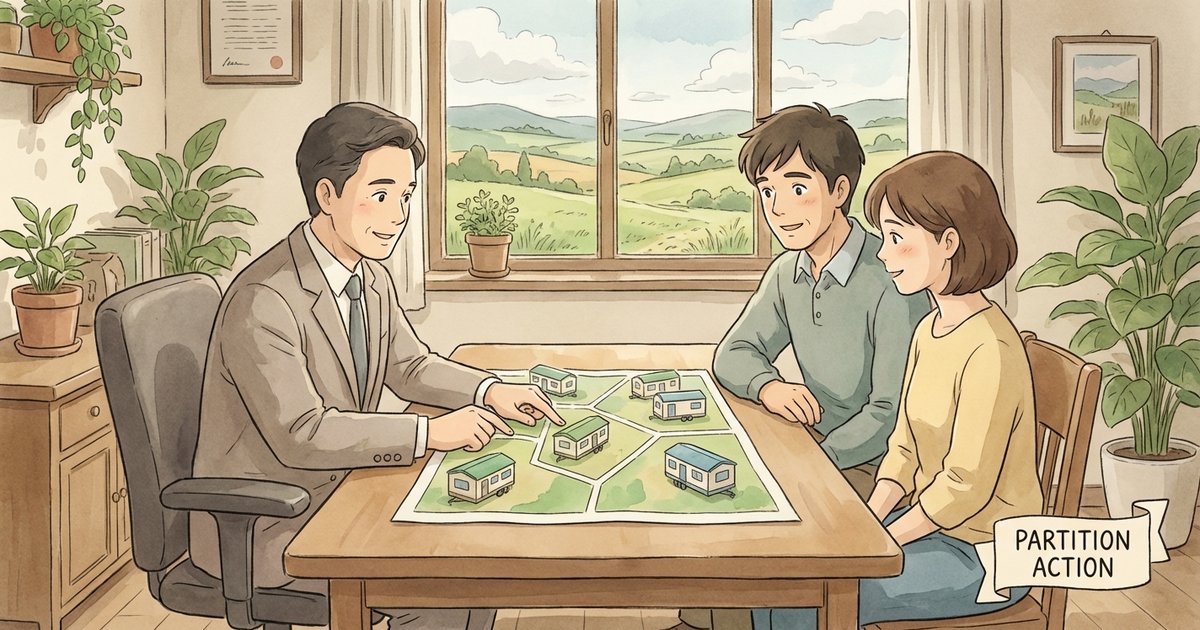
How can I proceed with a partition when the land is split into separate nearby parcels and includes mobile homes? – South Carolina
Short Answer
In South Carolina, a partition case can address co-owned property even when it consists of multiple nearby parcels, but the court must still decide whether a fair division “in kind” is practical or whether a sale is necessary. Mobile homes add an extra step because the court needs to know whether each home is treated as part of the real estate (title retired and affixed) or as personal property (titled like a vehicle). The cleanest path usually starts with confirming the deeded parcels, ownership percentages, and the legal status of each mobile home, then filing a partition action in the Court of Common Pleas.
Understanding the Problem
In South Carolina, can co-owners force a partition when the shared property is not one continuous tract, but instead is split into separate nearby parcels, and some parcels have mobile homes on them? The decision point is how the Court of Common Pleas should divide (or sell) the co-owned interests when the “property” is really a bundle of parcels and improvements, and when some improvements may be legally personal property rather than real estate.
Apply the Law
South Carolina partition cases are handled in the Court of Common Pleas. The court has authority to order a physical division (partition in kind), an allotment to one or more owners with an equalizing payment, or a sale with proceeds divided by ownership shares when a fair in-kind division cannot be made without injury to the parties’ interests. When the property qualifies as “heirs’ property,” South Carolina’s heirs’ property partition rules can add steps such as a court-determined value, a cotenant buyout option, and a preference for partition in kind unless it would cause “manifest prejudice” to the cotenants as a group.
Key Requirements
- Co-ownership exists: The parcels must be held in joint tenancy or tenancy in common (for example, multiple names on deeds, or inherited interests after a death).
- The court must choose a fair remedy: The court evaluates whether the land can be divided fairly (including using surveys and proposed divisions) or whether a sale is required to avoid unfairness.
- Mobile homes must be classified correctly: A mobile/manufactured home may be treated as real property only if it has been properly affixed and the title has been retired by filing the required affidavit in the county land records; otherwise, it is typically treated as personal property, which can change what gets partitioned and how value is handled.
What the Statutes Say
- S.C. Code Ann. § 15-61-50 (Partition jurisdiction; in kind, allotment, or sale) – gives the Court of Common Pleas power to partition co-owned real and personal property, including by sale when a fair in-kind partition cannot be made without injury.
- S.C. Code Ann. § 15-61-350 (Partition procedure; testimony; commissioners under Rule 71) – allows the court to decide practicability of in-kind partition and to order sale when needed; addresses use of commissioners when appointed.
- S.C. Code Ann. § 15-61-370 (Heirs’ property buyout process) – if a cotenant requests a sale in an heirs’ property case, other cotenants may elect to buy those sale-requesting interests, with specific timing requirements (including notice of intent to buy no later than ten days before trial and a payment date not sooner than sixty days after notice).
- S.C. Code Ann. § 15-61-380 (Heirs’ property preference for partition in kind; owelty) – directs the court to order partition in kind unless it would cause manifest prejudice, and allows equalizing payments to make the split proportionate in value.
- S.C. Code Ann. § 15-61-400 (Heirs’ property sale method) – if the court orders a sale of heirs’ property, it generally must be an open-market sale unless another method is better for the group.
- S.C. Code Ann. § 56-19-510 (Affixing manufactured home; retirement of title affidavit) – explains how an owner can affix a manufactured home to real property by removing transport components and recording the required affidavit, after which it is treated as real property (with stated exceptions).
Analysis
Apply the Rule to the Facts: When co-owned land is split into separate nearby parcels, the partition case usually turns on whether the parcels can be divided so each owner receives a fair share of overall value, not just acreage. If one parcel has better road access or utilities, a “simple” split may be unfair unless the court orders an equalizing payment or a different configuration. Mobile homes matter because a home with a properly retired title and recorded affidavit may be treated as part of the real estate, while a titled home may need to be handled separately from the land when the court divides or sells.
Process & Timing
- Who files: Any cotenant (co-owner). Where: South Carolina Court of Common Pleas in the county where the land is located. What: A summons and complaint for partition describing each parcel (tax map numbers and legal descriptions) and naming all owners and lienholders. When: There is no single “partition deadline,” but timing becomes critical if a cotenant is trying to stop a pending transfer, prevent waste, or address a looming sale or foreclosure.
- Early case work (often the make-or-break step): confirm the chain of title for each parcel, identify every cotenant and percentage, and determine whether the case is “heirs’ property.” For mobile homes, check whether a Manufactured Home Affidavit for the Retirement of Title Certificate was recorded in the county land records; if not, the home may still be personal property, and liens may exist on the title.
- Propose the remedy: if a fair split is possible, present a survey-based division plan (often with proposed boundary lines and access) and, if needed, request an equalizing payment so each share is proportionate in value. If a fair split is not practical, request a sale and division of proceeds; in heirs’ property cases, be prepared for valuation, buyout elections, and a court-supervised sale method.
Exceptions & Pitfalls
- Assuming all parcels must be split the same way: separate nearby parcels can have very different values. A workable plan often requires grouping parcels, trading acreage for value, or using an equalizing payment rather than drawing one straight line.
- Not clarifying whether the mobile home is real property: if the title was never retired and the affidavit was not recorded, the home may not transfer with the land in the way people expect. If the title was retired, the affidavit can change ownership treatment and how liens attach.
- Overlooking liens and access issues: mortgages, judgment liens, and easements can affect whether a parcel can be awarded to one owner or must be sold. Landlocked parcels or shared driveways can require easements as part of any practical in-kind division.
Conclusion
In South Carolina, a partition can move forward even when co-owned land consists of separate nearby parcels and includes mobile homes, but the court must still choose a fair remedy: partition in kind/allotment (sometimes with an equalizing payment) or a sale with proceeds divided by ownership shares. A key early step is confirming whether each mobile home is treated as real property through a properly recorded title-retirement affidavit. The next step is to file a partition complaint in the Court of Common Pleas in the county where the land sits and be ready to meet any heirs’ property buyout deadlines, including the ten-day pretrial notice rule when it applies.
Talk to a Partition Action Attorney
If co-owners cannot agree on how to divide nearby parcels or how to handle mobile homes on the land, a partition action can provide a structured path to a fair division or a court-supervised sale. Our firm has experienced attorneys who can help identify the correct parcels and owners, clarify whether the mobile homes are real property or personal property, and map out the options and timelines in South Carolina.
Disclaimer: This article provides general information about South Carolina law based on the single question stated above. It is not legal advice for your specific situation and does not create an attorney-client relationship. Laws, procedures, and local practice can change and may vary by county. If you have a deadline, act promptly and speak with a licensed South Carolina attorney.

