
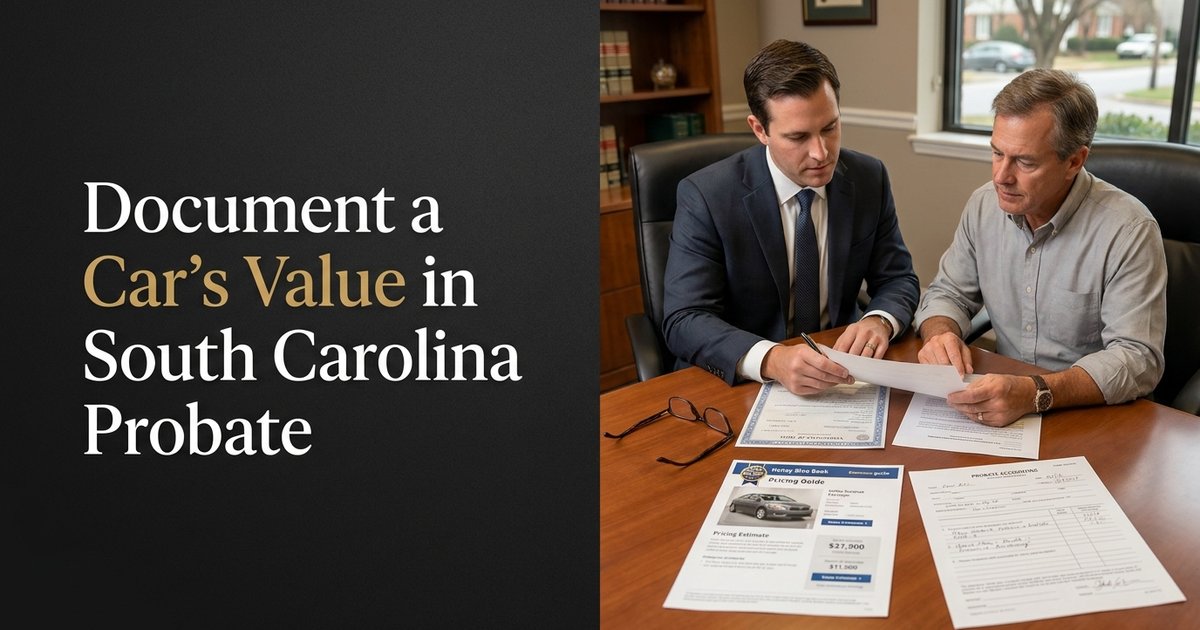
How do we document the value of a car (like using a pricing guide) so the probate accounting shows everyone received the correct percentage under the will? – South Carolina
Short Answer
In South Carolina probate, the personal representative should document the car’s fair market value with a clear valuation packet and show the transfer as an in-kind distribution charged against the receiving beneficiary’s percentage share. For the inventory, the value is generally the car’s fair market value as of the date of death; for an in-kind distribution, South Carolina law focuses on fair market value as of the date of distribution, unless the will provides a different method. A pricing guide can help, but the accounting should also include mileage, condition, VIN, photos, lien information, repair issues, and, when needed, a disinterested appraisal.
Understanding the Problem
In South Carolina probate, the personal representative must decide how to value a decedent’s vehicle before transferring it to one heir, then record that value so percentage-based gifts under the will remain equal or proportional. The key timing issue is that the creditor notice period is still open while the inventory and accounting are being prepared. The single issue is whether the car can be valued and documented well enough for the Probate Court accounting to show that the vehicle recipient received the correct share and that the trust share for minor beneficiaries is protected.
Apply the Law
South Carolina law treats the personal representative as a fiduciary. That means the personal representative must settle the estate according to the will, protect creditors, and make distributions in a way that is fair to the beneficiaries. A vehicle is probate personal property if it was titled in the decedent’s name and did not pass outside probate. The inventory should list it with reasonable detail and fair market value as of the date of death. If the vehicle is later transferred to one beneficiary as an early distribution, the accounting should show the distribution value, the date of transfer, and how that value is charged against that beneficiary’s percentage share.
A pricing guide can be part of the proof, but it should not stand alone when condition, mileage, damage, liens, or market changes matter. A strong valuation packet often includes the vehicle identification number, year, make, model, trim, odometer reading, title status, lien payoff or proof that no lien exists, photos, repair records, condition notes, pricing-guide printouts using the same options and mileage, and a written appraisal if anyone disputes value. For more background on vehicle valuation in this setting, see how to make sure a car is valued and distributed fairly under a South Carolina estate plan.
Key Requirements
- Use the correct valuation date: The inventory uses date-of-death fair market value. An in-kind distribution generally uses fair market value as of the distribution date unless the will says otherwise.
- Describe the vehicle clearly: The accounting should identify the vehicle by VIN, year, make, model, mileage, condition, and any lien or encumbrance.
- Support the number with proof: Pricing-guide printouts, photos, service records, lien payoff records, and a neutral appraisal help show that the number was reasonable.
- Charge the value against the correct share: The heir receiving the car should be credited with a distribution equal to the documented value, and the remaining cash or property should be adjusted so each beneficiary receives the will’s stated percentage.
- Protect creditors and minor beneficiaries: Because the creditor period is still open, the estate should keep enough reserves for unpaid or disputed claims, expenses, and court costs. A minor’s percentage share should be handled through the named trustee if the will creates a trust share.
What the Statutes Say
- S.C. Code Ann. § 62-3-703 (personal representative duties) – The personal representative must settle and distribute the estate according to the will and the South Carolina Probate Code.
- S.C. Code Ann. § 62-3-706 (inventory and appraisement) – Within 90 days after appointment, the personal representative must file an inventory listing probate property with fair market value as of the date of death and any encumbrance.
- S.C. Code Ann. § 62-3-707 (employment of appraisers) – The personal representative may use a qualified, disinterested appraiser to determine fair market value, and the Probate Court may require an appraisal on request.
- S.C. Code Ann. § 62-3-906 (distribution in kind and valuation) – In-kind distributions may be made at fair market value, and for assets without readily ascertainable values, a reasonable valuation within 30 days before distribution can control.
- S.C. Code Ann. § 62-3-907 (evidence of distribution in kind) – The personal representative should execute the necessary instrument to transfer personal property to the distributee.
- S.C. Code Ann. § 62-3-801 (notice to creditors) – The personal representative must publish notice to creditors once a week for three successive weeks, and creditors generally have eight months from first publication to present claims.
- S.C. Code Ann. § 62-3-1001 (accounting and settlement) – The personal representative must file a written accounting and proposal for distribution unless all interested persons waive those filings.
Analysis
Apply the Rule to the Facts: Because the estate is still in probate and the creditor notice period remains open, the personal representative should be careful about transferring the car before final settlement. The inventory should list the vehicle at date-of-death fair market value, while the early transfer should be shown in the accounting as an in-kind distribution at a supported distribution-date value. Since the will uses percentages and includes a trust share for minors, the accounting should charge the car’s value to the receiving heir and preserve the proper percentage share for the named trustee of the minor beneficiaries’ trust.
A practical example is a vehicle assigned to one heir at a documented fair market value. The accounting would show that heir as having already received that amount, then reduce that heir’s later cash distribution or other property distribution by the same amount. If the pricing guide assumes excellent condition but the vehicle has high mileage or repair needs, the personal representative should document those facts and consider an appraisal so the other beneficiaries can see why the chosen value is reasonable.
Process & Timing
- Who files: The personal representative. Where: The Probate Court in the South Carolina county where the estate is being administered. What: Inventory and Appraisement, any required interim or annual accounting, proposal for distribution, proof of publication, claim records, funeral-expense receipts, and the vehicle valuation packet. When: The inventory is due within 90 days after appointment unless the court grants more time.
- Build the vehicle valuation packet: Use the same valuation date consistently, save pricing-guide pages showing options and mileage, add photos and condition notes, list any lien or payoff, and keep repair or mechanic records. If beneficiaries disagree or the car has unusual condition issues, the personal representative may obtain a qualified, disinterested appraisal.
- Circulate a proposed distribution if appropriate: After probable estate charges are known, the personal representative may deliver a proposal for distribution to interested persons. If a person with the right to object does not object in writing within 30 days after mailing or delivery, the objection right can end under South Carolina law.
- Transfer and account for the car: The personal representative should sign the appropriate title-transfer documents and any estate distribution receipt or assignment for personal property. The accounting should show the car as a distribution to the receiving heir and offset that value against the heir’s percentage share.
- Complete settlement: When creditor issues, expenses, and any required accountings are ready, the personal representative files the settlement documents with the Probate Court. The final accounting should show each beneficiary’s percentage, prior distributions, remaining distributions, and any trust share paid or assigned to the named trustee.
Exceptions & Pitfalls
- The will may control the method: If the will gives the car specifically to one person, gives the personal representative a power of sale, or states a valuation method, that language can change the analysis.
- Date-of-death value and distribution value may differ: The inventory value and the in-kind distribution value serve different accounting purposes. Mixing them without explanation can make the percentage calculation unclear.
- A pricing guide may overstate or understate value: Condition, mileage, accident history, missing title paperwork, needed repairs, and local market limits can affect fair market value.
- Early distributions can create creditor risk: If the estate distributes the car before claims and expenses are fully known, the personal representative should keep enough assets in reserve to pay allowed claims and administration costs.
- Beneficiary consent helps but does not replace accounting: Written acknowledgments, waivers, or receipts can reduce later disputes, but the accounting should still show the math.
- Minor beneficiaries should not receive trust property directly: If the will creates a trust share for minors, the accounting should show the share allocated to the named trustee, not to the minors individually.
- Liens must be shown: A car with a loan or other encumbrance should be valued and accounted for with that obligation clearly identified, because net value may differ from guide value.
Conclusion
South Carolina probate accounting should document a car with a reliable fair market value, clear vehicle details, and proof supporting the number used. The inventory generally uses date-of-death value, while an early in-kind distribution should show the value charged against the receiving heir’s percentage share. The next step is for the personal representative to prepare the valuation packet and file or update the inventory/accounting with the Probate Court by the 90-day inventory deadline.
Talk to a Probate Attorney
If the estate needs to transfer a vehicle before final settlement while preserving percentage-based distributions, our firm has experienced attorneys who can help review the valuation proof, accounting entries, creditor timing, and trust-share issues.
Disclaimer: This article provides general information about South Carolina law based on the single question stated above. It is not legal advice for your specific situation and does not create an attorney-client relationship. Laws, procedures, and local practice can change and may vary by county. If you have a deadline, act promptly and speak with a licensed South Carolina attorney.

