
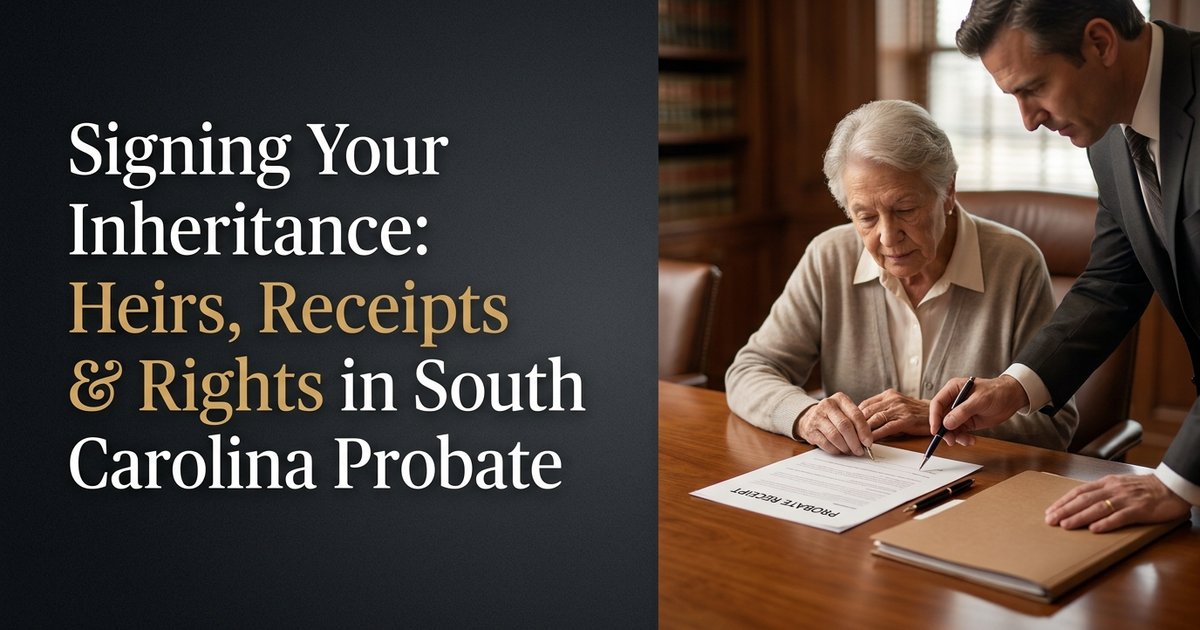
How do heirs receive their share of an estate, and do I have to sign something before the estate can be closed? – South Carolina
Short Answer
In South Carolina probate, heirs usually receive their share after the personal representative identifies estate assets, files an inventory, handles creditor claims and expenses, and either makes or proposes final distribution through the Probate Court. An heir may be asked to sign a receipt, release, waiver of accounting, or waiver of hearing, but signing is not always required for the estate to close. If an heir does not agree or does not understand the paperwork, the heir can refuse to sign, request copies, demand notice, and ask the Probate Court to require an accounting or hearing.
Understanding the Problem
In South Carolina, the key question is whether an heir can find out what happened in a parent’s probate estate, how distributions should be made, and whether a signature is required before the personal representative can close the estate. The issue usually turns on who was appointed by the Probate Court, what assets were part of the probate estate, whether the heir already signed a waiver or receipt, and whether the estate has reached the final accounting and distribution stage.
Apply the Law
South Carolina probate runs through the Probate Court in the county where the deceased person was domiciled. The person appointed to administer the estate is called the personal representative. That person must gather and protect probate assets, notify heirs and devisees, file an inventory, handle creditor claims, and distribute the remaining estate to the people entitled to receive it.
If there is a valid will, the will controls who receives probate property, subject to South Carolina law. If there is no will, South Carolina intestacy law controls. For example, if a parent dies without a surviving spouse, the children generally share the intestate estate equally. If the parent leaves a surviving spouse and children, the spouse receives one-half of the intestate estate and the children share the other half.
Distributions usually occur by check, transfer of personal property, deed or other transfer documents for real estate, or delivery of specific items. Before closing, the personal representative often asks beneficiaries to sign receipts showing they received their distributions. The personal representative may also ask beneficiaries to waive a final accounting, waive a hearing, or approve a proposed distribution. Those documents matter. A signature may give up the right to receive certain court filings or object before closing.
For a deeper look at closing requirements, see what steps must be completed before closing an estate in South Carolina and what the final accounting means in South Carolina probate.
Key Requirements
- Appointment of a personal representative: The Probate Court must appoint someone to manage the estate before that person has authority to collect probate assets and make distributions.
- Inventory and asset information: The personal representative must identify probate property, value it as of the date of death, list liens or encumbrances, and file the inventory within the required time unless the court extends the deadline.
- Creditor and expense handling: Estate expenses, allowed claims, and required administration costs generally come before heirs receive final distributions.
- Accounting or waiver: Before ordinary closing, the personal representative must file a full accounting and proposal for distribution unless all interested persons waive those filings.
- Receipts or court approval: Beneficiaries are commonly asked to sign receipts after receiving distributions, but the Probate Court may still approve settlement after proper notice and a hearing opportunity if someone does not sign.
What the Statutes Say
- S.C. Code Ann. § 62-3-705 (Information to heirs and devisees) – the personal representative must send appointment information to heirs and devisees within 30 days after appointment.
- S.C. Code Ann. § 62-3-706 (Inventory and appraisement) – the personal representative must file an inventory within 90 days after appointment and may have to provide a nonprobate property list after a proper demand.
- S.C. Code Ann. § 62-3-801 (Notice to creditors) – the personal representative must publish creditor notice, and published creditors generally have eight months from first publication to present claims.
- S.C. Code Ann. § 62-3-807 (Payment of claims) – allowed claims generally must be paid before closing and no later than 14 months after death unless the Probate Court extends the time.
- S.C. Code Ann. § 62-3-1001 (Settlement, accounting, and distribution) – the personal representative must file an application for settlement and, unless waived by all interested persons, accounting, proposal for distribution, and notice materials.
- S.C. Code Ann. § 62-3-204 (Demand for notice) – an interested person may file a demand for notice of estate orders or filings, and the demand generally lasts one year.
- S.C. Code Ann. § 62-2-102 (Intestate share of surviving spouse) – if there is no will, a surviving spouse receives all or one-half of the intestate estate depending on whether the deceased person left descendants.
- S.C. Code Ann. § 62-2-103 (Shares of heirs other than spouse) – if there is no will, children and other relatives inherit in the order set by South Carolina intestacy law.
Analysis
Apply the Rule to the Facts: Here, the parent died in South Carolina, and the heir does not know what assets exist because estate paperwork was removed from the home. The first step is to identify whether a Probate Court file exists and who, if anyone, was appointed as personal representative. If a relative already handled the estate, that person should have filed appointment papers, an inventory, creditor materials, and closing documents unless the estate used a limited or summary procedure. If the heir signed documents without understanding them, those papers may have been a receipt, release, waiver of accounting, waiver of hearing, consent to appointment, or approval of distribution, so copies are essential before deciding whether distributions were proper.
Process & Timing
- Who files: An heir or other interested person. Where: The Probate Court in the South Carolina county where the deceased parent was domiciled. What: Request copies of the estate file, including the application or petition for appointment, will if any, inventory and appraisement, accounting, proposal for distribution, receipts, waivers, and order closing the estate if entered. When: As soon as there is concern that documents were signed without understanding them or that assets were removed.
- Who files: An heir who wants future notice. Where: The same Probate Court. What: A demand for notice under South Carolina probate law. When: Any time after death, but the demand generally expires one year after filing.
- Who files: The personal representative. Where: The Probate Court. What: Inventory and appraisement, commonly using South Carolina probate inventory forms such as Form 350ES or a streamlined version when appropriate. When: Within 90 days after appointment unless the court grants more time.
- Who files: The personal representative. Where: The Probate Court. What: Accounting, proposal for distribution, application for settlement, proof of creditor notice, and proof that interested persons received notice of the right to demand a hearing, unless all interested persons waived the required filings. When: After the relevant creditor-claim and claim-disallowance periods have run, or after receipt of estate tax closing letters if state or federal estate tax returns were filed.
- Who files: An heir who disagrees or needs answers. Where: The Probate Court. What: A written demand for hearing after receiving notice, or a petition asking the court to require the personal representative to perform required duties. When: A demand for hearing must be filed within 30 days after the personal representative files proof that notice of the right to demand hearing was sent.
- Final step: The Probate Court may approve settlement, direct or approve distribution, terminate the personal representative’s appointment, and close the estate. If distributions were already made, the file should show receipts, waivers, an accounting, or a closing statement depending on the type of administration.
Exceptions & Pitfalls
- Signing a waiver can change the process: A waiver of accounting, waiver of proposal for distribution, or waiver of notice may allow the estate to close with fewer filings. A receipt may confirm that a distribution was received. Copies of signed documents should be reviewed before assuming what rights remain.
- A receipt is different from a waiver: A receipt usually proves delivery of property or funds. A waiver may give up the right to receive an accounting, demand a hearing, or object before closing. For more detail, see what paperwork and receipts South Carolina Probate Court may require before final distributions.
- Refusing to sign does not always stop closing: If the personal representative gives required notice and no timely demand for hearing is filed, the court may approve settlement after the statutory waiting period. If an objection exists, it should be filed in writing on time.
- Some assets may not pass through probate: Joint accounts, beneficiary-designated accounts, life insurance payable to a named beneficiary, and trust assets may pass outside the estate. The personal representative’s inventory focuses on probate assets, but an interested person can demand a list of known nonprobate property under the statute.
- Removed paperwork should be replaced through court records: If papers were taken from the home, the Probate Court file is often the best starting point. Certified copies may show who opened the estate, what was filed, and whether the estate has closed.
- Personal representative duties are enforceable: If the appointed person fails to file the inventory, accounting, proposal for distribution, or other required papers, an interested person may ask the Probate Court to compel action. The court may also address failure to comply with inventory duties.
- Closed estates have time limits: Claims against a personal representative for breach of fiduciary duty may be barred if not brought within the time set by South Carolina law after settlement filings, but claims involving fraud, misrepresentation, or inadequate disclosure may be treated differently. Delay can reduce options.
- Early distributions can create risk: A personal representative may distribute before final closing in some cases, but unpaid claims, expenses, or unresolved disputes can create problems. That is why the accounting, proposal for distribution, and receipts matter.
Conclusion
In South Carolina, heirs receive estate shares through the personal representative after probate assets are identified, creditor claims and expenses are handled, and the Probate Court process reaches distribution. A signature may be requested for a receipt, release, or waiver, but an heir should not sign unclear documents without copies and review. The next step is to request the Probate Court file in the county where the parent was domiciled and file any written demand for hearing within 30 days if notice has been given.
Talk to a Probate Attorney
If there are concerns about missing estate paperwork, unclear probate documents, or whether an inheritance was distributed, our firm has experienced attorneys who can help review the court file, explain signed documents, and identify available options and timelines.
Disclaimer: This article provides general information about South Carolina law based on the single question stated above. It is not legal advice for your specific situation and does not create an attorney-client relationship. Laws, procedures, and local practice can change and may vary by county. If you have a deadline, act promptly and speak with a licensed South Carolina attorney.

