
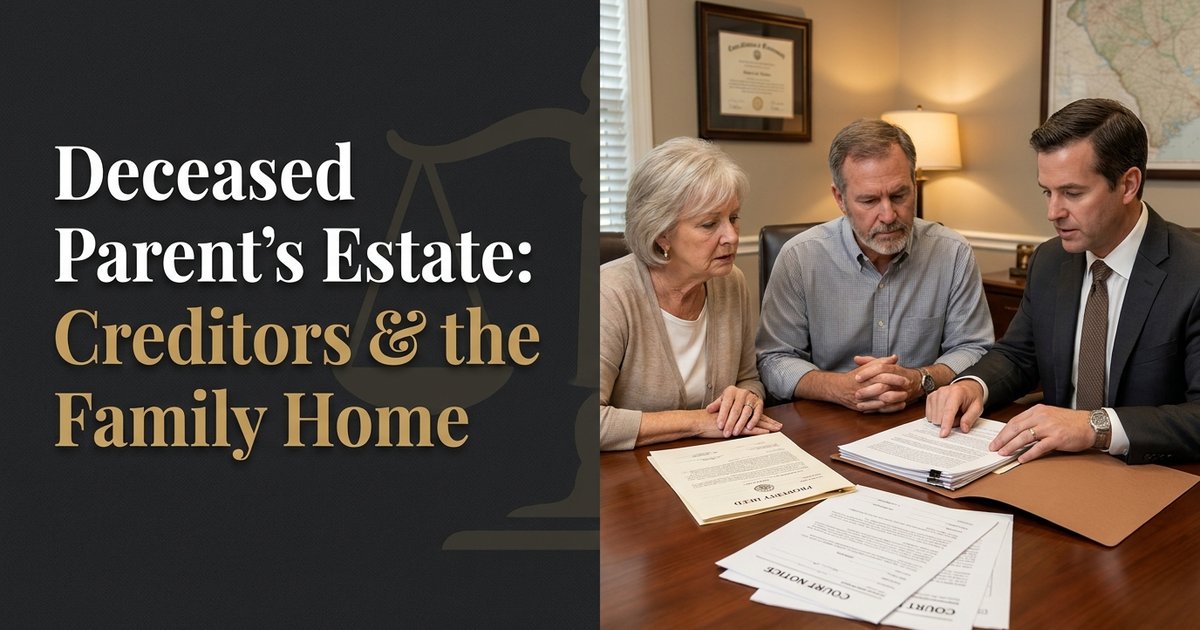
What happens to creditors when probate is opened for a deceased parent’s estate? – South Carolina
Short Answer
Opening probate in South Carolina gives creditors a formal process for presenting claims against the estate. Valid, timely claims generally must be addressed before heirs receive estate property, and the house may be used to satisfy claims if other assets are insufficient. However, most unsecured claims arising before death are barred no later than one year after death, while mortgages and other enforceable liens may remain attached to the property.
Understanding the Problem
The issue is whether opening a South Carolina probate estate long after a parent’s death allows creditors to claim against a house that remains titled in the deceased parent’s name. The key decision turns on when the death occurred, whether a creditor has a secured interest in the house, and whether the creditor met the applicable claim deadline. The surviving family member’s occupancy alone does not resolve the estate’s debts or establish clear title.
Apply the Law
The Probate Court in the county where the deceased parent lived appoints a personal representative to administer the estate. After appointment, the personal representative ordinarily publishes notice once a week for three consecutive weeks. Creditors must present claims properly and on time, and the personal representative must evaluate those claims before distributing affected estate assets.
Key Requirements
- Appointment and notice: A personal representative must be appointed before most creditors can enforce claims through the estate. When required, the representative publishes notice to creditors for three successive weeks.
- Timely presentation: A creditor must file a written claim with the Probate Court and deliver or mail the claim to the personal representative. For debts arising before death, the controlling deadline is generally the earliest applicable deadline, including one year after death, eight months after the first publication, or the deadline created by direct written notice.
- Allowance and priority: The personal representative may allow or disallow a claim. If estate assets cannot pay every allowed claim, South Carolina law sets a payment order, with administration and reasonable funeral expenses ahead of ordinary unsecured claims.
- Property remains subject to administration: Real estate passes to the appropriate heirs or beneficiaries at death, but it remains subject to creditor rights and estate administration. The personal representative may take control of the house if administration requires it.
What the Statutes Say
- S.C. Code § 62-3-801 — Notice to creditors – Requires publication once a week for three successive weeks and establishes the publication and direct-notice periods.
- S.C. Code § 62-3-803 — Deadlines for creditor claims – Generally bars pre-death claims after the earliest applicable deadline and preserves proceedings to enforce mortgages, liens, and other security interests.
- S.C. Code § 62-3-804 — Presenting an estate claim – Requires a creditor to provide claim information to the personal representative and file the prescribed written claim with the Probate Court.
- S.C. Code § 62-3-805 — Priority of estate claims – Establishes the order for paying allowed claims when the estate lacks enough assets to pay all creditors.
- S.C. Code § 62-3-101 — Property at death – Provides that inherited real estate remains subject to creditor rights and the purposes of estate administration.
Analysis
Apply the Rule to the Facts: Because the house remains titled in the deceased parent’s name, probate may be needed to identify the lawful heirs, address estate claims, and establish record title. The date of death is critical: if more than one year passed before probate opened, most unsecured pre-death claims are ordinarily barred and do not become valid again merely because an estate is opened. A recorded mortgage or other enforceable lien may still burden the house, and the personal representative may need to preserve or use the property if a surviving claim must be paid.
The family member living in the house does not ordinarily become personally responsible for the deceased parent’s debts merely by occupying the property or opening probate. Creditors generally look to estate assets, not an heir’s separate property. Distribution or transfer should wait until the personal representative determines which claims remain enforceable; additional information about this issue appears in the discussion of how South Carolina probate treats inherited real estate and estate claims.
Process & Timing
- Who files: A creditor asserting an estate claim. Where: The Probate Court administering the estate in the South Carolina county where the deceased parent lived. What: A written statement describing the claim, amount, creditor’s contact information, and any security. When: For a pre-death claim, generally before the earliest applicable deadline: one year after death, eight months after the first publication, or the direct-notice deadline, which is the earlier of one year after death or 60 days after notice.
- Review: The personal representative investigates the claim and serves an allowance or disallowance. The response is generally due by the later of 60 days after presentation or 14 months after death, although the Probate Court may extend the period for good cause.
- Resolution: A creditor must start a proceeding to challenge a disallowance within 30 days after service of the disallowance. Allowed claims receive payment according to statutory priority and available estate assets before the estate closes.
Exceptions & Pitfalls
- Secured debts: The general claim deadline does not prevent a creditor from enforcing a valid mortgage, lien, pledge, or other security interest against the property. A barred personal claim and an enforceable lien are not necessarily the same thing.
- Late probate: If no personal representative was appointed during the first year after death, South Carolina law does not require the usual creditor publication. Opening probate later generally does not revive unsecured claims that the one-year limit already barred.
- Improper presentation: Sending a bill only to a family member may not satisfy the filing requirement. A creditor generally must file the written claim with the Probate Court and provide it to the personal representative.
- Distributing too early: Transferring the house before identifying enforceable claims can create disputes and possible liability. The personal representative should confirm claim status and any recorded liens before completing the transfer.
- Unauthorized sale: A personal representative cannot assume that appointment alone permits a sale of estate real property. The will, statutory procedures, or a court order must provide the necessary authority.
Conclusion
When South Carolina probate opens, creditors receive a formal route to present claims, but opening the estate does not revive most unsecured debts already barred one year after death. Timely allowed claims take priority over distributions, and an enforceable mortgage or lien may remain attached to the house. After appointment, the personal representative should publish creditor notice once a week for three successive weeks when South Carolina law requires publication.
Talk to a Probate Attorney
If a deceased parent’s house remains in that parent’s name and creditor issues may affect the transfer, our firm has experienced attorneys who can help explain the probate process, claim deadlines, lien issues, and available options.
Disclaimer: This article provides general information about South Carolina law based on the single question stated above. It is not legal advice for your specific situation and does not create an attorney-client relationship. Laws, procedures, and local practice can change and may vary by county. If you have a deadline, act promptly and speak with a licensed South Carolina attorney.

