
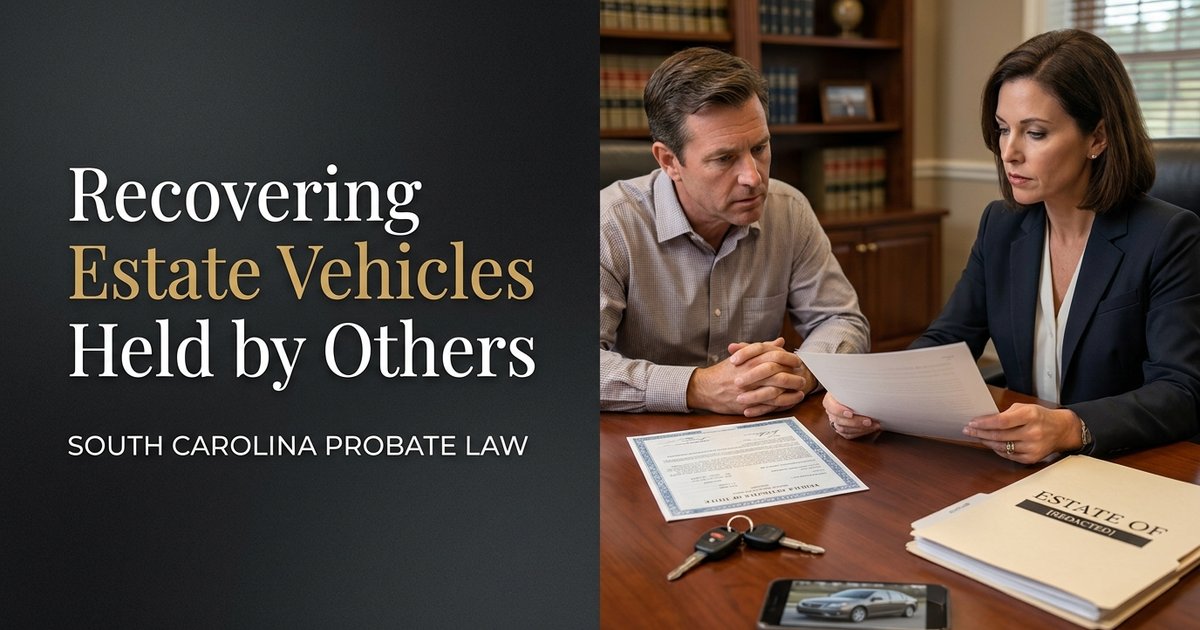
How can I recover estate vehicles that siblings or other people are holding after a parent dies? – South Carolina
Short Answer
In South Carolina, an appointed personal representative generally has the right and duty to take control of vehicles that belong to the probate estate. The personal representative should make a documented demand for delivery and, if the holder refuses or disputes ownership, may file a formal action seeking possession or a title determination. Joint ownership, a valid transfer-on-death designation, a completed lifetime transfer, or a lien may change the result.
Understanding the Problem
Can a South Carolina personal representative recover a deceased parent’s vehicle from a sibling or another person when the vehicle is needed for estate administration? The decision turns on whether the vehicle belongs to the probate estate, whether the administrator has received an appointment from the Probate Court, and whether possession is necessary to inventory, protect, or sell the vehicle.
Apply the Law
South Carolina law gives the appointed personal representative authority over estate property for the benefit of creditors and beneficiaries. The personal representative may take possession of a probate vehicle, protect it, determine its date-of-death value, and pursue an action to recover it or resolve disputed ownership. A formal dispute generally belongs in the Probate Court handling the estate, which is usually the court in the county where the parent lived at death.
Key Requirements
- Valid appointment: The person seeking the vehicle should have Probate Court authority to act as the estate’s personal representative. Being a child or beneficiary alone does not provide the same recovery power.
- Estate ownership: Records must support that the parent owned the vehicle at death and that it did not pass outside probate through survivorship, a transfer-on-death designation, or a valid prior transfer.
- Need for possession: Possession may be necessary to protect, insure, appraise, inventory, or sell the vehicle. A personal representative’s request to an heir or devisee conclusively establishes this administrative need in an action for possession.
- Proper inventory: The inventory must describe each probate vehicle, state its fair market value as of the date of death, and identify any loan or other encumbrance. It generally must be filed within 90 days after appointment.
- Court approval for some sales: Unless the will provides otherwise, the personal representative generally must obtain a prior court order before selling tangible or intangible estate property with an aggregate value of at least $10,000.
What the Statutes Say
- S.C. Code § 62-3-709 (Possession of estate property) – Gives the personal representative authority to take control of estate property and bring an action for possession or a determination of title.
- S.C. Code § 62-3-706 (Inventory and appraisement) – Requires a detailed inventory, date-of-death values, and encumbrance information within 90 days after appointment, subject to a court-approved extension.
- S.C. Code § 62-3-708 (Supplementary inventory) – Requires a corrected or supplemental inventory when additional property or corrected information becomes known.
- S.C. Code § 62-3-711 (Powers and sale authority) – Defines the personal representative’s control over estate property and the $10,000 court-approval threshold for certain sales.
- S.C. Code § 62-3-201 (Probate venue) – Places later estate proceedings in the Probate Court where the estate proceeding began unless the matter has been transferred.
- S.C. Code § 62-6-401 (Transfer-on-death titles) – Provides that a valid vehicle transfer-on-death designation can pass the vehicle outside estate administration.
Analysis
Apply the Rule to the Facts: The administrator is trying to inventory and sell vehicles to address estate obligations, so possession appears connected to valid administrative duties. Recovery still depends on evidence that each vehicle belonged to the parent’s probate estate. If a sibling merely has the keys or physical possession, that fact alone does not establish ownership or defeat the personal representative’s authority.
Useful evidence includes the certificate of title, registration, vehicle identification number, loan records, insurance records, purchase documents, and communications concerning any claimed transfer. The personal representative should document the vehicle’s condition and location and avoid driving or moving it without proper authority and insurance. More detail about valuation and ownership documentation appears in this discussion of appraising vehicles when co-heirs dispute ownership.
Process & Timing
- Who acts: The court-appointed personal representative. Where: The Probate Court administering the estate. What: Confirm the appointment, collect ownership records, and send the holder a written demand identifying the vehicle by year, make, model, and vehicle identification number. Include a copy of the appointment document and give a reasonable delivery deadline. When: Act promptly so the vehicle can be addressed in the inventory due within 90 days after appointment.
- If the holder refuses: The personal representative may file a summons and petition seeking possession of the vehicle, a determination of title, and appropriate protective relief. Formal proceedings require proper service under South Carolina civil procedure. The holder may answer and present evidence of joint ownership, a prior transfer, or another ownership claim.
- After an order or voluntary delivery: Secure and document the vehicle, obtain a date-of-death valuation, record any lien, and file or correct the inventory. If a sale is proper, confirm whether the will supplies authority or whether the proposed sale requires a prior Probate Court order. Contested proceedings may take several weeks or months, depending on service, discovery, and the court’s schedule.
Exceptions & Pitfalls
- Physical possession is not ownership: A sibling’s use of the vehicle does not necessarily make it that sibling’s property, but title in the parent’s name may not resolve every dispute if someone claims a completed lifetime gift or sale.
- Nonprobate title arrangements: A surviving joint owner or valid transfer-on-death beneficiary may own the vehicle outside probate. The title language and applicable effective dates require careful review.
- Demand rule differs by holder: A demand to an heir or devisee conclusively establishes the estate’s administrative need for possession. That specific rule does not automatically resolve ownership or apply in the same way to every third-party holder.
- Do not use risky self-help: Entering property without permission, taking a disputed vehicle without an order, or driving an uninsured vehicle can create additional problems. A formal possession order may be safer when access or ownership remains disputed.
- Do not overlook liens: A lender’s lien remains relevant even when the estate owns the vehicle. The inventory should identify the encumbrance, and sale proceeds may remain subject to the secured obligation.
- Do not miss the sale threshold: Unless the will permits otherwise, selling covered estate personal property with an aggregate value of at least $10,000 without prior court approval may violate the personal representative’s duties.
- Correct incomplete filings: If ownership or value becomes clear after the original inventory, file a supplementary or corrected inventory rather than leaving inaccurate information in the court record. Additional guidance is available in this overview of preparing a South Carolina probate inventory and appraisal.
Conclusion
An appointed South Carolina personal representative may recover a parent’s probate vehicles when possession is necessary to inventory, protect, or sell them. Estate ownership must be supported by the title and related records, and joint ownership, transfer-on-death status, prior transfers, and liens may change the answer. The immediate next step is to send the holder a documented demand for delivery while preserving the 90-day deadline after appointment for filing the inventory with the Probate Court.
Talk to a Probate Attorney
If an heir or another person refuses to return an estate vehicle or disputes its ownership, our firm has experienced attorneys who can help the personal representative understand the recovery process, court procedures, and inventory deadlines.
Disclaimer: This article provides general information about South Carolina law based on the single question stated above. It is not legal advice for your specific situation and does not create an attorney-client relationship. Laws, procedures, and local practice can change and may vary by county. If you have a deadline, act promptly and speak with a licensed South Carolina attorney.

