
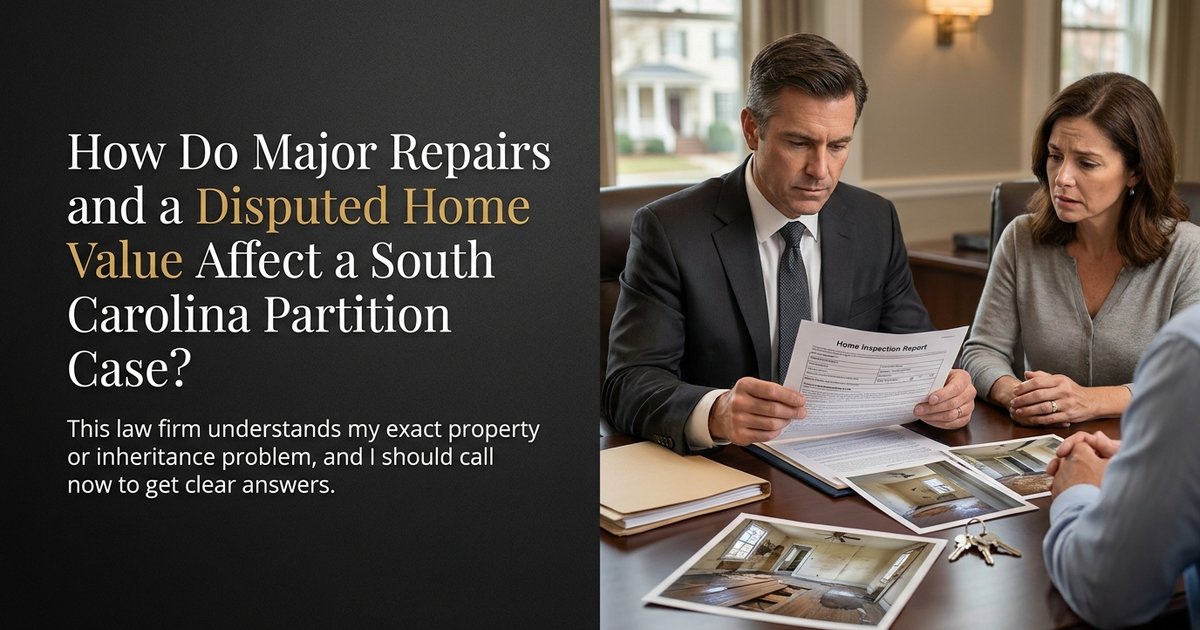
What happens in a partition case if the house needs major repairs and is worth less than my former spouse claims? – South Carolina
Short Answer
A former spouse’s asking price does not determine a jointly owned home’s value in a South Carolina partition case. The court considers reliable valuation evidence, including the home’s present condition, and may order an allotment, buyout, or sale. The court can also account for proven mortgage, property tax, insurance, maintenance, and necessary repair payments when dividing the equity, but those payments do not automatically create a dollar-for-dollar credit.
Understanding the Problem
In South Carolina, can a former spouse force a partition of a jointly titled home, and how will the Court of Common Pleas determine a fair buyout or sale result when one owner disputes the claimed value and has paid the property’s expenses since the divorce?
Apply the Law
South Carolina generally allows a joint tenant or tenant in common to seek partition. The Court of Common Pleas for the county where the house sits can divide the property, allot it to one owner with an equalizing payment, or order a sale when a fair physical division or allotment cannot be made without injury to the owners. A single-family house usually cannot be divided physically, so the practical dispute often concerns a buyout, an allotment to one owner, or a sale.
Fair market value means the price the property would reasonably bring under current market conditions. The analysis should reflect the house as it actually exists, not as if unfinished repairs had already been completed. A licensed appraisal, photographs, inspection reports, contractor estimates, comparable sales, and evidence of structural or system defects can rebut an unsupported valuation. Repair costs may affect market value, but the reduction in value does not always equal the full estimated cost of the work.
Key Requirements
- Co-ownership: The deed must show that both former spouses still hold an ownership interest. Living in the house or paying its expenses does not, by itself, remove the other owner from the title.
- Reliable valuation evidence: A party disputing value should provide evidence that addresses the home’s current condition and the local market rather than relying only on an online estimate or preferred listing price.
- Accounting for contributions: The party requesting a credit should document each mortgage, property tax, insurance, maintenance, and repair payment and explain why it preserved the property or reduced shared debt.
- Appropriate partition remedy: The court decides whether the property can be divided, allotted to one owner subject to payment, or sold with the net proceeds divided according to the parties’ rights.
What the Statutes Say
- S.C. Code Ann. § 15-61-10 (Right to Partition) – Joint tenants and tenants in common generally may compel partition.
- S.C. Code Ann. § 15-61-50 (Partition, Allotment, or Sale) – The Court of Common Pleas may divide property, allot it subject to an accounting, or order a sale when a fair division or allotment cannot be made without injury.
- S.C. Code Ann. § 15-7-10 (County for a Partition Action) – A real-property partition case must be tried in the county where the property or part of it is located.
- S.C. Code Ann. § 15-61-320 (Heirs’ Property Definition) – Additional appraisal and buyout procedures apply only if the property meets the statutory definition of heirs’ property.
- S.C. Code Ann. § 15-61-360 (Heirs’ Property Valuation) – When this special statute applies, a party generally has 30 days after appraisal notice is sent to file a written objection stating the grounds.
Analysis
Apply the Rule to the Facts: Both former spouses remain owners because the home stayed titled in both names after the divorce. The resident owner can challenge the other owner’s valuation with an appraisal that considers the property’s defects, supported by inspection findings, photographs, and repair estimates. Records of mortgage, property tax, insurance, and repair payments may also support an accounting before the court calculates each owner’s net share.
The valuation dispute and the expense accounting are related but separate. First, the court determines the property’s current value or the amount produced by a court-approved sale. It then considers liens, sale expenses, ownership shares, and any supported equitable adjustments. More information about the equity calculation appears in this discussion of calculating equity in South Carolina co-owned property.
Process & Timing
- Who files: Either titled co-owner. Where: The South Carolina Court of Common Pleas in the county where the house is located; the matter may be referred to that county’s Master-in-Equity. What: A summons and complaint identifying the property, owners, requested remedy, and any requested accounting. When: South Carolina sets no general waiting period before a co-owner files, but a party who receives court papers must respond within the deadline stated in the summons.
- Develop the evidence: The parties exchange deed, mortgage, payment, condition, and valuation evidence. The party challenging value should obtain a current appraisal and preserve inspection reports, photographs, invoices, canceled checks, bank statements, and contractor estimates. Discovery and valuation commonly take several months, although timing varies by county and the scope of the dispute.
- Determine the remedy and accounting: The court may approve an agreed buyout, allot the property to one owner with an equalizing payment, or order a sale. After resolving liens, permitted costs, ownership percentages, and supported credits or offsets, the court directs distribution or issues the documents needed to transfer title.
Exceptions & Pitfalls
- The divorce order may control: A divorce decree, settlement agreement, or later order may establish sale terms, possession rights, payment duties, or a buyout procedure. Those documents must be reviewed before assuming that an ordinary partition remedy applies.
- Not every payment receives the same treatment: Mortgage principal that reduced shared debt, property taxes, insurance, and necessary repairs may be treated differently from interest, utilities, routine living expenses, cosmetic work, or voluntary improvements. A court considers the purpose, proof, and fairness of each claimed adjustment.
- Payment records matter: A list prepared from memory rarely carries the same weight as statements, receipts, invoices, and proof that funds came from the paying owner. This article on credits for property taxes and major repairs explains the types of records that can support a claim.
- Occupancy can affect the accounting: The court may need to consider the terms under which one owner remained in the home, whether the other owner agreed to that arrangement, and whether either party seeks an offset connected to exclusive use. Occupancy by adult children does not change the deed or create an ownership share.
- Repairs do not reduce value dollar for dollar: A repair estimate measures projected work, while an appraisal measures the defect’s effect on the market. Both forms of evidence can help, but they answer different questions.
- Heirs’ property rules may not apply: A home acquired by former spouses in their own names will not necessarily qualify as heirs’ property. The court must make that determination before the special statutory appraisal, objection, and buyout deadlines apply.
Conclusion
In a South Carolina partition case, a former spouse’s claimed price does not control the home’s value. The court considers current market evidence, the property’s actual repair needs, each owner’s deed interest, and documented contributions before approving a buyout, allotment, or sale. The key threshold for a sale is whether fair division or allotment can occur without injury to the owners. The next step is to obtain a condition-based appraisal and organize proof of every claimed property payment before the response deadline in any summons.
Talk to a Partition Action Attorney
If a former spouse is threatening partition while overstating a home’s value or disputing payment credits, our firm has experienced attorneys who can help evaluate the deed, divorce documents, repair evidence, accounting claims, and available resolution options.
Disclaimer: This article provides general information about South Carolina law based on the single question stated above. It is not legal advice for your specific situation and does not create an attorney-client relationship. Laws, procedures, and local practice can change and may vary by county. If you have a deadline, act promptly and speak with a licensed South Carolina attorney.

