
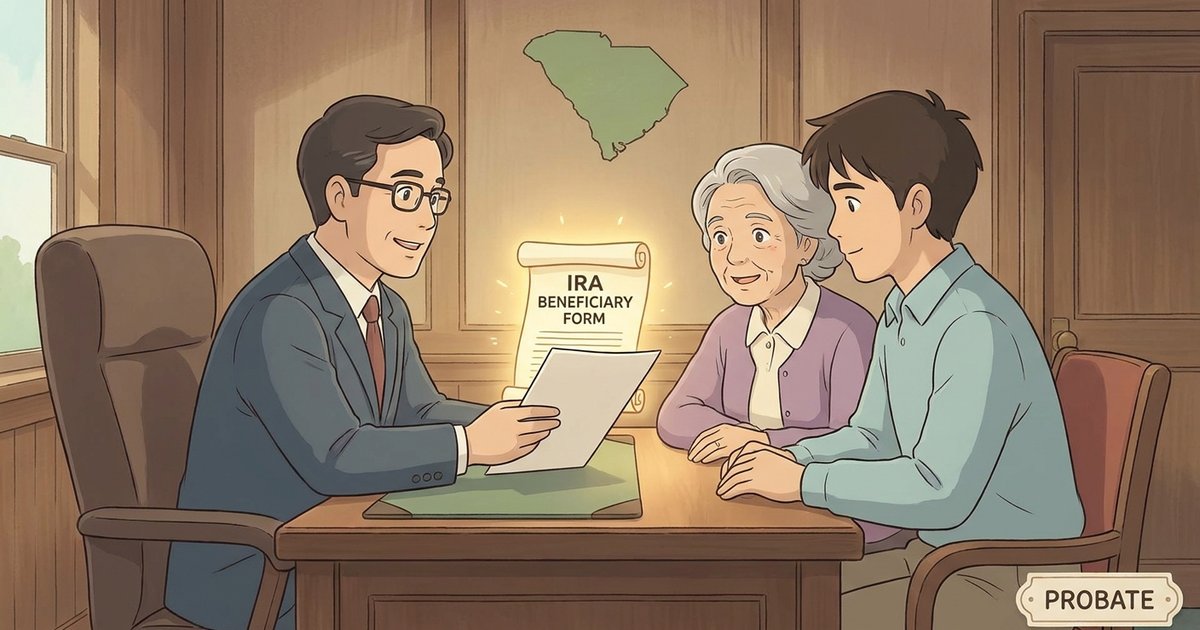
How do I find out whether an IRA has a beneficiary listed, and what happens if it doesn’t? – South Carolina
Short Answer
In South Carolina, the fastest way to find out whether an IRA has a beneficiary is to contact the IRA custodian and request the account’s beneficiary designation on file after providing a death certificate and proof of authority or relationship. If a valid beneficiary is listed, the IRA usually passes outside probate under the account contract. If no beneficiary is listed, or if the designation failed and no backup beneficiary applies, the IRA often becomes payable to the decedent’s estate and may have to be handled through the probate estate.
Understanding the Problem
The issue is whether a surviving spouse can confirm if a deceased spouse’s IRA names a beneficiary and, if not, whether the account must be handled through a South Carolina probate estate. The decision point is narrow: identify who the IRA custodian recognizes at death and whether the account passes by contract or through the estate. That answer controls who can claim the account and what probate steps may follow in South Carolina.
Apply the Law
Under South Carolina law, property that passes under a will or by intestacy is part of the probate estate, while assets that transfer by beneficiary designation usually pass outside probate. In practice, an IRA is controlled first by the custodian’s contract and beneficiary form on file, not by the will. The main forum is the probate court only if the IRA becomes payable to the estate or if authority is needed to collect it, and the surviving spouse should act promptly because custodians often require claim paperwork before they will disclose or transfer the account.
Key Requirements
- Custodian confirmation: The IRA company or financial institution controls the account records and can confirm whether a beneficiary designation is on file once it receives the required death and identity documents.
- Valid designation at death: The controlling beneficiary is usually the person or estate named in the IRA records effective at the owner’s death, unless the form was revoked, replaced, or failed under the account terms.
- Probate only if needed: If the IRA has no valid living beneficiary and no contingent beneficiary, the account may become an estate asset and then must be collected through the personal representative in the South Carolina probate estate.
What the Statutes Say
- S.C. Code Ann. § 62-2-202 (Probate estate) – defines the probate estate as property passing under the will or by intestacy, which helps explain why nonprobate beneficiary transfers are treated differently.
- S.C. Code Ann. § 62-6-203 (Rights of parties) – states that rights at death are determined by the terms of the account at death and by notice received by the financial institution during life.
- S.C. Code Ann. § 62-6-101 et seq. (Nonprobate Transfers on Death) – governs certain nonprobate transfers at death, but whether and how it applies to a particular IRA depends on the account terms and the custodian.
Analysis
Apply the Rule to the Facts: Here, most assets already appear to pass outside probate because they are jointly owned or have beneficiary designations. The uncertain asset is the IRA, so the first element is custodian confirmation: the surviving spouse should request the beneficiary designation and claim instructions from the IRA custodian using the death certificate and proof of identity. If the custodian confirms the spouse is the named beneficiary, the IRA will usually transfer outside probate; if the custodian reports no valid beneficiary, the account may need to be claimed by the estate through the personal representative.
A will does not usually override an IRA beneficiary form because the account contract controls who takes the account at death. If the IRA paperwork names a primary beneficiary who survived the owner, that person usually has priority even if the will says something different. If the primary beneficiary died first and no contingent beneficiary was named, the custodian will often look to the account agreement to decide whether the IRA goes to the estate.
Process & Timing
- Who files: The surviving spouse or, if needed, the personal representative. Where: First with the IRA custodian; if the estate must collect the account, then with the Probate Court in the South Carolina county where the decedent was domiciled. What: Death certificate, proof of identity, beneficiary claim packet, and if estate collection is required, probate appointment papers such as the personal representative’s certificate. When: As soon as the death certificate is available and before the custodian treats the account according to its records and account terms.
- The custodian reviews its records and usually confirms whether a beneficiary designation is on file, whether a contingent beneficiary exists, and what transfer paperwork is required. If no valid beneficiary is found, the custodian commonly asks for estate documents before releasing the account.
- If probate is required, the personal representative collects the IRA for the estate and then administers it under the will or intestacy rules, subject to normal estate procedures and creditor issues. The final result is either a direct inherited IRA transfer to the named beneficiary or payment to the estate for probate administration.
Exceptions & Pitfalls
- A common complication is an outdated beneficiary form, a deceased primary beneficiary, or missing contingent beneficiary language. In those cases, the custodian’s contract terms often decide whether the estate receives the account.
- Another mistake is assuming a spouse is a joint owner of an IRA. IRAs are usually individually owned accounts, so the real question is beneficiary status, not joint title.
- Delay can create notice and administration problems. If probate is opened late or the wrong person submits claim paperwork, the custodian may refuse transfer until proper authority is shown. For related background, see how IRAs and Roth IRAs are transferred after death in South Carolina and how beneficiary designations can avoid probate in South Carolina.
Conclusion
In South Carolina, the key question is what beneficiary designation the IRA custodian had on file at the owner’s death. If a valid beneficiary is listed, the IRA usually passes outside probate; if none is listed and no backup applies, the account often becomes part of the probate estate. The next step is to request the custodian’s beneficiary records and claim packet immediately, and if the account is payable to the estate, open or use the probate estate to collect it.
Talk to a Probate Attorney
If a surviving spouse is trying to confirm an IRA beneficiary and determine whether the account passes outside probate or through the estate, our firm can help explain the records to request, the probate steps involved, and the timelines that may affect the transfer.
Disclaimer: This article provides general information about South Carolina law based on the single question stated above. It is not legal advice for your specific situation and does not create an attorney-client relationship. Laws, procedures, and local practice can change and may vary by county. If you have a deadline, act promptly and speak with a licensed South Carolina attorney.

