
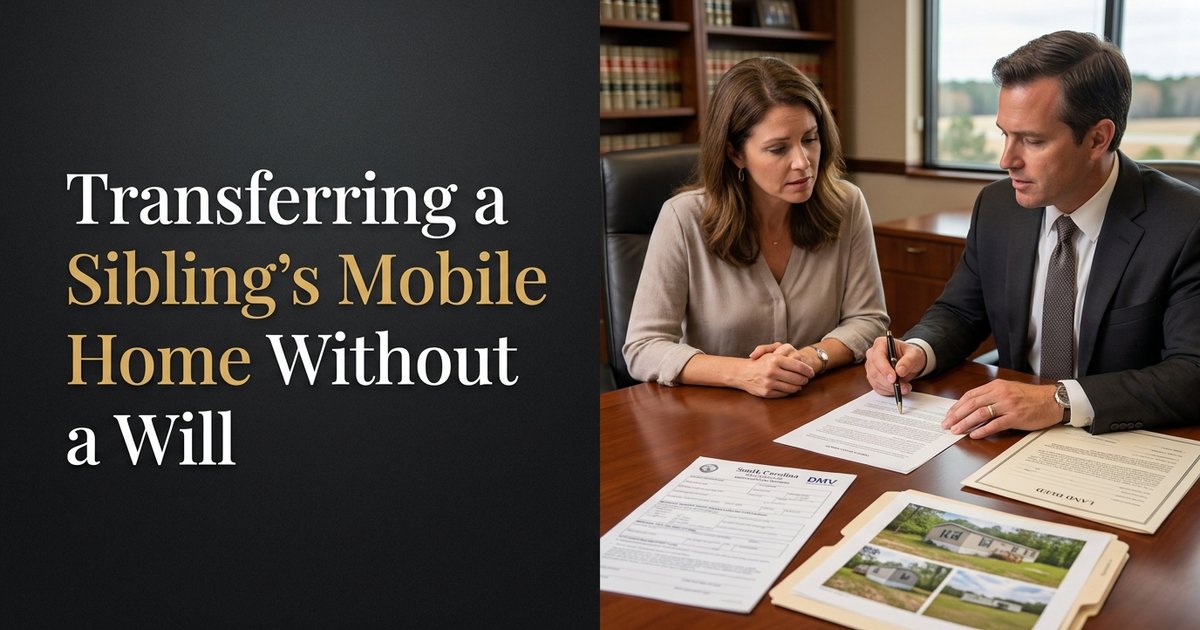
How do I transfer a mobile home after a sibling dies without a will? – South Carolina
Short Answer
In South Carolina, a sibling cannot transfer or authorize remodeling of a deceased sibling’s mobile home until ownership and inheritance rights are established. The first issue is whether the home has an active Department of Motor Vehicles title or a retired title that makes it part of the underlying real estate. If it belongs to the estate, an eligible successor may use the small-estate process after 30 days when the entire probate estate, less liens and encumbrances, does not exceed $45,000; otherwise, the Probate Court generally must appoint a personal representative.
Understanding the Problem
The narrow question is how a sibling or other heir can transfer a South Carolina mobile home after its apparent owner dies without a will. The answer depends on whether the home remained titled personal property or became part of real estate through title retirement. Ownership must be resolved before an heir, personal representative, buyer, or person planning renovations can legally transfer or materially alter the home.
Apply the Law
South Carolina uses two different ownership systems for mobile homes. A home with an active certificate of title generally remains personal property administered through the estate. If the title was properly retired after the home was permanently affixed to land, the home is treated as real property and ownership follows the land. The Probate Court in the county where the deceased sibling lived has primary authority over estate administration.
Key Requirements
- Confirm the ownership record: Locate the serial number or vehicle identification number and check Department of Motor Vehicles title records, county property records, and recorded manufactured-home affidavits.
- Identify every legal heir: A sibling inherits only if the deceased person left no surviving spouse, descendants, or parent. Other siblings or descendants of deceased siblings may share the estate.
- Obtain authority to transfer: Use a court-approved small-estate affidavit when all statutory conditions apply, or obtain appointment as personal representative through the Probate Court.
- Address liens and title status: A transfer cannot disregard a recorded lien, a retired title, or ownership of the land beneath the home.
What the Statutes Say
- S.C. Code § 62-2-102 — Surviving spouse’s intestate share – A surviving spouse receives the entire intestate estate when there are no descendants and one-half when descendants survive.
- S.C. Code § 62-2-103 — Shares of other intestate heirs – Descendants and parents inherit before siblings or descendants of siblings.
- S.C. Code § 62-3-1201 — Collection of personal property by affidavit – After 30 days, a successor may seek court approval to collect qualifying personal property when the net probate estate does not exceed $45,000 and no application or petition for appointment of a personal representative is pending or has been granted.
- S.C. Code § 56-19-210 — Title required for sale of a mobile home – A mobile home generally cannot be sold without a current certificate of title.
- S.C. Code § 56-19-510 — Retirement of a manufactured-home title – Recording a qualifying retirement affidavit makes the home part of the real property and vests ownership in the lawful landowner.
Analysis
Apply the Rule to the Facts: Because neither a deed nor a title has been located, the sibling relationship alone does not establish ownership or authority to transfer the home. Records must show whether the parent transferred an active mobile-home title, whether someone recorded a title-retirement affidavit, or whether the parent remained the legal owner. The deceased sibling’s spouse, descendants, or surviving parent would inherit before a sibling; if none exist, siblings and certain nieces or nephews may inherit by representation.
The serial number or vehicle identification number is often the best starting point when a name-based search fails. It may appear on the home’s data plate, frame, prior registration paperwork, financing documents, county property account, or insurance records. The county Register of Deeds or Clerk of Court should also be searched for a Manufactured Home Affidavit for the Retirement of Title Certificate. The Department of Motor Vehicles maintains records of retired manufactured-home titles.
If the title remained active and the net value of the entire probate estate is no more than $45,000, the successor may qualify for the small-estate procedure. The affidavit must identify the successor’s legal right to the property, state that at least 30 days have passed, and confirm that no application or petition for appointment of a personal representative is pending or has been granted. The probate judge must approve and countersign it before it can serve as authority to collect the property. The current threshold may depend on when the estate proceeding began, so the Probate Court should confirm the applicable amount.
If the small-estate procedure does not apply, an heir generally must seek appointment as personal representative. Heirs have statutory priority after any surviving spouse. The personal representative then investigates ownership, lists the home and any lien on the estate inventory, protects the property, and completes the title or distribution process. More information about the order of inheritance appears in this discussion of how South Carolina intestate succession prioritizes siblings.
Process & Timing
- Who files: An eligible heir or proposed personal representative. Where: The Probate Court for the county where the deceased sibling was domiciled. What: A court-approved affidavit for collection of personal property if the estate qualifies, or an application or petition for appointment as personal representative. When: The small-estate affidavit cannot be presented until 30 days after death.
- Verify the home’s legal status: Search by serial number or vehicle identification number through the Department of Motor Vehicles, county assessor, and county Register of Deeds or Clerk of Court. Also identify any lien and determine who owns the underlying land. Record searches and court review commonly take several weeks, with timing varying by county and record condition.
- Complete the correct transfer: For an active title, submit the estate authority and the title application materials required by the Department of Motor Vehicles. For a retired title, address the home through the land records and estate distribution process. The final document should be a new certificate of title, a recorded instrument affecting the real property, or a court order establishing the right to transfer.
Exceptions & Pitfalls
- A closer heir may control the estate: A surviving spouse, child, grandchild, or parent may prevent a sibling from inheriting or acting alone.
- The parent may still own the home: Possession, payment of expenses, or an informal family agreement does not necessarily transfer a mobile-home title.
- The home may belong to the landowner: If the title was retired, South Carolina law treats the home as real property vested in the lawful owner of the land.
- Multiple heirs may have interests: One sibling cannot transfer the entire home without proper estate authority and resolution of the other heirs’ rights.
- Missing title documents require investigation: A duplicate title request does not cure a disputed ownership chain. A court order may be necessary when agency and land records conflict or remain incomplete.
- Renovations should wait: Remodeling before authority is established can damage estate property, create reimbursement disputes, or interfere with a lienholder’s rights.
- Small-estate limits cover the whole estate: The $45,000 test applies to the entire net probate estate, not only the apparent value of the mobile home.
Conclusion
A South Carolina sibling may transfer the mobile home only after confirming whether it has an active title or a retired title and proving who inherits under intestate law. Siblings inherit only when no spouse, descendant, or parent has priority. If the entire net probate estate is within the applicable $45,000 threshold, the next step is to file the small-estate affidavit with the deceased sibling’s county Probate Court after 30 days; otherwise, seek appointment of a personal representative.
Talk to a Probate Attorney
If a missing mobile-home title, uncertain land ownership, or competing heirs are delaying a transfer, our firm has experienced attorneys who can help clarify the probate process, ownership records, and available transfer options.
Disclaimer: This article provides general information about South Carolina law based on the single question stated above. It is not legal advice for your specific situation and does not create an attorney-client relationship. Laws, procedures, and local practice can change and may vary by county. If you have a deadline, act promptly and speak with a licensed South Carolina attorney.

