
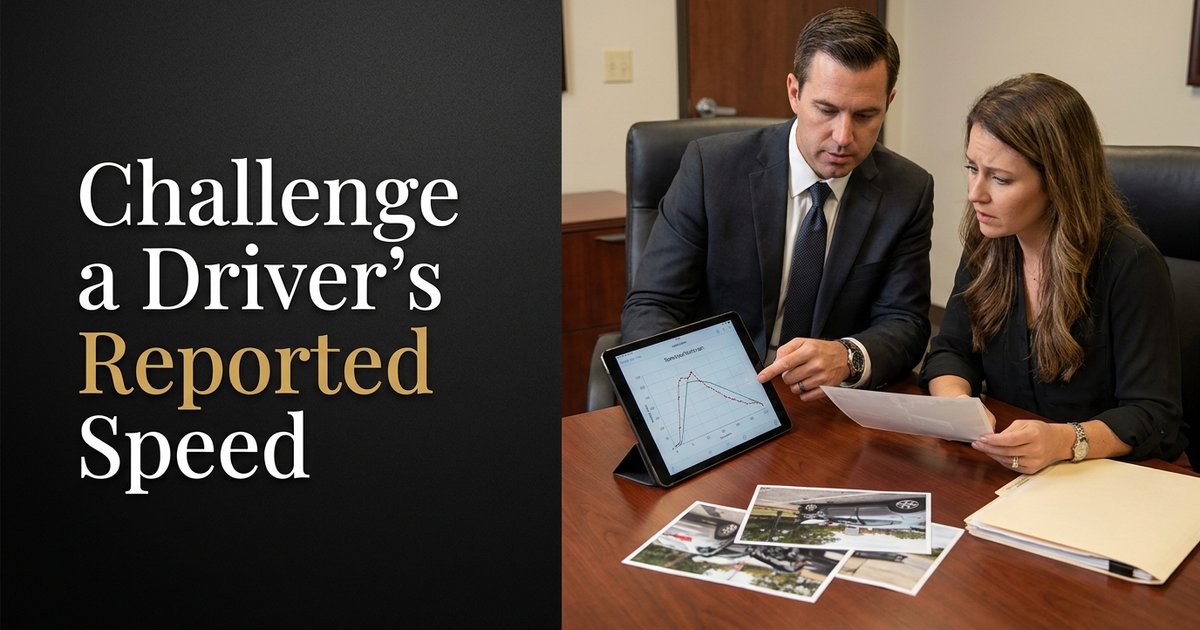
What evidence can be used to challenge the reported speed and prove the driver was at fault in a pedestrian death case? – South Carolina
Short Answer
In South Carolina, vehicle data, video, physical roadway evidence, witness accounts, and a reconstruction of the collision can challenge a speed estimate in a police report. The evidence must show that the driver failed to use reasonable care and that this failure caused the pedestrian’s death. A police report is important investigative material, but South Carolina law generally does not allow the report itself to prove negligence at trial.
Understanding the Problem
Can the personal representative of a pedestrian killed on a South Carolina multi-lane highway use evidence outside a redacted police report to dispute the driver’s reported speed and establish that the driver’s conduct caused the fatal collision? The central issue is whether reliable evidence shows that the driver traveled too fast for the posted limit or existing pedestrian hazard, failed to react reasonably, or could have avoided the collision by using proper care.
Apply the Law
South Carolina requires drivers to travel at a reasonable and prudent speed under the actual and potential hazards present. A posted speed limit is not the only measure. A driver may act negligently while traveling below that limit if darkness, visibility, traffic, road design, or the presence of pedestrians required a lower speed. A wrongful death claim is generally filed in the South Carolina Court of Common Pleas by the estate’s executor or administrator within three years after the death.
Key Requirements
- Duty of care: The driver had to keep a reasonable lookout, control the vehicle, and select a safe speed for the roadway conditions and potential pedestrian hazards.
- Breach of duty: Evidence must show unsafe speed, delayed braking, distraction, failure to maintain a lookout, or another unreasonable action or omission.
- Causation: The unsafe conduct must have caused or contributed to the collision and death. Speed evidence is most useful when it also addresses reaction time, stopping distance, sight distance, and whether a timely response could have avoided the impact.
- Reliable proof: Electronic data, measurements, photographs, records, and testimony must be preserved, authenticated, and presented in a form that a court may consider.
- Proper claimant: The executor or administrator brings the wrongful death action, even though the statutory beneficiaries receive the benefit of the claim.
What the Statutes Say
- S.C. Code § 56-5-1520 (Speed and existing hazards) – A driver must use a reasonable and prudent speed, control speed to avoid collisions, and reduce speed when pedestrians create a special hazard.
- S.C. Code § 19-1-70 (Proof of negligence in vehicle cases) – The claimant must prove that the driver’s negligence proximately caused the collision; a speed-limit violation alone does not remove that burden.
- S.C. Code § 56-5-1290 (Use of accident reports at trial) – A required accident report generally cannot serve as evidence of negligence or due care, although an officer may use it to refresh recollection while testifying.
- S.C. Code § 56-5-3150 (Crossing outside a crosswalk) – A pedestrian crossing outside a marked or unmarked intersection crosswalk generally must yield to vehicles.
- S.C. Code § 15-1-300 (Comparative fault in vehicle cases) – A pedestrian’s possible negligence does not automatically bar recovery when it is equal to or less than the negligence established against the driver.
- S.C. Code § 15-51-10 (Wrongful death liability) – A wrongful act, neglect, or default that causes death may support a civil action when the deceased person could have pursued a claim if death had not occurred.
- S.C. Code § 15-51-20 (Who brings the action) – The executor or administrator files the wrongful death action for the statutory beneficiaries.
- S.C. Code § 15-3-530 (Three-year filing period) – A South Carolina wrongful death action ordinarily must begin within three years after the death.
Analysis
Apply the Rule to the Facts: Because the available police report is redacted and the reported speed is disputed, the speed figure should be tested against independent electronic, physical, and testimonial evidence. The multi-lane roadway, pedestrian location, available sight distance, lighting, braking evidence, and vehicle data can show whether the driver maintained a proper lookout and selected a reasonable speed. Evidence concerning where the pedestrian crossed also matters, but crossing outside a crosswalk does not automatically establish that the driver used reasonable care.
Vehicle and electronic evidence: The vehicle’s event data recorder may contain pre-impact speed, braking, throttle position, steering input, and related information for a short period before the collision. Other useful sources include onboard telematics, navigation history, dash-camera files, mobile-device records, and data from connected safety systems. These records must be preserved promptly because a vehicle may be repaired, sold, destroyed, or returned to service, and electronic information may be overwritten.
Video and time-distance evidence: Traffic cameras, nearby security systems, doorbell cameras, and recordings from passing vehicles may show the vehicle’s movement before impact. When a recording contains identifiable roadway points and reliable timing, measured distance between frames can support an independent speed calculation. Original digital files are generally more useful than compressed clips or screen recordings because they retain timing and file information.
Physical collision evidence: Scene measurements, tire marks, gouges, debris, fluid trails, vehicle crush, final rest positions, pedestrian contact points, and damage to the hood or windshield may support a reconstruction. Investigators may also evaluate road grade, lane width, sight obstructions, streetlights, weather, tire condition, brake condition, and headlight operation. Photographs and scans taken close to the collision date preserve conditions that may later change.
Witness and record evidence: Eyewitnesses may describe acceleration, braking, traffic movement, visibility, and whether the driver appeared to react before impact. Recorded emergency calls, dispatch timestamps, body-camera footage, officer photographs, coroner materials, autopsy findings, and the driver’s recorded statements may help test the timeline. Medical findings can support conclusions about the mechanics of impact, but they should not be treated as a stand-alone speedometer.
Process & Timing
- Who files: The duly appointed executor or administrator. Where: The Probate Court in the decedent’s county handles the estate appointment, and the wrongful death lawsuit is filed with the Clerk of Court for the appropriate South Carolina Court of Common Pleas, subject to venue rules. What: The representative should promptly send written preservation demands covering the vehicle, event data, phones, video, photographs, measurements, recordings, and insurance materials. When: Preservation should begin immediately, while the lawsuit ordinarily must be filed within three years after the death.
- Request the complete investigative file from the investigating agency and obtain available coroner and roadway records. Redactions may remain while an investigation is open, so follow-up requests may be necessary. Additional guidance appears in obtaining investigation materials after a fatal South Carolina accident.
- After filing, use discovery requests, depositions, vehicle inspections, and subpoenas to obtain material that was not produced voluntarily. A reconstruction professional can compare the reported speed with electronic data, video timing, stopping distance, impact evidence, and sight-distance measurements, then explain whether speed or delayed reaction contributed to the death.
Exceptions & Pitfalls
- Treating the police report as the final answer: A speed entry may reflect a driver statement, a preliminary estimate, or incomplete information. The report should be compared with the underlying photographs, measurements, recordings, diagrams, witness interviews, and electronic data.
- Waiting to inspect the vehicle: Repairs, salvage, or destruction may eliminate event data and physical evidence. A preservation demand should identify both the vehicle and each category of electronically stored information.
- Relying only on the posted limit: The controlling question includes whether the speed was reasonable for actual conditions and pedestrian hazards, not merely whether it exceeded a sign.
- Ignoring stopping distance: Proving a higher speed has limited value unless the evidence also explains how that speed affected perception time, braking distance, impact severity, or the opportunity to avoid the collision.
- Overlooking comparative fault: The defense may argue that the pedestrian failed to yield or crossed from a place of safety into an immediate hazard. Evidence about visibility, time in the roadway, lane progression, driver lookout, and opportunities to brake can answer that argument.
- Assuming delayed family notification extends the deadline: A delay in notification does not ordinarily change the three-year period, which runs from the death. The filing deadline should therefore be calculated without waiting for an unredacted report or completion of a criminal investigation.
- Using the wrong plaintiff: A child, spouse, or other relative generally does not file the wrongful death case individually. The estate’s executor or administrator brings it for the statutory beneficiaries.
Conclusion
South Carolina permits electronic vehicle data, video, physical scene evidence, witness testimony, roadway measurements, and reconstruction analysis to challenge a reported speed and prove that a driver failed to use reasonable care. The evidence must connect unsafe speed or delayed reaction to the fatal impact, while addressing the pedestrian’s conduct. The personal representative should preserve the vehicle and electronic records immediately and file the wrongful death action in the appropriate Court of Common Pleas within three years after the death.
Talk to a Wrongful Death Attorney
If a family is questioning the reported speed or completeness of a fatal pedestrian investigation, our firm has experienced attorneys who can help identify missing evidence, protect time-sensitive records, and explain South Carolina filing requirements.
Disclaimer: This article provides general information about South Carolina law based on the single question stated above. It is not legal advice for a specific situation and does not create an attorney-client relationship. Laws, procedures, and local practice can change and may vary by county. If there is a deadline, act promptly and speak with a licensed South Carolina attorney.

