
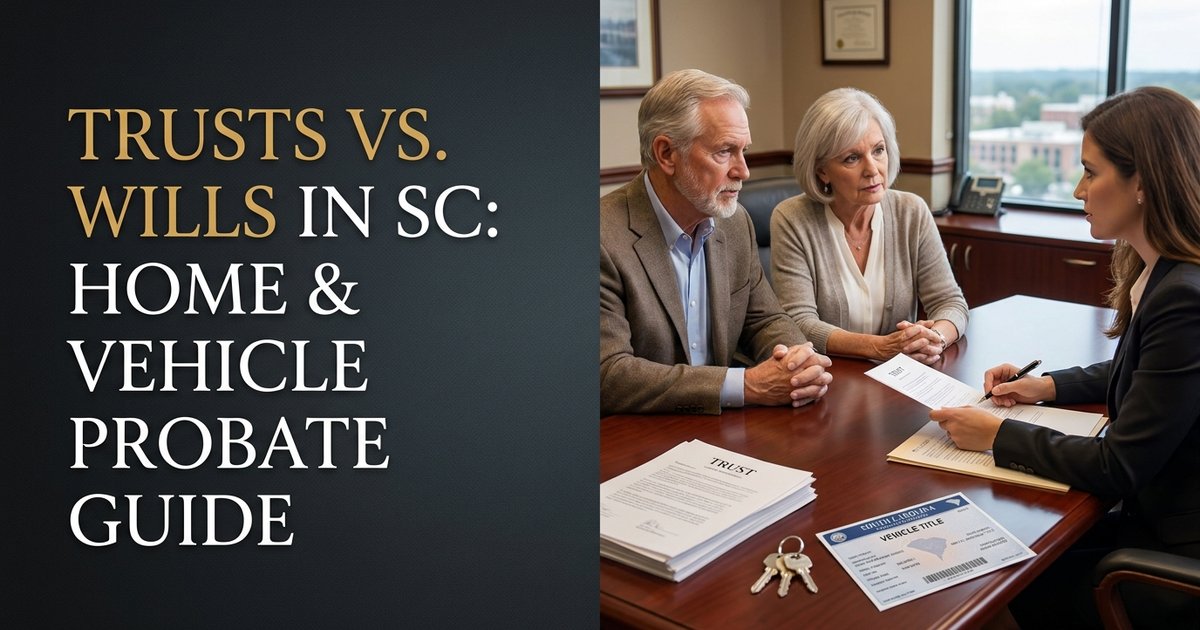
How does a trust keep my home and vehicles out of probate compared to a will? – South Carolina
Short Answer
In South Carolina, a properly funded revocable living trust can keep a home and vehicles out of probate because the trust, through its trustee, owns those assets before death. A will does not avoid probate; it tells the South Carolina probate court who should receive property that remains in the person’s individual name at death. The trust only works for assets actually transferred to it, such as by deed for real estate and by proper title paperwork for vehicles.
Understanding the Problem
In South Carolina estate planning, the key question is whether a property owner can use a trust to move a home and vehicles outside the probate process while a will would still require probate court involvement. The single decision point is ownership: whether the home and vehicles remain in the individual owner’s name at death, or whether they have been properly titled to a trustee before death. Draft powers of attorney and advance medical documents help with lifetime decision-making, but they do not by themselves decide whether titled property avoids probate.
Apply the Law
South Carolina treats a will and a funded revocable living trust differently because they operate at different times. A will takes effect through probate after death. A revocable living trust can hold property during life and continue after death, so the successor trustee can follow the trust instructions for trust-owned property without first using the will to prove title in probate court.
A trust is not automatic. The trust document creates the plan, but funding the trust puts the plan to work. For a home, funding usually means signing and recording a deed that transfers the owner’s interest to the trustee of the trust. For a vehicle, funding usually means complying with South Carolina Department of Motor Vehicles title rules so the certificate of title shows the proper owner. For a deeper step-by-step discussion, see how to set up a revocable living trust for a home and car in South Carolina.
Key Requirements
- Valid trust: The person creating the trust must have capacity, must intend to create a trust, must name beneficiaries, and must give the trustee duties to perform.
- Proper funding: The home and vehicles must be transferred to the trustee or otherwise arranged to pass to the trust. An unfunded trust does not keep individually owned property out of probate.
- Clear successor trustee authority: The trust should name who acts after death or incapacity so that someone can manage, sell, or distribute trust property without using a will for those assets.
- Coordinated will: A will still matters. Many plans use a pour-over will to send missed assets to the trust, but those missed assets may still need probate first.
What the Statutes Say
- S.C. Code Ann. § 62-7-401 (Methods of creating a trust) – South Carolina allows a trust to be created by transfer of property to a trustee, by a written declaration, or by other approved methods.
- S.C. Code Ann. § 62-7-402 (Requirements for creation of a trust) – A trust needs capacity, intent, a beneficiary, trustee duties, and no improper merger of all legal and beneficial interests.
- S.C. Code Ann. § 62-7-602 (Revocation or amendment of revocable trust) – Unless the trust says it is irrevocable, the settlor may generally amend or revoke it under South Carolina law.
- S.C. Code Ann. § 62-3-102 (Necessity of probate order for a will) – A will must be admitted to probate or otherwise approved by the court to prove a transfer of property or nominate a personal representative.
- S.C. Code Ann. § 62-3-101 (Devolution of estate at death) – Property passing under a will remains subject to estate administration, creditor claims, and the powers of the personal representative.
- S.C. Code Ann. § 56-19-360 (Vehicle title transfer procedure) – A vehicle transfer requires proper assignment and title application steps through the Department of Motor Vehicles.
- S.C. Code Ann. § 62-3-801 (Notice to creditors) – When a personal representative is appointed, creditor notice generally runs for eight months after first publication.
Analysis
Apply the Rule to the Facts: The couple is considering a trust mainly for a home and vehicles, so the controlling issue is whether those assets will be titled to the trust before death. If the home remains in an individual name, a will can direct who receives it, but the will generally must go through the county probate court to prove that transfer. If the home is deeded to the trustee and the vehicles are properly titled to the trustee, those assets usually pass under the trust instructions instead of under the will. The current draft estate documents may still be useful, but a power of attorney and medical documents do not replace the funding step needed for probate avoidance.
Process & Timing
- Who files: The property owners sign the trust and transfer documents during life. Where: The trust itself usually is not filed with the probate court; a deed for the home is recorded with the Register of Deeds or land records office in the county where the real estate sits, and vehicle title paperwork goes to the South Carolina Department of Motor Vehicles. What: The usual documents include a trust agreement, a deed to the trustee, and the assigned certificate of title with any required DMV application. When: Funding should happen before death and preferably before any loss of capacity; vehicle title transfer paperwork should be handled promptly after the transfer.
- Next step: The owners should confirm that lender rules, insurance coverage, property tax classifications, and vehicle lien information remain consistent with the transfer. Procedures and document requirements can vary by county office and by DMV title status.
- Final step: At death, the successor trustee uses the trust terms and proof of authority to manage or distribute trust-owned property. If an asset was never transferred to the trust, the personal representative may need to open probate in the South Carolina probate court for the county of the decedent’s domicile.
Exceptions & Pitfalls
- Unfunded trust: A signed trust that owns nothing does not avoid probate for a home or vehicle left in an individual name. This is the most common trust mistake.
- Pour-over will limits: A pour-over will can send missed property to the trust, but it usually must be probated first. It is a safety net, not a substitute for funding.
- Vehicle title details: Vehicles follow certificate-of-title rules. A trust schedule listing a car is not the same as a completed DMV title transfer.
- Real estate deed issues: A deed should use the correct trustee name, legal description, and recording office. Mistakes can create title problems later.
- Joint ownership and beneficiary designations: Some assets pass outside probate by survivorship or beneficiary form. Those assets do not pass under a will or trust unless the ownership or beneficiary arrangement sends them to the trust.
- Creditor and spouse rights: A trust can avoid routine probate administration for funded assets, but it does not erase valid creditor claims or all surviving-spouse rights under South Carolina law.
For related planning questions, the comparison in when a trust may be needed instead of only a will to avoid probate in South Carolina may help. If some accounts or vehicles were not retitled, see what happens when bank accounts or vehicles were not retitled into a living trust before death.
Conclusion
In South Carolina, a trust keeps a home and vehicles out of probate only when the trust is valid and those assets are properly transferred to the trustee before death. A will still controls property left in an individual name, but it generally must be admitted to probate to prove the transfer. The next step is to complete trust funding by recording the deed with the proper county land records office and submitting any needed DMV title paperwork before death.
Talk to a Estate Planning Attorney
If a family is deciding whether a will alone is enough or whether a trust should hold a home and vehicles, our firm has experienced attorneys who can help explain South Carolina probate avoidance, trust funding, and practical timelines.
Disclaimer: This article provides general information about South Carolina law based on the single question stated above. It is not legal advice for your specific situation and does not create an attorney-client relationship. Laws, procedures, and local practice can change and may vary by county. If you have a deadline, act promptly and speak with a licensed South Carolina attorney.

