
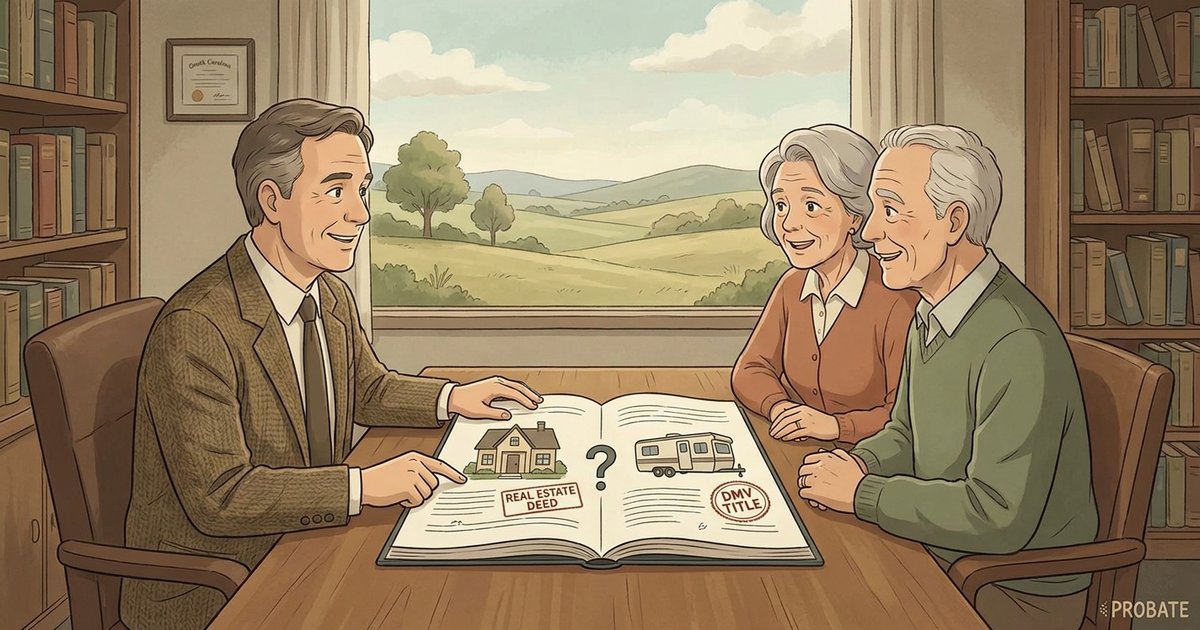
Does a mobile home count as real estate or personal property for inheritance, and how does that affect whether probate is required? – South Carolina
Short Answer
In South Carolina, a mobile or manufactured home can be either personal property or real property for inheritance purposes. If the home still has a DMV title, it is usually treated as personal property; if the title was properly retired after the home was permanently affixed to land, it is treated as real property. That classification matters because South Carolina’s small-estate affidavit applies only to probate personal property and has a value cap, while land and other real property usually require a probate filing or another recorded title step to clear ownership.
Understanding the Problem
In South Carolina probate, the key question is whether a deceased owner’s mobile home is legally treated as titled personal property or as part of the land. That single classification affects who has authority to transfer it, whether the probate court must be involved, and whether a simplified small-estate procedure is even available. The same issue often comes up when an estate also includes a parcel of land and older vehicles that the family wants to retitle after death.
Apply the Law
South Carolina draws a sharp line between a manufactured home that still carries a DMV title and one whose title has been retired after the home was permanently affixed to real property. If the owner installed the home, removed the running gear, and filed the required retirement affidavit in the county land records, the home is treated as real property for all purposes except condemnation. If that did not happen, the home generally remains titled personal property, much like a vehicle. In probate, that difference matters because real property devolves to heirs or devisees subject to administration, while personal property passes through the personal representative for administration. The main forum is usually the Probate Court in the county where the decedent lived, with related land records handled through the county Register of Deeds or Clerk of Court. For a small-estate affidavit, at least 30 days must pass after death, and the entire probate estate must not exceed $45,000.
Key Requirements
- Classify the mobile home correctly: A titled manufactured home is usually personal property. A permanently affixed home with a properly retired title is treated as real property.
- Identify what is probate property: Life insurance with a living named beneficiary usually passes outside probate, while land, vehicles, and a titled mobile home may still require probate or other transfer steps.
- Match the transfer method to the asset: Small-estate collection by affidavit works only for qualifying probate personal property under the value cap. Real property usually needs a probate estate, a recorded deed from a personal representative when authorized, or another title-clearing step based on the estate’s facts.
What the Statutes Say
- S.C. Code Ann. § 56-19-510 (Retirement of title for affixed manufactured home) – if the owner permanently affixes the home to land and files the required affidavit, the home is treated as real property.
- S.C. Code Ann. § 56-19-560 (Manufactured home treated as real property) – once the title-retirement requirements are met, county records must treat the home as real property, not personal property.
- S.C. Code Ann. § 62-3-1201 (Collection of personal property by affidavit) – after 30 days, a successor may collect qualifying probate personal property by affidavit if the entire probate estate does not exceed $45,000 and no personal representative has been appointed.
- S.C. Code Ann. § 62-3-101 (Devolution of estate at death) – real property passes to heirs or devisees subject to administration, while personal property passes first to the personal representative for estate administration.
- S.C. Code Ann. § 62-3-709 (Possession of estate property) – the personal representative may take control of estate property when needed for administration.
- S.C. Code Ann. § 62-3-711 (Powers of personal representative) – a personal representative has broad authority over estate property, but sale or transfer of real property follows specific probate procedures.
Analysis
Apply the Rule to the Facts: The estate described appears to include a mobile home on land, an additional small parcel, and two older vehicles. If the mobile home’s DMV title was retired after it was permanently affixed to the land, the home is likely part of the real estate, which means the estate includes real property and the family usually cannot rely on South Carolina’s personal-property affidavit alone to transfer everything. If the mobile home still has a DMV title, it is more likely personal property, but the separate land parcel still points toward a probate filing to clear title to the real estate.
Life insurance with named beneficiaries usually does not control the probate analysis because that benefit commonly passes outside the estate. By contrast, the vehicles and any still-titled mobile home are probate personal property unless they already pass by another valid title designation. That is why the first practical step is to confirm whether the manufactured home title was retired and whether the land and home were owned in the same name at death.
South Carolina law also treats the small-estate affidavit as a limited tool. It applies only if the entire probate estate is within the statutory cap and no personal representative has been appointed. Even when the vehicles might fit within that process, the existence of real property often means the family still needs a probate case to put record title in the correct names and to handle any deed work. For more on related title issues, see how to transfer a vehicle-titled mobile home through probate in South Carolina and how vehicle title transfers work during South Carolina estate administration.
Process & Timing
- Who files: an heir, devisee, or nominated personal representative, depending on the estate papers. Where: the Probate Court in the South Carolina county where the decedent was domiciled; land-record filings go with the county Register of Deeds or Clerk of Court. What: either a small-estate affidavit for qualifying personal property under Section 62-3-1201 or an application to open a probate estate so a personal representative can transfer land, a retired-title manufactured home, and vehicles. When: the affidavit route is available only after 30 days after death; a probate filing should be made promptly when title to land or other estate assets must be cleared.
- Next, confirm the asset list and classification: check the county land records for any Manufactured Home Affidavit for Retirement of Title Certificate, check the DMV title status for the mobile home and vehicles, and identify any liens, taxes, or missing title documents. County practice can vary on the exact supporting documents needed for recording and retitling.
- Final step: once the probate court approves the filing path and the required documents are recorded or submitted, title can be updated. That may result in a deed or recorded probate document for the land and affixed home, and new DMV titles or registrations for the vehicles and any still-titled mobile home.
Exceptions & Pitfalls
- A mobile home sitting on land is not automatically real estate. If the title was never retired, the home may still be personal property even though it looks permanent.
- A separate parcel of land can make the transfer process more involved because the small-estate affidavit is aimed at personal property, not a full title cleanup for real estate.
- Families often assume life insurance proceeds count toward probate transfer steps. If a valid beneficiary is named and survives, those proceeds usually pass outside probate, but that does not solve title issues for land, vehicles, or a titled mobile home.
- Unpaid taxes, liens, or missing title paperwork can delay both DMV transfers and land-record filings. A retired-title manufactured home also has special rules if anyone tries to sever it from the land later.
- Notice and administration issues still matter even when heirs agree. Creditors’ rights and the probate court’s procedures can affect when property may be transferred.
Conclusion
In South Carolina, a mobile home counts as personal property if it still has a DMV title, but it counts as real property if the title was properly retired after the home was permanently affixed to land. That distinction often decides whether the estate can use the small-estate affidavit, which is limited to probate personal property and a $45,000 cap after 30 days. The next step is to confirm the mobile home’s title status and file the appropriate probate matter in the county Probate Court.
Talk to a Probate Attorney
If a family is trying to determine whether a mobile home, land, and vehicles can be transferred without full probate in South Carolina, our firm has experienced attorneys who can help explain the title status, probate options, and filing timelines.
Disclaimer: This article provides general information about South Carolina law based on the single question stated above. It is not legal advice for your specific situation and does not create an attorney-client relationship. Laws, procedures, and local practice can change and may vary by county. If you have a deadline, act promptly and speak with a licensed South Carolina attorney.

