
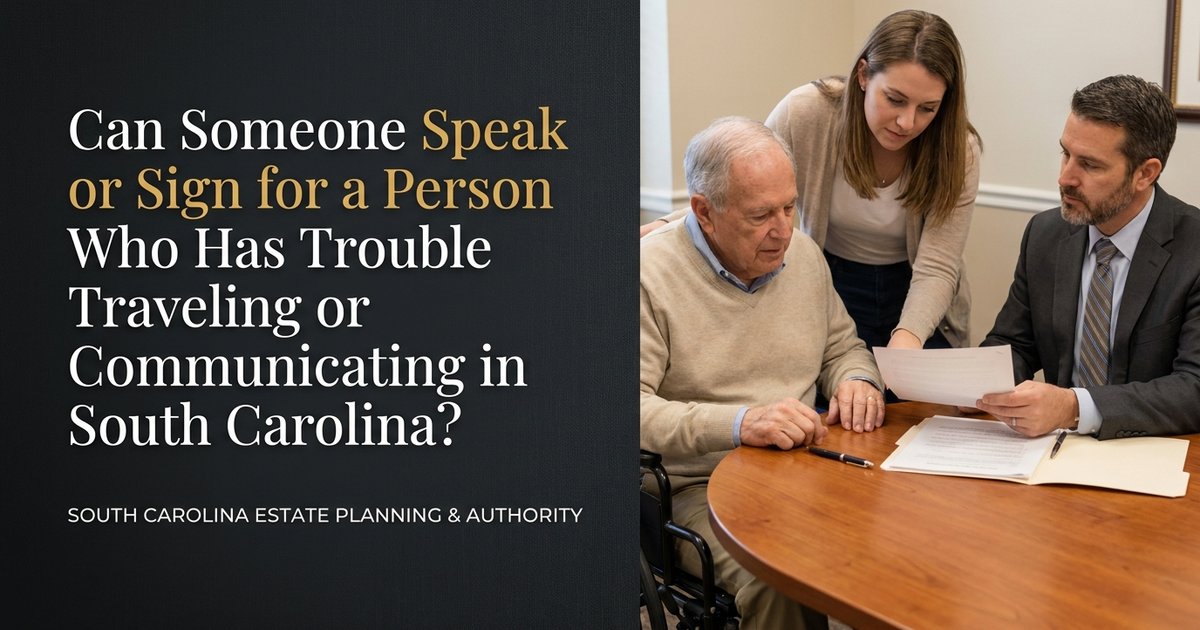
Can I speak or sign on their behalf if they have trouble traveling or communicating, and what proof is needed? – South Carolina
Short Answer
Yes, in South Carolina, a person may speak or sign for another adult only with the right authority. If the adult still has legal capacity, South Carolina law allows certain estate planning documents to be signed by another person in the adult’s presence and at the adult’s direction. If the adult cannot make decisions, the proof usually must be a valid power of attorney, health care power of attorney, HIPAA release, applicable surrogate authority under the Adult Health Care Consent Act, or a Probate Court order appointing a guardian or conservator.
Understanding the Problem
In South Carolina estate planning, the key question is whether a family member, caregiver, or trusted helper can communicate instructions or sign documents for an adult who has trouble traveling, speaking, writing, or meeting in an office. The answer depends on the adult’s role as the decision-maker, the helper’s authority, the document involved, and whether the adult can still understand and direct the action.
Apply the Law
South Carolina law separates physical difficulty from legal incapacity. Trouble traveling, speaking, or holding a pen does not automatically remove the person’s right to decide. If the adult understands the document and can communicate a choice, the adult may still sign personally, make a mark, acknowledge a signature, or direct another person to sign in the adult’s presence when the statute allows it.
A helper may speak with an attorney, bank, or medical provider only if the adult consents, a legal document gives that authority, or South Carolina health-care consent law authorizes the person to act. For financial matters, the usual proof is a properly executed durable power of attorney. For medical decisions and medical information, the usual proof is a South Carolina health care power of attorney, HIPAA authorization, other legally accepted health care authority, or, when applicable, statutory surrogate authority under the Adult Health Care Consent Act. For deeper background on these planning documents, see which powers of attorney and HIPAA authorizations belong in a South Carolina estate plan.
Key Requirements
- Capacity: The adult must understand the nature and effect of the document when creating or changing an estate planning document.
- Clear direction: If another person signs for the adult, the adult must direct that person to sign, and the signing must occur in the adult’s presence when required by statute.
- Proper formalities: Wills, financial powers of attorney, and health care powers of attorney have different witness, acknowledgment, and proof rules.
- Scope of authority: An agent can do only what the document or court order allows. Some powers, such as gifting or changing beneficiary rights, require specific authority.
- Proof to third parties: Banks, medical providers, and attorneys may ask for the signed document, identification, an agent certification, medical capacity proof, or court-issued letters.
What the Statutes Say
- S.C. Code Ann. § 62-8-105 (Execution of power of attorney) – A power of attorney must be signed by the principal or by another person in the principal’s presence and at the principal’s direction, witnessed like a will, and acknowledged or proved.
- S.C. Code Ann. § 62-8-119 (Reliance on acknowledged power of attorney) – A person asked to accept a power of attorney may request an agent certification about the principal, the agent’s authority, and whether the authority remains effective.
- S.C. Code Ann. § 62-5-503 (Health care power of attorney requirements) – A health care power of attorney must be dated, signed by the principal or at the principal’s direction in the principal’s presence, and witnessed by two qualified witnesses.
- S.C. Code Ann. § 62-5-502 (Effectiveness of health care power of attorney) – A health care power of attorney is durable, and mental incompetence for health care decisions is determined under the statutory standards for inability to consent.
- S.C. Code Ann. § 62-2-502 (Execution of wills) – A will must be in writing, signed by the testator or by another person in the testator’s presence and at the testator’s direction, and signed by at least two witnesses.
- S.C. Code Ann. § 62-5-403 (Protective proceedings) – If no adequate agent exists and property or support needs protection, a person may petition the Probate Court for a conservator or protective order.
Analysis
Apply the Rule to the Facts: When the problem is travel or communication, the first issue is not convenience; it is authority. If the adult can understand and direct the decision, South Carolina law may allow another person to sign certain documents in the adult’s presence and at the adult’s direction. If the adult cannot understand or direct the decision, a helper needs existing legal authority, statutory health care authority, or a Probate Court order before speaking or signing as the adult’s representative.
For example, an adult who cannot travel to a law office may still meet by phone or video for discussion and then sign during an in-person execution appointment with the required witnesses and notary, if needed. An adult who cannot physically sign may direct another person to sign the adult’s name, but the witnesses and notary should clearly document that the adult gave the direction and appeared to understand the act.
Process & Timing
- Who files: No court filing is needed if the adult still has capacity and signs valid estate planning documents. Where: The signing usually occurs wherever the adult can safely meet the attorney, witnesses, and notary in South Carolina. What: The proof may include the signed will, financial power of attorney, health care power of attorney, HIPAA authorization, and identification. When: The documents should be completed before the adult loses the ability to understand and direct decisions.
- Who presents proof: The named agent presents the power of attorney, health care power of attorney, or HIPAA authorization to the bank, medical provider, attorney, or other institution. The agent should sign in a representative capacity, such as the adult’s name by the agent as power of attorney, so the signature does not look like a personal obligation.
- Who files if capacity is already lost: An interested person may file a summons and petition in the South Carolina Probate Court for the county with proper jurisdiction. Where: Probate Court. What: The petition asks for guardianship, conservatorship, or a protective order and must explain why less restrictive options are not enough. When: There is no simple waiting period, but delay can leave bills, care decisions, or property matters unresolved.
- Final proof: If the Probate Court grants authority, the representative uses certified court orders or letters as proof of appointment. Third parties may still review the limits in the order before accepting a signature or instruction.
Exceptions & Pitfalls
- Physical limits are not the same as incapacity: A person who cannot travel, speak easily, or write may still have full legal capacity if the person can understand and communicate decisions.
- A family relationship is not enough: Being a spouse, adult child, sibling, or caregiver does not by itself create authority to sign estate planning papers or access financial accounts, and medical decision-making authority depends on the Adult Health Care Consent Act or other valid health care authority.
- Health care authority has its own rules: A South Carolina health care power of attorney is often broader than a living will because it can authorize a chosen agent to make health care decisions during periods when the principal cannot consent. A living will is narrower and mainly addresses life-sustaining procedures in limited end-of-life situations.
- Witness rules matter: Health care powers of attorney require two qualified witnesses, and certain people may not serve as witnesses. A health care power of attorney generally does not require a notary, but a financial power of attorney does require acknowledgment or proof.
- Some powers require specific wording: Under a financial power of attorney, major acts such as making gifts, changing survivorship rights, changing beneficiary designations, or dealing with trusts require express authority.
- Institutions may ask for more proof: A bank or other third party may request an agent certification under penalty of perjury. Medical providers may need proof that the health care power of attorney is active, especially when the document becomes effective only during incapacity.
- Remote and electronic steps can be limited: South Carolina electronic notary rules do not apply to wills and trusts, so estate planning documents should be planned with the required in-person formalities unless a South Carolina attorney confirms a lawful alternative for the specific document.
- No one can create a will for another person after incapacity: A conservator may manage property under a court order, but South Carolina law does not give a conservator the power to make a will for the protected person.
If the adult is already in a hospital, care facility, or homebound setting, prompt planning matters. For more on that situation, see how to draft medical and financial powers of attorney for someone in the hospital in South Carolina.
Conclusion
In South Carolina, a helper may speak or sign for another adult only with valid authority. If the adult has capacity, the adult may direct another person to sign certain estate planning documents in the adult’s presence, with the required witnesses and acknowledgment. If capacity is gone, the helper needs an existing power of attorney, health care power of attorney, HIPAA release, applicable statutory health care authority, or Probate Court order. The next step is to complete or verify the proper authority before incapacity prevents signing.
Talk to a Estate Planning Attorney
If you’re dealing with a loved one who cannot travel, communicate easily, or sign without help, our firm has experienced attorneys who can help you understand the proper documents, proof requirements, and timelines under South Carolina law.
Disclaimer: This article provides general information about South Carolina law based on the single question stated above. It is not legal advice for your specific situation and does not create an attorney-client relationship. Laws, procedures, and local practice can change and may vary by county. If you have a deadline, act promptly and speak with a licensed South Carolina attorney.

