
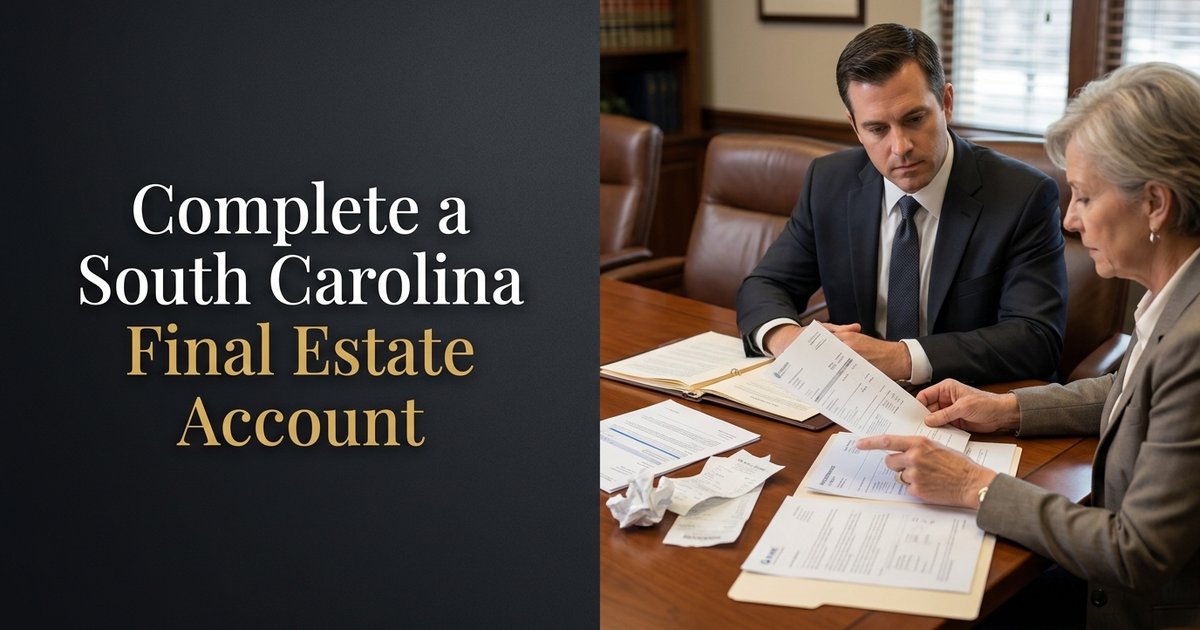
How do I complete a final account if I only have separate financial documents? – South Carolina
Short Answer
A South Carolina personal representative may prepare a final account from separate bank statements, invoices, receipts, canceled checks, distribution records, and filed return documents. Organize every estate transaction by date and category, separate transfers from true income or expenses, and reconcile the records so all assets received equal all payments, distributions, losses, and property remaining. Documents from two parents’ estates must remain separate.
Understanding the Problem
In South Carolina, can the personal representative for one parent’s estate sign and complete the final account when the available information consists of separate financial documents? The central issue is whether those records can be organized into a complete, accurate history of that estate’s administration before the closing papers are filed with the Probate Court.
Apply the Law
Under the ordinary closing procedure, South Carolina requires the personal representative to provide a full written accounting unless every interested person properly waives it. The accounting should explain what estate property came under the personal representative’s control, what the estate received, what it paid or distributed, and what remains. Closing documents go to the Probate Court administering the estate, generally in the county where the deceased parent was domiciled.
Key Requirements
- Authority to sign: The signer must be the court-appointed personal representative for the particular estate. Appointment in one parent’s estate does not create authority to sign for the other parent’s estate.
- Complete transaction history: The account should begin with the filed inventory and include later receipts, income, sale proceeds, expenses, creditor payments, distributions, gains, losses, and property still held.
- Reconciliation: The total assets received must balance against the total paid, distributed, lost, or remaining. Transfers between estate accounts should appear as transfers rather than as new income or duplicate expenses.
- Supporting records: Statements, invoices, receipts, canceled checks, closing documents, and signed beneficiary receipts should support the entries. Filed return documents may confirm some transactions, but they do not replace a complete probate accounting.
- Notice and closing papers: Unless waived, interested persons must receive the accounting, proposal for distribution, application for settlement, and notice of the right to demand a hearing.
What the Statutes Say
- S.C. Code Ann. § 62-3-1001 (Final accounting and settlement) – Requires a written accounting and related closing documents by the latest applicable statutory trigger concerning a contested claim, the conclusion of claim proceedings, or an estate tax closing letter, subject to permitted waivers.
- S.C. Code Ann. § 62-3-706 (Inventory and appraisement) – Requires the initial probate inventory within 90 days after appointment and provides the starting point for the final account.
- S.C. Code Ann. § 62-3-806 (Allowance and disallowance of claims) – Gives a claimant 30 days after service of a disallowance to begin a proceeding concerning the claim.
- S.C. Code Ann. § 62-3-807 (Payment of claims) – Generally requires allowed claims to be paid before closing and no later than 14 months after death, unless the Probate Court grants additional time.
Analysis
Apply the Rule to the Facts: The separate financial documents can support a final account if they collectively show every transaction involving the estate. Because the records concern two deceased parents, each statement, receipt, and filed return document should first be assigned to the correct estate. Only the appointed personal representative for the estate being closed should sign its probate forms.
Start with the inventory for the estate at issue. Create a chronological ledger with columns for the date, description, source document, money received, money paid, distribution, transfer, and running balance. Then compare the ledger’s ending balance with the final bank statement and identify any property that remains for distribution. For additional background, see preparing a South Carolina estate accounting from multiple accounts.
Process & Timing
- Who files: The court-appointed personal representative. Where: The South Carolina Probate Court administering the particular parent’s estate. What: The accounting, proposal for distribution, application for settlement, notice documents, and any required receipts or supporting schedules. When: File within the time required by Section 62-3-1001, measured by the later of the expiration of the time to contest a claim disallowance, the conclusion of claim-allowance proceedings, or, if a state or federal estate tax return was filed, 90 days after receipt of the applicable closing letter.
- Reconstruct the account from the inventory, estate-account statements, checks, invoices, sale records, and distribution receipts. Mark account-to-account transfers so they do not inflate receipts or expenses. Ask the financial institution for missing statements or check images when the sequence is incomplete.
- Provide the closing documents to interested persons unless the applicable requirements have been waived. After proof of notice has been filed, interested persons generally have 30 days to demand a hearing. The Probate Court may then approve settlement, authorize final distribution, and discharge the personal representative.
Exceptions & Pitfalls
- Mixing the estates: Do not combine records, expenses, refunds, or distributions belonging to different parents. If one estate paid an expense for the other, flag the transaction for review rather than treating it as an ordinary expense.
- Counting transfers twice: Moving money between estate accounts does not create new income or a new expense. Record both sides as a transfer and confirm that they offset.
- Using return documents as the entire account: Filed return documents may help identify income, expenses, or refunds, but they may omit probate transactions. Questions about the contents or treatment of a return should go to a tax attorney or CPA.
- Missing proof of payment: A bank withdrawal alone may not identify the purpose of a payment. Match it to an invoice, check image, settlement statement, or written explanation.
- Unsupported distributions: Keep signed receipts or other proof that each beneficiary received the listed property. The final account should also identify any proposed distribution that has not occurred.
- Unexplained differences: Do not force the ledger to balance by adding an unidentified adjustment. Investigate missing statements, service charges, interest, refunds, sale costs, or checks that never cleared.
- Waiver assumptions: A waiver applies only when all required interested persons validly provide it. The application for settlement still must be filed even when other closing documents are waived.
Conclusion
Separate financial documents can support a South Carolina final account when they create a complete, estate-specific record and reconcile to the property remaining. The controlling threshold is that all assets received must equal all payments, distributions, losses, and assets still held. The personal representative should file the reconciled accounting and required closing papers by the applicable deadline under Section 62-3-1001, including within 90 days after receipt of an applicable estate tax closing letter if that is the latest statutory trigger.
Talk to a Probate Attorney
If separate statements, receipts, and return documents must be converted into a final estate account, our firm has experienced attorneys who can help organize the records, identify missing support, and prepare the South Carolina closing documents within the applicable timeline.
Disclaimer: This article provides general information about South Carolina law based on the single question stated above. It is not legal advice for your specific situation and does not create an attorney-client relationship. Laws, procedures, and local practice can change and may vary by county. If you have a deadline, act promptly and speak with a licensed South Carolina attorney.

