
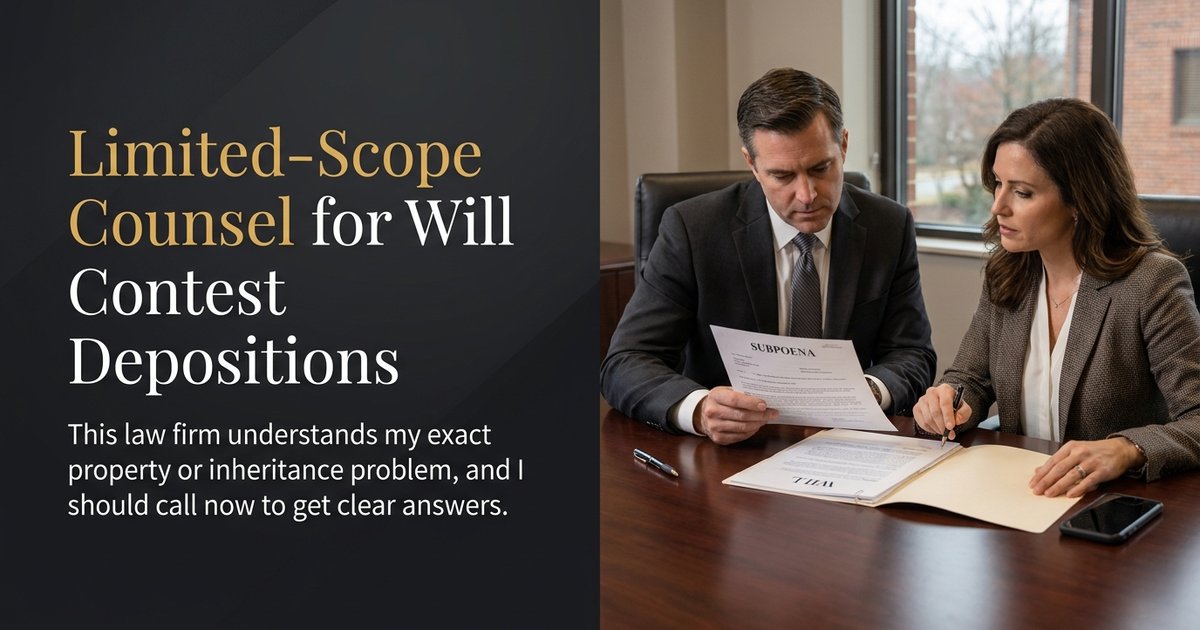
Can I hire a lawyer just to represent me at a deposition in a will contest? – South Carolina
Short Answer
Yes. A subpoenaed witness in a South Carolina will contest may generally hire a lawyer for the limited purpose of preparing for and attending the deposition. The representation should be defined in a written engagement agreement, and hiring counsel does not cancel the subpoena or excuse the witness from appearing on the scheduled date.
Understanding the Problem
Can a witness subpoenaed in a South Carolina will contest retain a lawyer only for deposition preparation and representation? The key issue is whether the lawyer may limit the engagement to that testimony rather than represent the witness throughout the entire probate dispute, particularly when the subpoena sets a specific appearance date.
Apply the Law
South Carolina permits a lawyer and client to agree to a reasonable limited scope of representation when the client gives informed consent. In this setting, the engagement may cover reviewing the subpoena, preparing the witness, attending the deposition, making proper objections, protecting privileged communications, and addressing an improper subpoena. A will contest usually begins in the Probate Court for the county administering the estate, although a particular proceeding may be removed to Circuit Court.
Key Requirements
- Clear scope: The engagement agreement should state whether counsel will handle only preparation and attendance or will also review documents, negotiate scheduling, or seek court relief.
- Conflict review: The lawyer must determine whether representing the witness conflicts with representation of a sibling, beneficiary, personal representative, or another person involved in the estate.
- Subpoena compliance: The witness must appear at the stated time and place and produce properly requested materials unless the parties agree otherwise or the court modifies, stays, or quashes the subpoena.
What the Statutes Say
- S.C. Code Ann. § 62-1-302 (Probate Court jurisdiction) – Gives the Probate Court original jurisdiction over will contests and other matters involving decedents’ estates.
- S.C. Code Ann. § 62-1-304 (Civil procedure in formal probate proceedings) – Applies the South Carolina Rules of Civil Procedure to formal probate cases, including discovery procedures.
- S.C. Code Ann. § 14-23-330 (Depositions in Probate Court) – Allows qualifying depositions taken under civil procedure rules to be used in Probate Court proceedings.
Analysis
Apply the Rule to the Facts: The subpoenaed witness may seek a South Carolina probate lawyer for deposition-only representation. Counsel can review the subpoena, explain the deposition process, prepare the witness to answer truthfully from personal knowledge, attend the deposition, and protect applicable privileges. Because the dispute involves siblings, the lawyer must complete a conflict review, and any assistance with the larger estate dispute should be included separately in the engagement agreement.
The lawyer may object to improper questions and take appropriate steps when a question seeks privileged information or falls outside permissible discovery. However, counsel cannot answer for the witness, coach testimony, or automatically block relevant nonprivileged questions. Communications with the newly retained lawyer may be protected, but hiring counsel does not make the witness’s underlying knowledge or existing documents privileged.
Process & Timing
- Who files: No court filing is ordinarily required merely to hire deposition counsel. Where: The witness retains a South Carolina lawyer familiar with probate litigation. What: Counsel reviews the subpoena, deposition notice, document requests, pleadings, and a written limited-scope engagement agreement. When: This should occur as soon as possible and before the subpoena’s scheduled deposition date.
- If the subpoena presents a scheduling, privilege, scope, service, or undue-burden problem, counsel may contact the issuing lawyer and, when necessary, seek relief from the court handling the proceeding. Any request to stop or modify the deposition should be made before the compliance date rather than after a missed appearance.
- Counsel prepares the witness, attends the deposition, states proper objections on the record, and reviews any transcript correction procedure included with the deposition materials. The engagement ends after those tasks unless the written agreement covers additional estate-dispute work.
Exceptions & Pitfalls
- A limited engagement may not remain practical if the witness receives additional subpoenas, faces a claim personally, controls disputed estate property, or needs to assert rights as an interested person.
- Ignoring the subpoena because a lawyer has been contacted can lead to enforcement proceedings. Only an agreement, court order, or other legally effective relief changes the duty to comply.
- Deposition preparation must focus on truthful testimony. The witness should not guess, delete records, alter documents, or coordinate testimony with family members.
- Privilege questions can be fact-specific, especially when the witness previously communicated with the person who made the will, the drafting lawyer, or a fiduciary. Counsel should review those communications before testimony begins.
- Service defects and overly broad document demands should be raised promptly. Waiting until the deposition starts may narrow the available options.
For additional context about compelled participation, see whether witnesses can be required to testify in a South Carolina contested will case.
Conclusion
A witness subpoenaed in a South Carolina will contest can generally hire a lawyer solely for deposition preparation and attendance if the lawyer accepts a reasonable, clearly defined engagement after checking for conflicts. The limited role does not invalidate the subpoena or eliminate the duty to provide truthful, nonprivileged testimony. Send the subpoena and related documents to a South Carolina probate attorney before the appearance date printed on the subpoena.
Talk to a Probate Attorney
If you are facing a deposition in a South Carolina will contest, our firm has experienced attorneys who can help explain the subpoena, prepare you for testimony, protect applicable privileges, and clarify whether limited representation fits your situation.
Disclaimer: This article provides general information about South Carolina law based on the single question stated above. It is not legal advice for your specific situation and does not create an attorney-client relationship. Laws, procedures, and local practice can change and may vary by county. If you have a deadline, act promptly and speak with a licensed South Carolina attorney.

