
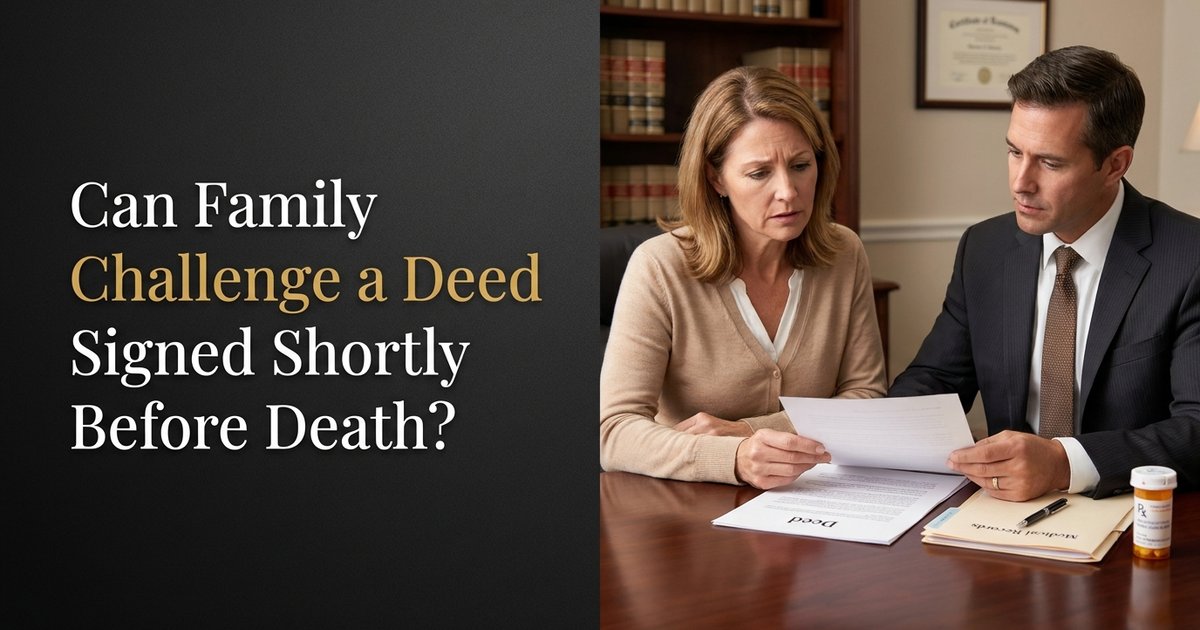
Can a family challenge a deed signed shortly before someone died if they were on strong pain medication or had dementia? – South Carolina
Short Answer
Yes. In South Carolina, a family may challenge a deed if the person lacked the mental capacity to understand the transfer or signed because of undue influence, fraud, or coercion. Strong medication, dementia, and the timing of the deed can support a challenge, but none automatically makes the deed invalid. The evidence must focus on the person’s condition and understanding when the deed was signed.
Understanding the Problem
The issue is whether a South Carolina deed adding a caregiver and former partner as a joint owner can remain valid when the property owner signed shortly before death while experiencing dementia symptoms and taking strong pain medication. The central decision is whether the owner understood the deed and acted voluntarily at the time of signing.
Apply the Law
A deed involves a lifetime transfer, so it generally requires more mental capacity than a will. The grantor must have been able to understand the property involved, the nature of the transfer, and its probable effect on the grantor’s ownership rights. The relevant moment is when the grantor signed the deed. A dementia diagnosis, physical weakness, or medication use does not establish incapacity by itself because a person may still understand a transaction during a period of clarity.
Undue influence presents a separate ground for relief. It requires pressure or coercion strong enough to overcome the grantor’s free choice. A confidential relationship may arise when the recipient controlled the grantor’s care, finances, transportation, communications, or access to legal services. If that relationship existed and the recipient benefited from the deed, those circumstances may support an undue-influence claim. A court will still examine all available evidence surrounding the transaction.
Key Requirements
- Insufficient mental capacity: The grantor could not reasonably understand the deed, the property being transferred, or the effect on the grantor’s rights when signing.
- Undue influence or other misconduct: The recipient used coercion, fraud, isolation, dependency, or a position of trust to replace the grantor’s free decision with the recipient’s wishes.
- Valid execution: A South Carolina deed generally must contain the grantor’s signature and satisfy applicable witness and acknowledgment requirements. Recording a deed does not prevent a court from examining its validity.
- Proper party and forum: The estate’s personal representative normally has authority to pursue an estate claim concerning ownership. A formal proceeding may begin in the Probate Court for the county handling the estate, and a title dispute may be removed or heard in Circuit Court as allowed by law.
- Timely filing: The deadline depends on the legal claims. A fraud claim generally carries a three-year period measured from discovery, while other theories may follow different rules. South Carolina also suspends an unexpired limitations period on a decedent’s cause of action during the eight months after death.
What the Statutes Say
- S.C. Code Ann. § 62-1-302 (Probate Court jurisdiction) – Gives the Probate Court original jurisdiction over estate matters, including determining property in which an estate claims an interest, while recognizing Circuit Court authority over certain real estate actions.
- S.C. Code Ann. § 62-3-709 (Recovery and protection of estate property) – Authorizes a personal representative to protect estate property and bring an action to recover property or determine title.
- S.C. Code Ann. § 62-3-703 (Standing of the personal representative) – Gives the personal representative standing to pursue surviving claims that the deceased person could have pursued.
- S.C. Code Ann. § 27-7-10 (Execution and witnesses for deeds) – Provides for execution of a deed in the presence of at least two credible witnesses.
- S.C. Code Ann. § 30-5-30 (Prerequisites to recording a deed) – Establishes signature, acknowledgment, proof, and witness requirements for recording real estate instruments.
- S.C. Code Ann. § 15-3-530 (Three-year limitations periods) – Applies a three-year period to listed claims, including equitable fraud claims measured from discovery of the fraud.
- S.C. Code Ann. § 62-3-109 (Suspension after death) – Suspends an unexpired limitations period on a decedent’s cause of action for eight months after death.
Analysis
Apply the Rule to the Facts: The reported dementia symptoms, strong pain medication, and proximity between signing and death raise legitimate capacity concerns, but the family must connect those facts to the exact signing period. The former partner’s role as an in-home caregiver, the verbal compensation arrangement, and the later ownership benefit may also support an undue-influence claim if the evidence shows dependence, control, isolation, pressure, or a confidential relationship. The deed’s witnesses, acknowledgment, preparation history, and survivorship language also require review.
Useful evidence may include medical and medication records from the days surrounding execution, prescription administration logs, communications, prior estate plans, the caregiver arrangement, payment records, and testimony from people who observed the grantor. The personal representative should also identify who selected the person preparing the deed, supplied its instructions, arranged the signing, attended the execution, and delivered it for recording. Evidence from neutral witnesses who discussed the deed with the grantor may carry substantial weight.
The family may find additional background in this discussion of evidence used to prove undue influence or lack of capacity for a South Carolina deed.
Process & Timing
- Who files: Usually the estate’s appointed personal representative. Where: The Probate Court handling the estate, subject to removal or other proceedings in the Circuit Court connected to the property’s county. What: A formal petition or complaint seeking a determination of ownership and appropriate relief concerning the deed. When: As soon as the deed and supporting facts are discovered because a fraud-based claim may have a three-year discovery period.
- Preserve and collect evidence: Obtain a certified deed and recording information from the county Register of Deeds. Request medical, pharmacy, caregiving, financial, drafting, witness, and notarial evidence before records disappear or memories fade. The parties ordinarily exchange evidence during discovery, which may take several months.
- Obtain a title ruling: After service, discovery, motions, and any hearing or trial, the court decides whether the deed remains effective. If the court cancels the deed, the resulting order can correct the title record and allow the property interest to be administered through the estate as directed by the ruling.
Exceptions & Pitfalls
- Diagnosis is not the legal test: Dementia, serious illness, or opioid use does not automatically prove incapacity. The court focuses on the grantor’s ability to understand this deed when it was signed.
- An unusual transfer is not automatically undue influence: The evidence must show coercion or circumstances that displaced the grantor’s independent choice. A caregiver may argue that the deed reflected voluntary compensation or an intended gift.
- A verbal compensation agreement may complicate the remedy: Even if caregiving services occurred, that does not necessarily establish that the grantor knowingly agreed to transfer an ownership interest. Conversely, failure to prove an agreement does not alone invalidate a properly understood gift.
- Recording does not cure every problem: Recording gives public notice, but it does not necessarily cure incapacity, undue influence, fraud, forgery, or material execution defects.
- Standing matters: Individual relatives should not assume they can litigate an estate claim in their own names. The personal representative ordinarily acts for the estate unless a court authorizes another procedure.
- Delay can harm the case: Limitations periods, loss of medical records, fading witness memories, later transfers, and equitable delay defenses can make relief harder to obtain.
Conclusion
A South Carolina family can challenge a deathbed deed if evidence shows that the grantor could not understand the transfer or acted because of undue influence, fraud, or coercion. Medication and dementia are relevant but do not invalidate the deed automatically; proof must address the signing itself. The personal representative should promptly file the appropriate property proceeding in the Probate Court handling the estate, keeping any applicable three-year discovery deadline in mind.
Talk to a Probate Attorney
If you’re dealing with a late-life deed that may have removed property from an estate, our firm has experienced attorneys who can help evaluate capacity evidence, caregiver influence, title records, filing deadlines, and the proper court procedure.
Disclaimer: This article provides general information about South Carolina law based on the single question stated above. It is not legal advice for your specific situation and does not create an attorney-client relationship. Laws, procedures, and local practice can change and may vary by county. If you have a deadline, act promptly and speak with a licensed South Carolina attorney.

