
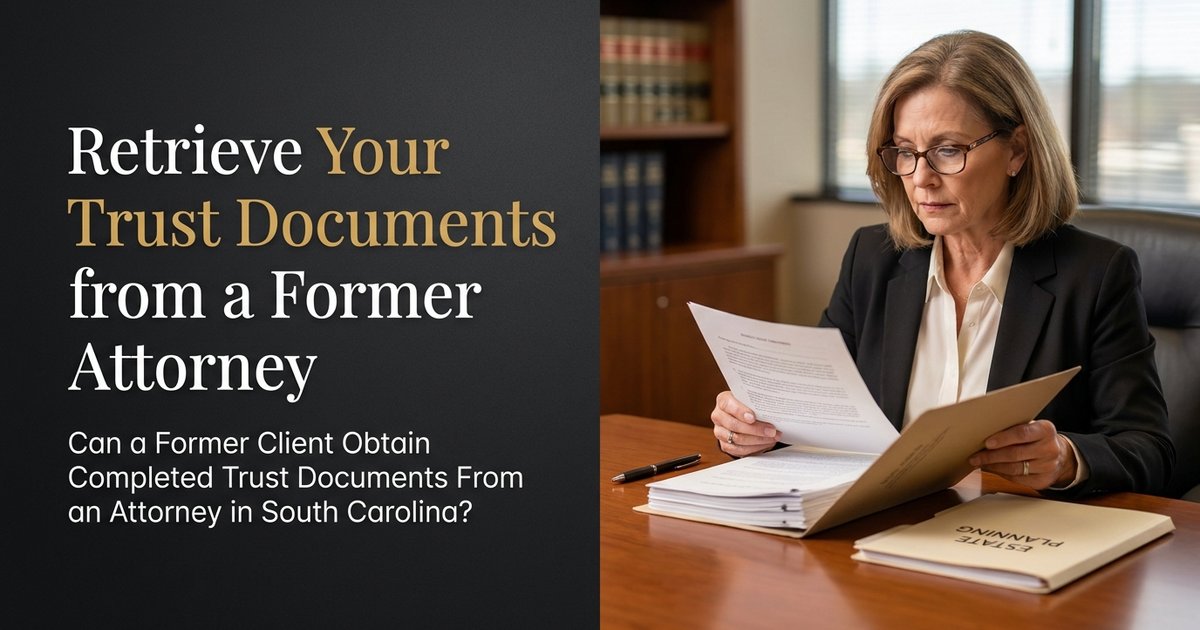
Can I still get my trust documents from a former attorney after the matter was completed? – South Carolina
Short Answer
Yes. A former South Carolina client may request trust documents and other file materials to which the client is entitled, even after the estate planning matter ends. The request should go to the office that actually holds the file, which may be the original firm rather than the attorney’s new office. Acting promptly matters because a file may be destroyed under a valid retention policy after the required retention period.
Understanding the Problem
Can a former estate planning client in South Carolina obtain a completed trust for an adult disabled child when the drafting attorney has moved to another office? The single issue is whether the client can retrieve the signed trust from the attorney or firm that now controls the closed file.
Apply the Law
South Carolina’s Rules of Professional Conduct require an attorney ending representation to surrender papers and property to which the client is entitled. They also generally require secure storage of a closed client file for at least six years after the representation ends, unless the file was delivered to the client or the client authorized its destruction in writing under the rule’s conditions. After that minimum period, a firm may destroy an abandoned file under its retention policy if no other legal duty requires preservation.
The attorney’s departure does not necessarily move the file to the attorney’s new office. The original firm may remain the records custodian. A written request should therefore identify the client, the approximate planning date, the trust’s name if known, and the specific materials requested, including the final signed trust, amendments, certifications, and related execution records.
Key Requirements
- Client authority: The person requesting the documents should be the former client or provide valid written authority from that client. Being a beneficiary or family member alone may not permit access to confidential file materials.
- File possession: The request must reach the attorney or firm that actually maintains the file. The former attorney may need the client’s written authorization before coordinating with the original firm.
- Document status: The request should distinguish the final signed trust from unsigned drafts. A signed or authenticated copy is more useful for confirming the trust’s terms and administration.
- Retention timing: The request should be made promptly and, when possible, within six years after the matter ended. A firm may retain estate planning files longer, but it generally does not have to preserve every closed file indefinitely.
What the Statutes Say
- S.C. Code Ann. § 62-7-401 (Methods of Creating a Trust) – identifies ways to create a trust and requires signed written proof for a trust involving real property.
- S.C. Code Ann. § 62-7-402 (Requirements for Creating a Trust) – lists the basic requirements for a valid trust and addresses signatures on written trust agreements.
- S.C. Code Ann. § 62-7-1013 (Certification of Trust) – permits a trustee to use a certification containing key trust information in many transactions without disclosing the entire trust.
Analysis
Apply the Rule to the Facts: Because the individual previously retained counsel to prepare the trust, the individual can request the final trust documents as the former client. The attorney’s move does not eliminate that right, but the original firm may still control the file. The request should ask both offices to identify the records custodian and locate any paper or electronic signed copy.
South Carolina trusts usually do not have to be filed as public records merely to become effective. As a result, the probate court or land records office may not have a complete copy. If neither office has the signed trust, the individual should review the options when original estate planning documents cannot be found before relying on a draft or recreating the plan.
Process & Timing
- Who files: No court filing is normally required. Where: Send a dated written request to the records custodian at the original firm and, if appropriate, to the former attorney’s new office. What: Request the final signed trust, all amendments, any certification of trust, and the closing or transmittal letter. When: Send the request promptly and preferably before six years after the representation ended.
- Confirm authority and custody: Provide reasonable identity verification and a signed authorization if another person will receive the documents. Ask each office to confirm whether it has the file, transferred it, returned it, or destroyed it under a retention policy.
- Obtain and review the copy: Request secure electronic and paper copies when available. After receiving them, confirm that the documents contain signatures and include every amendment. If only an unsigned draft exists, a South Carolina estate planning attorney should evaluate the next step.
Exceptions & Pitfalls
- The attorney may have represented someone other than the person making the request. Confidentiality rules may prevent disclosure without authorization from the actual client or another person with legal authority.
- The new office may not possess or control files left with the original firm. Sending a request only to the former attorney can cause delay.
- A firm may retain copies of file materials, but it must surrender originals and other papers to which the client is entitled; reasonable copying arrangements may apply depending on the materials requested.
- An unsigned draft does not necessarily prove that the trust was executed or establish its final terms. Check signatures, dates, amendments, and attachments.
- A certification of trust can establish selected facts for a transaction, but it does not replace the complete agreement when the full dispositive terms must be reviewed.
Conclusion
A former South Carolina estate planning client can generally request completed trust documents from the attorney or firm holding the closed file. The attorney’s move does not cancel that right, but the original firm may remain the records custodian. Because closed files generally must be stored for at least six years but may later be destroyed, the next step is to send a written request for the signed trust, amendments, and certification to both offices before the six-year period expires.
Talk to an Estate Planning Attorney
If a completed trust for a disabled family member is missing or the former attorney’s office cannot locate it, our firm has experienced attorneys who can help identify the proper records custodian, review any recovered copy, and explain the available next steps.
Disclaimer: This article provides general information about South Carolina law based on the single question stated above. It is not legal advice for your specific situation and does not create an attorney-client relationship. Laws, procedures, and local practice can change and may vary by county. If you have a deadline, act promptly and speak with a licensed South Carolina attorney.

