
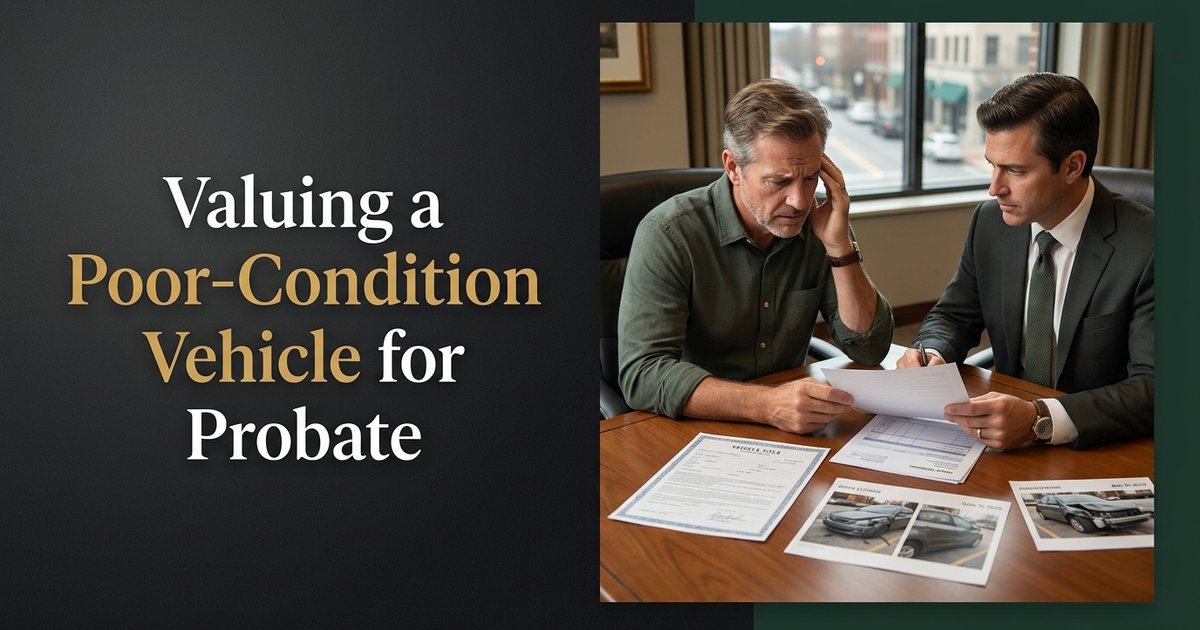
How is a vehicle valued for an estate accounting if it is in poor condition? – South Carolina
Short Answer
In South Carolina, an estate vehicle generally must appear on the inventory at its fair market value on the date of death, considering its actual mileage, mechanical problems, body damage, and overall condition. An online appraisal is only a starting point if its assumptions do not match the vehicle. The type and amount of any vehicle loan or lien must be identified as an encumbrance, and the final accounting should explain a later repossession or sale, the proceeds credited to the loan, and any remaining balance.
Understanding the Problem
Can a South Carolina personal representative rely on an online estimate when valuing a poor-condition vehicle, or must the value reflect the vehicle’s actual condition when the estate owner died? The decision concerns the value reported in the estate inventory and traced through the final accounting, including any loan, repossession, or sale affecting the vehicle.
Apply the Law
South Carolina requires the personal representative to list probate property with reasonable detail and report each asset’s fair market value as of the date of death. The inventory must also identify the type and amount of any lien or other encumbrance. It generally must be filed with the Probate Court handling the estate within 90 days after the personal representative’s appointment.
Fair market value means a reasonable open-market price based on the vehicle as it actually existed on the valuation date. Relevant facts include mileage, accident history, mechanical defects, body and interior damage, title status, maintenance history, and whether the vehicle ran. A pricing website that assumes average or good condition may overstate the value of a damaged or nonoperational vehicle.
Key Requirements
- Correct valuation date: The inventory value generally reflects the vehicle’s fair market value on the date of death, not its original purchase price or later loan balance.
- Condition-adjusted evidence: The valuation should account for the vehicle’s actual condition and may use photographs, repair estimates, inspection reports, comparable sales, dealer offers, or a qualified, disinterested appraisal.
- Separate treatment of debt: The inventory should report the vehicle’s value and the lien or loan amount separately. A loan larger than the vehicle’s value does not make the vehicle’s gross value negative.
- Accurate accounting of disposition: If a lender repossessed and sold the vehicle, the final accounting should trace the vehicle from the inventory through the sale and show the sale proceeds, allowable charges, credit against the debt, and claimed deficiency.
What the Statutes Say
- S.C. Code § 62-3-706 (Inventory and appraisement) – Requires date-of-death fair market value, disclosure of encumbrances, and filing generally within 90 days after appointment.
- S.C. Code § 62-3-707 (Employment of appraisers) – Allows a qualified, disinterested appraiser and permits an interested person to ask the Probate Court to require or approve an appraisal.
- S.C. Code § 62-3-708 (Supplementary inventory) – Requires a corrected or supplemental filing when an original value or description proves erroneous or misleading.
- S.C. Code § 62-3-1001 (Required filings with court; petition for order compelling personal representative to perform duties; court orders) – Generally requires a full accounting unless properly waived or a summary procedure applies and provides a procedure for demanding a hearing.
- S.C. Code § 36-9-610 (Disposition of repossessed collateral) – Requires every aspect of a secured creditor’s disposition of collateral to be commercially reasonable.
Analysis
Apply the Rule to the Facts: The online appraisal for the vehicle still held by the estate should match its actual date-of-death condition. If the estimate assumes a running vehicle in average or good condition while the vehicle has serious mechanical or cosmetic damage, the personal representative should obtain better condition-specific evidence and amend the inventory if the original figure is materially inaccurate.
The repossessed vehicle presents two separate entries: the vehicle’s date-of-death value and the secured loan. Because the vehicle was later sold, the accounting should document the sale price and how the lender applied the proceeds. The remaining loan balance may be a creditor claim, but it does not establish the vehicle’s value and should not appear as an unexplained negative asset.
Useful support may include dated photographs, mileage records, repair estimates, inspection results, local comparable sales, dealer purchase offers, and the lender’s post-sale statement. A repossession sale price can provide valuation evidence, but it may not establish date-of-death fair market value by itself because the sale occurred later and under different circumstances. For more about documenting vehicles, see how vehicle appraisals are handled when heirs dispute value.
Process & Timing
- Who files: The personal representative. Where: The Probate Court for the South Carolina county where the decedent was domiciled. What: The Inventory and Appraisement, commonly filed on Form 350ES, identifying the vehicle, date-of-death value, and loan or lien. When: Generally within 90 days after appointment.
- Document or correct the value: The personal representative should compare the online estimate with condition-specific records. If the listed value is erroneous or misleading, the personal representative should file a supplementary, amended, or corrected inventory showing the revised date-of-death value and the information supporting it.
- Review the final accounting: The heir may request the appraisal inputs, photographs, repair records, repossession notice, sale statement, loan history, and deficiency calculation before signing a waiver or consent. If the issue remains unresolved, a written demand for hearing may be filed under the final-settlement procedure.
Exceptions & Pitfalls
- Using the wrong condition category: A generic retail estimate may be unreliable if it assumes average condition, ignores major defects, or uses different mileage and equipment.
- Confusing value with equity: Fair market value is the vehicle’s gross value. Equity is the value remaining after the lien; the accounting should not combine the two without explanation.
- Using only a later sale price: A later repossession or auction price may help, but timing, deterioration, storage, sale costs, and the nature of the sale can affect its usefulness.
- Signing too early: A signature may waive the accounting, notice, or a hearing depending on the document. An heir with an unresolved valuation concern should identify the questioned entry and request supporting records before signing.
- Ignoring the deficiency calculation: The lender’s remaining balance should reconcile the starting debt, interest and permitted charges, sale proceeds, and credits. The claimed deficiency is distinct from the vehicle appraisal.
Conclusion
A poor-condition vehicle in a South Carolina estate should be valued at its condition-adjusted fair market value on the date of death, while any loan or lien appears separately. An online estimate is not controlling when it assumes better condition. The accounting should also trace any repossession, sale proceeds, and remaining debt. Submit one written valuation objection and demand for supporting records to the personal representative before signing, and demand a hearing within the applicable 30-day period if the dispute remains unresolved.
Talk to a Probate Attorney
If an estate accounting appears to overvalue a damaged vehicle or does not explain a repossession and unpaid loan balance, our firm has experienced attorneys who can help evaluate the supporting records, waiver language, and objection deadlines.
Disclaimer: This article provides general information about South Carolina law based on the single question stated above. It is not legal advice for your specific situation and does not create an attorney-client relationship. Laws, procedures, and local practice can change and may vary by county. If you have a deadline, act promptly and speak with a licensed South Carolina attorney.

