
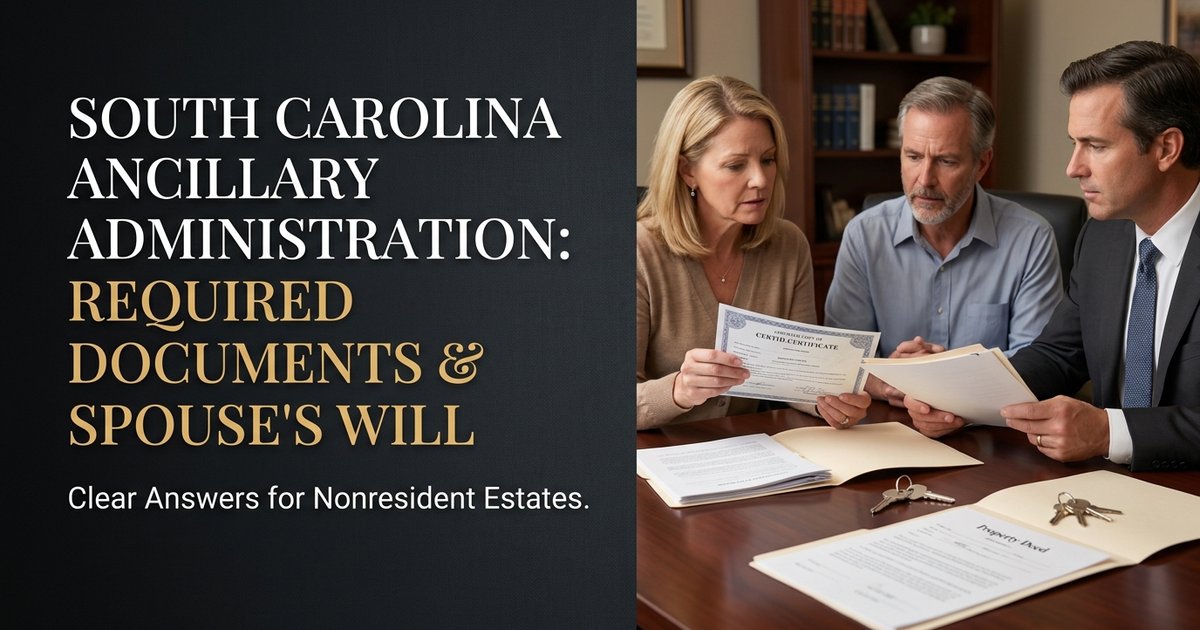
What documents are typically required for ancillary administration, and do I need certified copies of a spouse’s will and death certificate? – South Carolina
Short Answer
South Carolina ancillary administration usually requires an application or petition, proof of the decedent’s death, and authenticated copies of the out-of-state appointment, will, and probate order. A spouse’s will and death certificate are not automatically required. They are commonly needed when the spouse survived the decedent and later died, received an interest in the South Carolina property, or affects the identity or authority of the current beneficiaries.
Understanding the Problem
In South Carolina, must the person coordinating an ancillary estate provide certified copies of a spouse’s will and death certificate before the Probate Court can address property owned by a nonresident decedent? The answer turns on whether the spouse’s death or estate affects ownership, inheritance, appointment priority, or the chain of authority for the South Carolina property.
Apply the Law
South Carolina generally uses ancillary administration when a person who lived elsewhere died owning property in this state. A local administration proceeds in the Probate Court for the county where the property was located. As an alternative, an out-of-state personal representative may sometimes file authenticated copies of the representative’s appointment and the decedent’s will, if any, when no South Carolina administration or application is pending.
Key Requirements
- Proper South Carolina venue: The filing generally belongs in the Probate Court for a county where the nonresident decedent owned property at death.
- Proof of death: A certified or authenticated death certificate provides recognized proof of the decedent’s identity and the fact, place, date, and time of death.
- Authenticated foreign-estate records: The court will usually need authenticated copies of the decedent’s will, the order admitting it to probate, and the document appointing the out-of-state personal representative.
- Ownership and interested-person information: The filing should identify the South Carolina asset and provide information about the decedent’s spouse, children, heirs, devisees, and existing personal representative.
- Spouse’s records when material: If the spouse inherited or held an interest and later died, the spouse’s certified death certificate and authenticated probate records may be needed to establish the next link in ownership or authority.
What the Statutes Say
- S.C. Code § 62-4-207 (Ancillary and Local Administration) – Applies South Carolina’s estate-administration rules to local proceedings involving a nonresident decedent.
- S.C. Code § 62-4-204 (Proof of Foreign Representative’s Authority) – Permits the filing of authenticated copies of the foreign appointment and will when no local proceeding is pending.
- S.C. Code § 62-3-303 (Previously Probated Foreign Will) – Requires an authenticated copy of a previously probated will and the foreign court’s statement admitting it to probate.
- S.C. Code § 62-3-201 (Venue for a Nonresident Estate) – Places venue in a South Carolina county where the decedent owned property at death.
- S.C. Code § 62-1-507 (Evidence of Death) – Treats a certified or authenticated death certificate as initial legal proof of death and identity.
Analysis
Apply the Rule to the Facts: A third party is coordinating records for the ancillary matter, but the available facts do not show whether the spouse survived the decedent, inherited the South Carolina asset, or later transferred an interest through the spouse’s estate. If any of those conditions applies, authenticated probate records for the spouse and a certified or authenticated spouse’s death certificate will likely be important. If the spouse predeceased the decedent and had no relevant ownership or estate interest, those records may not be necessary.
The decedent’s records remain the primary documents. The usual package includes proof of death, the foreign will and codicils, the foreign probate order, current proof of the foreign personal representative’s appointment, a description of the South Carolina property, and names and addresses for heirs and devisees. Renunciations, nominations, bond documents, or additional title records may also be required depending on appointment priority and county practice.
A simple photocopy may not satisfy a request for an authenticated record. The issuing probate court should certify or authenticate the will, appointment, and probate order as part of its official record. Additional guidance is available on obtaining an out-of-state probated will for use in South Carolina.
Process & Timing
- Who files: The proposed South Carolina personal representative or domiciliary foreign personal representative. Where: The Probate Court for a South Carolina county where the decedent owned property. What: A verified application or petition, proof of death, authenticated foreign appointment, authenticated will and probate order, asset information, and any required priority or bond documents. When: Filing should occur promptly; original informal probate is generally subject to a ten-year limit, although a will already probated elsewhere may qualify for separate treatment under South Carolina law.
- Court review: Probate Court staff review venue, proof of death, appointment priority, authentication, and the connection between the decedent and the South Carolina property. The court may request the spouse’s records if they establish a later ownership transfer or identify the proper representative.
- Administration: After appointment, the personal representative generally provides appointment information to heirs and devisees within 30 days, publishes creditor notice when required, and files the inventory and appraisement within 90 days after appointment.
Exceptions & Pitfalls
- A spouse’s will alone may not prove who controls the spouse’s estate. The court may also require the order admitting that will to probate and proof of the spouse’s personal representative’s appointment.
- If the spouse died before the decedent, the death certificate may establish survivorship and identify the correct heirs or devisees even when the spouse’s will does not control the decedent’s property.
- If the spouse survived the decedent and received an interest, omitting the spouse’s later estate records can leave a gap in the chain of ownership.
- Starting a South Carolina local administration can limit or terminate authority that a foreign personal representative otherwise could exercise by filing foreign records alone.
- County filing practices vary. Sending uncertified photocopies without first confirming the required authentication can delay review.
Conclusion
South Carolina ancillary administration usually requires proof of the decedent’s death, authenticated foreign appointment records, the decedent’s authenticated will and probate order, and information about the South Carolina asset and interested persons. Certified records for a spouse are needed only when the spouse’s death or estate affects ownership, inheritance, or representative authority. The key post-appointment deadline is 90 days for the inventory. Ask the coordinating party to obtain the Probate Court’s document checklist and confirm whether the spouse appears in the property’s chain of ownership.
Talk to a Probate Attorney
If an out-of-state estate involves South Carolina property or uncertain document requirements, our firm has experienced attorneys who can help identify the correct Probate Court, determine which authenticated records are needed, and explain the applicable timelines.
Disclaimer: This article provides general information about South Carolina law based on the single question stated above. It is not legal advice for your specific situation and does not create an attorney-client relationship. Laws, procedures, and local practice can change and may vary by county. If you have a deadline, act promptly and speak with a licensed South Carolina attorney.

