
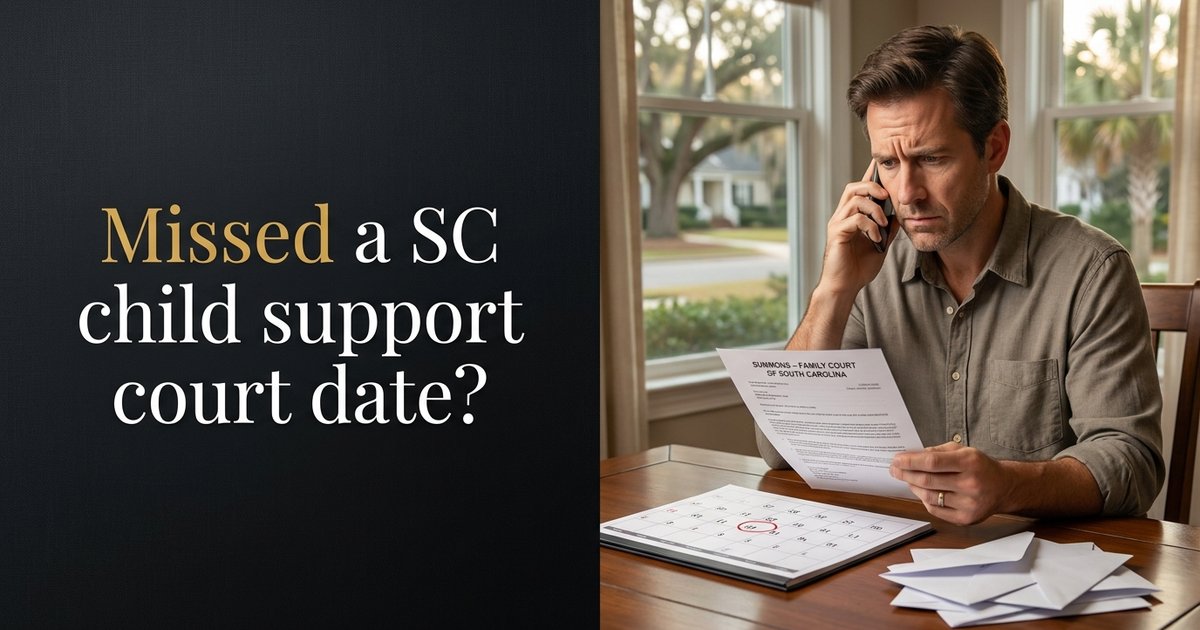
What happens if my adult child misses the court date or doesn’t respond to the summons? – South Carolina
Short Answer
In South Carolina, an adult who was properly served with a child support or paternity summons can face serious consequences for missing court or failing to respond. The Family Court or the Child Support Enforcement Division may move forward without that person, which can lead to a default order establishing paternity, setting child support, or both. Missing court can also expose the respondent to contempt if there is no reasonable cause for the failure to appear.
Understanding the Problem
This question asks what can happen in South Carolina when a special-needs adult respondent, who receives Social Security disability benefits, is served with a child support summons connected to a prior dating relationship but misses the hearing or does not respond. The key issue is whether the Family Court or child support agency can proceed when the respondent does not appear, and what immediate step may protect the respondent’s right to dispute paternity, support, or the ability to pay.
Apply the Law
South Carolina treats a child support summons as a court command, not an optional invitation. If the summons or notice requires the respondent to appear at a specific time and place, the respondent should attend unless the court excuses the appearance or continues the hearing. If the case includes paternity, the respondent must act quickly because failing to deny paternity or failing to appear can allow paternity to be resolved against the respondent without another full opportunity to contest it.
Social Security disability benefits do not make the summons disappear. They may matter when the court decides income, ability to pay, hardship, and whether a guideline amount should be adjusted. For more detail on that issue, see how Social Security disability can affect child support in South Carolina.
Key Requirements
- Proper service: The respondent must have been served with papers that give notice of the case, the requested relief, and the required response or hearing date.
- Timely response or appearance: The respondent should file any required written response, deny paternity if disputed, request genetic testing when appropriate, and attend the scheduled hearing or conference.
- Proof and ability to pay: If support is at issue, the court or agency will look at income, resources, disability benefits, medical limitations, other dependents, and guideline factors.
- Good cause for missing a deadline: A medical crisis, disability-related barrier, lack of proper notice, or another serious reason may support a request to reopen, continue, or set aside a default, but the respondent must act promptly.
What the Statutes Say
- S.C. Code Ann. § 63-17-370 (Summons and rule to show cause) – allows the court to require a respondent to appear and explain why the requested support order should not be granted.
- S.C. Code Ann. § 63-3-580 (Failure to obey summons) – permits contempt proceedings when a summoned person fails to appear without reasonable cause.
- S.C. Code Ann. § 63-17-790 (Establishment of paternity) – gives an alleged father in certain child support enforcement cases 30 days after service to file a written denial of paternity.
- S.C. Code Ann. § 63-17-800 (Paternity testing and default) – allows paternity to be established by default if the alleged father does not timely deny paternity, misses the negotiation conference, or misses genetic testing, subject to a short good-cause window.
- S.C. Code Ann. § 63-17-470 (Child support guidelines) – creates a rebuttable presumption that the guideline amount is correct, while allowing deviation when the guideline amount would be unjust or inappropriate.
- S.C. Code Ann. § 63-17-30 (Genetic tests) – allows or requires genetic testing in contested paternity cases and makes testing orders enforceable by contempt.
Analysis
Apply the Rule to the Facts: The adult child is the respondent because the papers were served on that adult, not on the parent. If the adult child does not respond or appear, South Carolina authorities may treat the silence as a failure to contest paternity or support, depending on the papers served. Disability benefits and special needs may affect the support analysis and may support a request for accommodation, continuance, or relief from default, but they do not automatically stop the case.
Process & Timing
- Who files: The adult respondent, or an attorney or legally authorized guardian or conservator if one exists. Where: The South Carolina Family Court Clerk of Court in the county listed on the summons, or the South Carolina Department of Social Services Child Support Enforcement Division if the papers direct a response there. What: A written answer or return, a written denial of paternity if paternity is disputed, a request for genetic testing, and any motion to continue or request for disability accommodation. When: File before the hearing date whenever possible; in certain child support enforcement paternity notices, a written denial is due within 30 days after service.
- If the hearing date has already passed, the respondent should act immediately. The next step is usually to contact the Family Court Clerk of Court to confirm what happened, get a copy of any order, and file a motion asking the court to reopen, continue, or set aside the default based on good cause. Local procedures can vary by county.
- If paternity was established by default through the child support enforcement process, the respondent may have a very short period to show good cause. In some cases, the default paternity order takes effect 15 days after entry unless good cause is presented before that deadline.
- If the case remains active, the respondent should gather Social Security benefit letters, medical documentation, proof of expenses, and any facts that relate to paternity. The court may then decide paternity, genetic testing, support, arrears, medical support, and payment terms.
Exceptions & Pitfalls
- Improper service: If the adult respondent was not properly served, the court may need to address notice before enforcing a default. Do not assume service was invalid without reviewing the return of service.
- Disability-related barriers: A cognitive disability, hospitalization, or inability to understand the papers may support a request for more time, an accommodation, or appointment-related relief. The request should be made in writing and supported by documentation when possible.
- Parent responding without authority: A parent usually cannot appear as the legal voice for an adult child unless the parent has legal authority, such as guardianship, conservatorship, or representation through counsel. The parent can help gather records and arrange legal help.
- Waiting after default: Delay can make the problem harder. A default paternity or support order may create ongoing obligations, arrears, and enforcement risks.
- Ignoring genetic testing: If paternity is disputed, the respondent should request testing and attend testing appointments. Missing a testing appointment can lead to a paternity finding or contempt issues.
- Assuming disability benefits end support: The court still reviews the support claim. Disability benefits, medical limits, and hardship should be presented with documents rather than left unexplained.
Conclusion
If an adult child misses a South Carolina child support court date or does not respond to a summons, the court or child support agency may proceed by default, establish paternity, set support, or consider contempt if there is no reasonable cause. The key next step is to file a written response, denial of paternity, request for genetic testing, or motion for relief with the proper Family Court or child support office as soon as possible, especially within any 30-day or 15-day deadline stated in the papers.
Talk to a Family Law Attorney
If you’re dealing with a child support summons involving an adult child with disabilities, our firm has experienced attorneys who can help you understand the court date, response deadlines, paternity issues, and disability-related support arguments.
Disclaimer: This article provides general information about South Carolina law based on the single question stated above. It is not legal advice for your specific situation and does not create an attorney-client relationship. Laws, procedures, and local practice can change and may vary by county. If you have a deadline, act promptly and speak with a licensed South Carolina attorney.

