
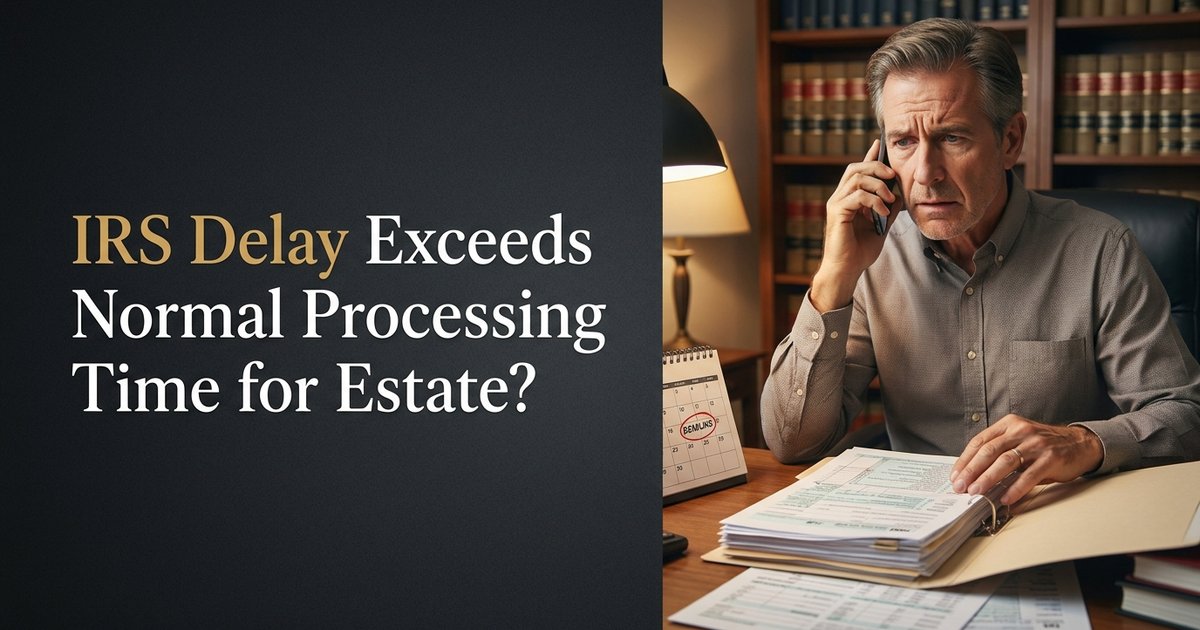
What Can I Do If the IRS Does Not Respond Within the Normal Processing Time? – South Carolina
Short Answer
Once the IRS exceeds its published processing time, the estate’s personal representative or authorized representative should make a documented status inquiry and confirm that the IRS received the submission. If the delay threatens estate administration, causes financial harm, or prevents the estate from meeting a deadline, the representative may ask the Taxpayer Advocate Service for assistance. An IRS delay does not eliminate South Carolina probate duties, but the Probate Court may extend certain administration deadlines when appropriate.
Understanding the Problem
Can a South Carolina personal representative escalate an IRS submission after the normal processing period has passed, particularly when the estate needs returned documents to complete probate work? The decision turns on who submitted the forms, whether the IRS received them, how long the stated processing period has expired, and whether the delay now affects a probate deadline or estate property.
Apply the Law
South Carolina cannot require the IRS to process a federal submission by a particular date. The personal representative should follow the IRS status process while continuing to administer the estate as promptly as reasonably possible. The applicable processing period depends on the form submitted, whether it was complete, and whether the IRS requested additional information.
Key Requirements
- Authority to act: The inquiry should come from the personal representative or another person whom the IRS recognizes as authorized to receive the estate’s protected tax information.
- Proof of submission: Keep the complete form, attachments, mailing or delivery confirmation, IRS correspondence, and notes of every follow-up contact.
- Expired processing period: Compare the submission date with the IRS’s current processing-status information. Processing times vary by form and may change.
- Reason for escalation: Explain the specific effect of the delay, such as a blocked probate filing, inability to obtain records, or financial harm to the estate.
The estate should not repeatedly resubmit the same form unless the IRS directs it to do so. Duplicate submissions can create conflicting files or further delay. Questions about which federal form, election, or return the estate needs should go to a tax attorney or CPA.
What the Statutes Say
- S.C. Code Ann. § 62-3-703 (Personal Representative’s Duties) – requires the personal representative to settle and distribute the estate as efficiently and promptly as the estate’s interests permit.
- S.C. Code Ann. § 62-3-704 (Probate Administration and Extensions) – allows the Probate Court to extend certain estate-administration deadlines when the estate remains significantly unadministered.
- S.C. Code Ann. § 62-3-1001 (Final Accounting and Settlement) – establishes final-accounting requirements and, when a federal or state estate tax return was filed, includes a deadline tied to receipt of the tax closing letter.
- S.C. Code Ann. § 62-3-1003 (Taxes and Final Accounting) – restricts approval of a final accounting in an estate required to file a federal estate tax return unless the court makes the required tax finding.
Analysis
Apply the Rule to the Facts: The forms have been submitted, but the IRS has not returned documents needed for the estate’s tax review. The authorized representative should verify delivery, identify the processing period for the exact submission, and create a written record of follow-up efforts. Because there has reportedly been no recent escrow activity, a written request for a current transaction ledger can confirm the balance and disbursements, although that accounting request will not accelerate the IRS response.
Waiting for the IRS can justify keeping estate funds available rather than distributing them prematurely. The personal representative must account for estate property and should avoid distributions that could leave insufficient funds for taxes, expenses, or unresolved claims. More information about the interaction between probate and federal tax matters appears in handling IRS issues during South Carolina probate.
Process & Timing
- Who files: The personal representative or IRS-authorized representative. Where: The IRS office, service center, fax number, or contact shown on the applicable form or notice. What: A status inquiry supported by a copy of the submission, proof of delivery, IRS reference numbers, and documents showing authority to act. When: After the IRS’s current processing period for that submission has passed.
- Confirm and document: Contact the IRS through the number listed on its notice or the appropriate IRS assistance channel. Record the date, representative identification information, reference number, expected response date, and any missing-document instructions. Do not send duplicate forms unless instructed.
- Escalate when justified: If the delay causes financial harm, threatens a probate deadline, or remains unresolved after ordinary IRS contacts, submit IRS Form 911, Request for Taxpayer Advocate Service Assistance. The Taxpayer Advocate Service decides whether the matter meets its assistance criteria.
- Protect the probate schedule: If the IRS delay prevents a required South Carolina filing, request an extension from the Probate Court in the county where the estate is pending before the applicable probate deadline expires. Continue preserving bank statements, escrow records, tax correspondence, and proof of follow-up.
Exceptions & Pitfalls
- An expired processing estimate does not automatically qualify the estate for Taxpayer Advocate Service assistance. The request should identify a concrete hardship, missed commitment, or effect on estate administration.
- The IRS may refuse to discuss the matter if the caller cannot establish authority to receive the deceased person’s or estate’s tax information. Confirm the IRS has the necessary fiduciary or authorization documents.
- Resending the same submission without instructions may create duplicate files. First confirm receipt and ask whether the IRS wants a replacement.
- An IRS delay does not automatically pause South Carolina probate deadlines. Ask the Probate Court for an extension when the delay prevents timely completion of a required filing.
- A prior escrow summary may not reflect the current balance. Request a dated ledger showing the opening balance, each receipt or payment, and the present amount held.
Conclusion
When the IRS exceeds its normal processing time, a South Carolina personal representative should confirm receipt, document each inquiry, and explain how the delay affects probate administration. Taxpayer Advocate Service assistance may be available if ordinary follow-up fails and the delay creates hardship. South Carolina probate obligations continue during the wait, although the Probate Court may grant appropriate extensions. Send a documented status request to the responsible IRS office as soon as the published processing period expires.
Talk to a Probate Attorney
If an IRS delay is preventing a South Carolina estate from moving forward, our firm has experienced attorneys who can help identify the probate deadlines, document the delay, and evaluate available procedural options. A tax attorney or CPA should address questions about federal forms, returns, elections, or tax liability.
Disclaimer: This article provides general information about South Carolina law based on the single question stated above. It is not legal advice for your specific situation and does not create an attorney-client relationship. Laws, procedures, and local practice can change and may vary by county. If you have a deadline, act promptly and speak with a licensed South Carolina attorney.

